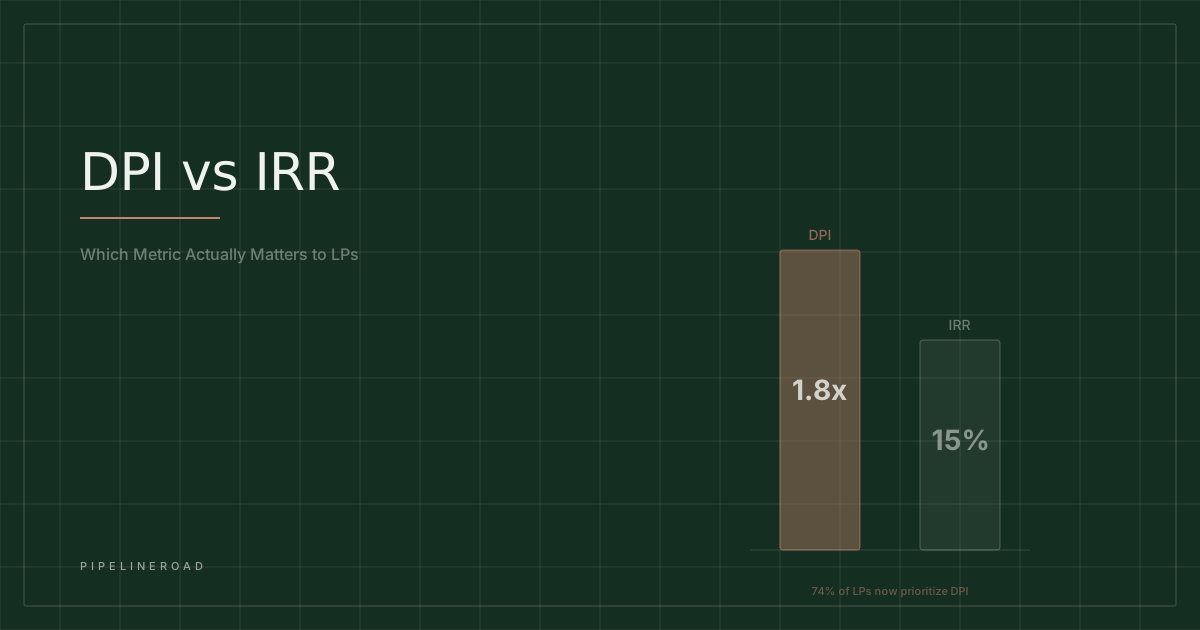
DPI (Distributions to Paid-In) and IRR (Internal Rate of Return) are the two most cited metrics in private fund performance, yet they measure fundamentally different things. According to a 2024 ILPA survey, 74% of institutional LPs now rank DPI as their primary criterion when evaluating re-ups, up from 52% in 2019 (Source: ILPA Principles 3.0 Survey, 2024). The shift reflects a hard-learned lesson from the 2021-2022 valuation reset: IRR based on paper gains is not the same as cash in hand.
This comparison covers when each metric matters, where each one fails, and how fund professionals should use both together. Use our DPI calculator and IRR calculator to model your own fund’s metrics.
What each metric actually measures
IRR is the annualized rate of return that sets the net present value of all cash flows (capital calls and distributions) equal to zero. It accounts for the timing and size of every cash movement in and out of the fund. A 20% net IRR means the fund’s cash flows are equivalent to earning 20% per year, compounded, on invested capital.
DPI is simpler. It divides total distributions by total paid-in capital. A DPI of 1.5x means the fund has returned $1.50 for every $1.00 an LP invested. DPI only counts cash that has actually been sent back to LPs. It ignores unrealized portfolio value entirely.
The distinction matters because these two numbers can tell very different stories about the same fund.
When IRR and DPI diverge
The most instructive cases are funds where IRR and DPI point in opposite directions.
High IRR, low DPI
A 2018-vintage growth equity fund marks up its portfolio aggressively through 2021, showing a 35% net IRR at the end of year three. But by year six, the fund has only distributed 0.3x DPI. The IRR looks exceptional. The DPI says LPs have received back 30 cents on every dollar committed, with most of the fund’s value sitting in unrealized positions that were marked up during the peak.
This pattern was widespread across late-stage venture and growth equity during 2020-2021. Funds reported headline IRRs above 30% driven by markup rounds at elevated valuations. When exit markets tightened in 2022-2023, many of those paper gains evaporated without converting to distributions. LPs who relied on IRR alone were left holding funds with impressive return figures and very little cash.
Low IRR, high DPI
A 2014-vintage buyout fund returns capital steadily through modest exits over eight years, achieving a 1.9x DPI. But because the distributions were spread evenly rather than front-loaded, the IRR calculates to 11% net. The fund returned nearly 2x to LPs in real cash, a strong outcome by any measure. The IRR understates the result because it penalizes the fund for the time it took to distribute.
This scenario is common in funds with disciplined hold periods and steady exit activity. The returns are real and meaningful, but the IRR calculation does not reward patience.
Limitations of each metric
IRR limitations
IRR is sensitive to timing in ways that can distort the picture:
Subscription line financing. When a GP uses a credit facility to fund investments before calling LP capital, the measured investment period compresses. This can boost IRR by 200 to 500 basis points without changing the total multiple. A fund that would show 15% IRR without a line might show 18-20% with one.
Early small exits. A quick 5x return on a small position in year one can inflate the fund’s overall IRR even if the remaining portfolio performs modestly. IRR weights early cash flows heavily, so a well-timed small win can mask mediocre overall performance.
Unrealized markups. IRR incorporates current NAV, which includes unrealized gains. Aggressive marking practices inflate IRR without any cash changing hands. This is the core reason LPs have shifted emphasis toward DPI.
DPI limitations
DPI has its own blind spots:
Ignores timing. A fund that returns 2.0x over 15 years and a fund that returns 2.0x over 7 years have the same DPI but very different return profiles. DPI does not account for how long LP capital was locked up.
Penalizes younger funds. A 2022-vintage fund with a 0.1x DPI is not underperforming. It is simply too early in its lifecycle for meaningful distributions. DPI is most useful for funds past year 5, where LPs reasonably expect some capital return.
Ignores unrealized value. A fund with 0.5x DPI and 2.5x TVPI has significant unrealized value that DPI ignores entirely. For younger funds or funds with strong portfolios approaching exit, DPI alone understates the picture.
How sophisticated LPs use both metrics
The best LP evaluation frameworks do not choose between DPI and IRR. They use both, along with TVPI, MOIC, and public market equivalent (PME) analysis, contextualized by vintage year and strategy.
For re-up decisions on existing managers: DPI is the anchor metric. LPs want to know how much cash they have received relative to what they committed. If a GP is raising Fund III and Fund I has a 0.4x DPI after seven years, that demands explanation regardless of what the IRR shows.
For evaluating new managers: IRR and TVPI on prior funds provide directional signal, but LPs discount unrealized portions. A new manager with a 2.5x TVPI and 1.8x DPI on their prior fund is more compelling than one with 3.0x TVPI and 0.5x DPI.
For benchmarking: Cambridge Associates and Burgiss provide vintage-year benchmarks for both IRR and DPI by strategy. A fund’s DPI relative to its vintage year peers tells you whether it is distributing at, above, or below the expected pace. Our fund performance benchmark tool lets you model these comparisons.
For portfolio construction: LPs use DPI across their portfolio to manage liquidity. If total portfolio DPI is declining, the LP may face cash flow challenges for new commitments. This portfolio-level view of DPI drives allocation pacing decisions that directly affect whether an LP can commit to your next fund.
What this means for fund managers
If you are raising capital or reporting to LPs, understanding how these metrics interact shapes your narrative.
Lead with your strongest realized metric. If your DPI is ahead of vintage-year peers, make that the headline. If your fund is younger and IRR is your strongest number, present it alongside TVPI and a clear exit pipeline to show how IRR will convert to DPI. For benchmarking context on what LPs expect from venture capital returns or private equity returns, see our data-driven analyses.
Contextualize the gap. If there is a large gap between IRR and DPI (in either direction), explain why. LPs will notice the gap whether you address it or not. Proactive framing demonstrates sophistication and transparency.
Know your vintage-year benchmarks. Saying your fund has a 1.3x DPI means nothing without context. A 1.3x DPI on a 2020-vintage fund is excellent. On a 2014-vintage fund, it is below median. Always benchmark against the relevant vintage and strategy.
Model both metrics in your fundraising materials. LPs will calculate them if you do not provide them. Presenting IRR, DPI, TVPI, and RVPI together, with benchmark comparisons, is table stakes for institutional fundraising. A private equity CRM that tracks fund-level metrics alongside LP interactions makes it easy to surface these numbers during conversations. If you need help identifying which LPs are actively evaluating managers in your strategy, our institutional investor database covers 570,000+ investors with allocation data and contact information.
The Bottom Line
- 74% of institutional LPs now rank DPI as their primary re-up criterion: Up from 52% five years ago, driven by the 2021-2022 valuation correction that proved paper IRR gains can evaporate without converting to distributions.
- Subscription line financing can inflate IRR by 200-500 basis points: By delaying capital calls, a fund showing 15% IRR without a credit facility might report 18-20% with one — without changing the actual multiple returned to LPs.
- A fund can show 35% net IRR and only 0.3x DPI: This pattern was widespread in late-stage venture and growth equity during 2020-2021, where aggressive markups drove headline returns that never materialized as cash.
- DPI penalizes younger funds and ignores timing: A fund returning 2.0x over 7 years and one returning 2.0x over 15 years have identical DPI but vastly different return profiles. DPI is most useful after year 5.
- Always present both metrics with vintage-year context: A 1.3x DPI on a 2020-vintage fund is excellent; on a 2014-vintage fund, it is below median. LPs will calculate these numbers if you do not provide them.
Frequently Asked Questions
Why do LPs increasingly prefer DPI over IRR?
LPs prefer DPI because it measures actual cash returned, not paper gains or time-weighted theoretical returns. After the 2021-2022 valuation correction, many funds reported strong IRRs based on unrealized markups that never converted to distributions. A 2024 Institutional Limited Partners Association survey found that 74% of LPs now rank DPI as their primary re-up criterion, up from 52% five years earlier. DPI cannot be inflated by timing tricks or aggressive markups because it only counts cash that has actually been distributed.
Can a fund have a high IRR but low DPI?
Yes, this is common in younger funds and in funds that mark up portfolio companies aggressively without exiting. A fund might show a 25% net IRR driven by paper gains on unrealized positions while having a DPI of only 0.2x. This happens when a GP raises valuations based on subsequent funding rounds but has not yet generated liquidity events. It also occurs when early small exits inflate the IRR calculation even though the total cash returned is modest relative to committed capital.
What is a good DPI for a private equity fund?
A DPI of 1.0x means LPs have received back their original investment. For buyout funds, LPs typically expect 1.5x or higher DPI by year 8 and 1.8-2.0x by the end of fund life. For venture capital, DPI expectations are lower in early years due to longer holding periods, but top-quartile VC funds target 2.0x+ DPI by year 10. According to Cambridge Associates data, median US buyout DPI for 2012-2015 vintage funds was approximately 1.4-1.7x as of 2024.
How does IRR get manipulated or distorted?
IRR is sensitive to the timing of cash flows, which creates opportunities for distortion. Common examples include subscription line financing (delaying capital calls to compress the measured investment period), early small exits that generate outsized IRR on minimal capital, and aggressive interim valuations that inflate unrealized returns. A fund that calls capital via a credit facility for 6 months before issuing the capital call can boost IRR by 200-500 basis points without changing the actual multiple. This is why sophisticated LPs always evaluate IRR alongside DPI and TVPI.
Should fund managers report both DPI and IRR to LPs?
Yes. Institutional LPs expect to see both metrics, along with TVPI and net multiples, in quarterly reporting. Reporting only IRR raises red flags, especially for funds older than 5 years where LPs expect meaningful distributions. The best practice is to present all four metrics (IRR, TVPI, DPI, RVPI) with vintage year context and benchmark comparisons. Transparency about the relationship between realized and unrealized returns builds LP confidence and supports re-up conversations.