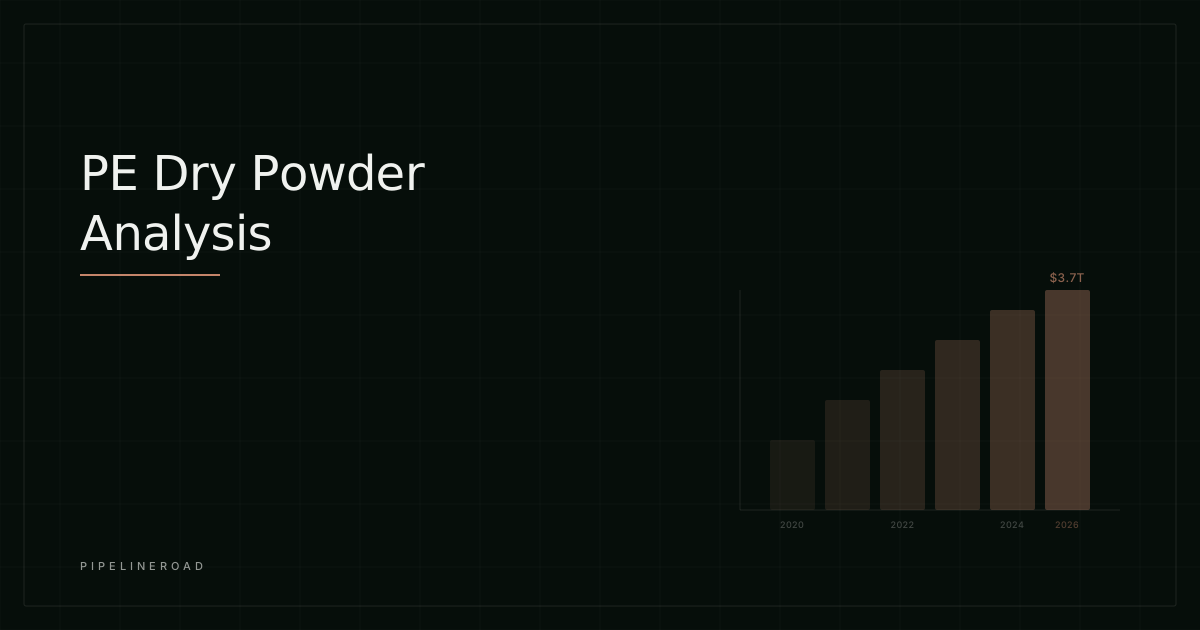
Private equity dry powder — defined as committed but uncalled LP capital — hit $3.7 trillion at the start of 2026, roughly doubling since 2019 (Source: Preqin 2025 Global Private Equity Report). That number has been climbing steadily for a decade. It represents committed capital sitting in GP accounts waiting to be deployed — money that LPs have legally committed but that has not yet been called.
The number gets cited frequently, usually as a headline-grabber. But the implications of record-high dry powder are more nuanced than “there is too much money chasing too few deals.” For fund managers actively raising capital or preparing to do so, understanding what dry powder means — and what it does not mean — is essential context.
What Dry Powder Actually Measures
Dry powder is the gap between LP commitments and capital deployment. When an LP commits $50 million to a PE fund, that $50 million does not transfer immediately. The GP draws it down over time through capital calls as investments are made, typically over a 3-5 year investment period. The undrawn portion at any given moment is dry powder.
Global PE dry powder is the aggregate of all undrawn commitments across all PE funds worldwide. As of early 2026, Preqin estimates this figure at approximately $3.7 trillion. Bain & Company’s 2025 Global Private Equity Report put the figure at $3.9 trillion when including all private capital strategies (PE, VC, real estate, infrastructure, private debt).
Several things are worth noting about how the number is calculated:
- It includes funds at all stages of their investment period. A fund that closed last month has 100% of its commitments as dry powder. A fund in year 4 of its investment period may have 20% remaining. Both are included in the aggregate figure.
- It is not liquid capital. Dry powder represents unfunded commitments, not cash sitting in bank accounts. GPs cannot spend it on whatever they want — it can only be called for investments consistent with the fund’s strategy and terms.
- It grows naturally with fund sizes. As the PE industry raises larger funds, aggregate dry powder increases mechanically. A portion of the growth reflects the industry’s expansion, not necessarily a problem.
Current Dry Powder by Strategy
The $3.7 trillion is not evenly distributed. Different strategies carry very different levels of undeployed capital.
| Strategy | Estimated Dry Powder (2026) | % of Total | 5-Year Growth |
|---|---|---|---|
| Buyout | $1.1T | 30% | +75% |
| Venture Capital | $580B | 16% | +90% |
| Growth Equity | $420B | 11% | +85% |
| Real Estate | $400B | 11% | +40% |
| Infrastructure | $370B | 10% | +120% |
| Private Debt | $440B | 12% | +110% |
| Other (Distressed, Secondaries, etc.) | $380B | 10% | +60% |
Source: Preqin, Bain & Company estimates.
Several observations stand out. Infrastructure and private debt dry powder have grown the fastest, reflecting the massive fundraising those strategies have experienced. Venture capital dry powder has also grown sharply, driven by the large funds raised during the 2020-2021 peak. Buyout dry powder remains the largest absolute category at over $1.1 trillion.
The strategy-level data matters for fundraising because LP scrutiny of dry powder is strategy-specific. An LP evaluating a new buyout fund will look at aggregate buyout dry powder and the specific GP’s deployment pace. They will not average that concern across infrastructure and private debt.
Why Dry Powder Has Accumulated
Record dry powder is the result of several converging factors, not all of which are cause for concern.
Fundraising Outpaced Deployment
The most straightforward driver: GPs raised more capital than they deployed. Between 2019 and 2024, global PE fundraising totaled approximately $4.8 trillion, while total deal value over the same period was roughly $3.6 trillion. The gap has accumulated as dry powder.
This is partially structural. Fundraising and deployment operate on different cycles. GPs raise capital based on LP demand and market positioning. They deploy capital based on deal availability, pricing, and strategy execution. These cycles do not always sync, particularly after periods of aggressive fundraising.
Slower Deployment in 2022-2024
Deal activity slowed significantly in the 2022-2024 period. According to PitchBook, global PE deal count fell approximately 30% from its 2021 peak, and total deal value declined by roughly 35%. Several factors contributed:
- Higher interest rates increased the cost of leverage, which reduced deal returns at equivalent entry multiples and made GPs more cautious about pricing.
- Seller-buyer valuation gaps persisted for much of this period. Sellers anchored to 2021 valuations while buyers adjusted to higher rate environments. The gap has narrowed but has not fully closed.
- Uncertain macro conditions made underwriting more difficult, particularly for cyclical businesses and sectors sensitive to consumer spending.
This slowdown meant that capital raised in 2020-2022 deployed more slowly than planned, adding to the dry powder total.
Larger Funds Taking Longer to Deploy
The mega-fund trend has directly contributed to higher dry powder. When Blackstone raises a $30 billion buyout fund, it takes longer to deploy than a $500 million mid-market fund simply because deploying $30 billion in equity at $500M-$2B per deal requires 15-60 transactions. The math takes time.
As more capital has concentrated in mega-funds (the largest 10 PE managers now control roughly 30% of industry AUM, according to McKinsey), the aggregate deployment timeline has lengthened. This is a mechanical feature of the industry’s consolidation, not necessarily a sign of dysfunction.
How Dry Powder Affects LP Decision-Making
LPs pay close attention to dry powder levels, both at the industry level and at the individual GP level. Here is how it shows up in fundraising conversations.
The “Deploy What You Have” Argument
When dry powder is at record levels, some LPs adopt a straightforward position: why should we commit more capital to PE when our existing managers haven’t deployed what we’ve already committed? This argument is particularly common among LPs who are at or above their target PE allocations.
The counterargument — which GPs need to articulate clearly — is that dry powder is vintage-year specific. Capital committed to a 2020 fund is nearing the end of its investment period and has largely been deployed or reserved for follow-on investments. Fresh commitments to a 2026 vintage fund provide exposure to current market pricing, which may be more attractive than the prices at which 2020-2021 vintage funds deployed.
GP-Level Dry Powder Scrutiny
LPs increasingly evaluate a GP’s deployment pace as a specific diligence item. The question is simple: if you raised your last fund 24 months ago and you have only called 30% of commitments, what does that tell us about your ability to find deals?
Managers need honest answers. Sometimes the answer is disciplined investment pacing in a pricey market — which LPs respect. Sometimes the answer is that deal flow has been challenging — which LPs will probe further. The worst answer is no answer, or an evasive one.
According to analysis from Bain, the average buyout fund has taken approximately 5.5 years to deploy 90% of committed capital in recent vintages, compared to approximately 4.5 years for vintages from 2010-2015. This lengthening is well-documented and somewhat expected, but it adds to the aggregate dry powder figure.
The Denominator Effect Connection
Dry powder also interacts with the denominator effect covered in our analysis of institutional allocation trends. When LPs are overallocated to PE (because unrealized holdings maintain marks while public equities declined), high levels of uncalled commitments compound the problem. LPs carry unfunded obligations that could be called at any time, which effectively increases their PE exposure beyond what the allocation percentage suggests.
This dynamic makes some LPs reluctant to take on new unfunded commitments even when their actual deployed allocation has room. The combination of overallocation plus large unfunded obligations is the scenario where LP pushback is strongest.
The Deployment Clock and LP Expectations
Every PE fund has a defined investment period, typically 5-6 years from closing, during which capital must be deployed. After the investment period expires, the GP can no longer make new investments (though they can usually make follow-on investments in existing portfolio companies).
The deployment clock creates implicit pressure on GPs. LPs expect their capital to be put to work, and they expect it to be deployed at reasonable valuations. These two expectations can conflict when deal markets are expensive.
Pacing Expectations by Fund Type
| Fund Type | Expected Deployment Timeline | LP Patience Level |
|---|---|---|
| Buyout | 3-5 years | Moderate (willing to wait for good pricing) |
| Growth Equity | 3-4 years | Lower (expectations of consistent deal flow) |
| Venture Capital | 3-4 years | Higher (accepts lumpy deployment) |
| Infrastructure | 4-6 years | Higher (fewer, larger deals accepted) |
| Distressed/Special Sit | Variable | Depends on cycle (very patient if waiting for opportunity) |
For fund managers preparing to raise new capital, your deployment pace on prior funds is a critical data point. If your Fund II is 4 years old and only 50% deployed, LPs will ask why — and they will wonder whether a new fund commitment will face the same slow deployment.
The best practice is proactive communication. Provide LPs with a clear deployment summary, explain any deviations from plan, and demonstrate that your investment pace reflects discipline rather than a lack of deal flow.
Vintage Year Implications
Dry powder has a direct bearing on vintage year dynamics, which in turn affects returns.
When large amounts of dry powder coincide with limited deal flow, two things tend to happen: (1) competition for available deals intensifies, and (2) entry prices get bid up. This is the mechanism through which dry powder can negatively impact returns — not because the capital is idle, but because when it deploys, it deploys at higher prices.
Historical data from Cambridge Associates bears this out. Vintage years following periods of heavy fundraising (and therefore high dry powder) have generally produced lower median returns than vintage years following fundraising troughs. The 2006-2007 vintages (high dry powder, high prices) underperformed the 2009-2011 vintages (lower dry powder, lower prices) by approximately 400-600 basis points in net IRR.
The current environment looks similar. Record dry powder, combined with still-elevated multiples in popular sectors (technology, healthcare services, business services), suggests that deployment discipline will be a major differentiator for current vintage returns. GPs who overpay to deploy capital will underperform those who wait for pricing to normalize.
What High Dry Powder Means for Emerging Managers
The dry powder picture for emerging managers is distinctly different from the industry aggregate, and in some ways more favorable.
The Crowding Out Concern
The most common worry is crowding out: mega-funds absorb so much LP capital that there is not enough left for smaller and emerging managers. There is some truth to this. According to PitchBook, the top 20 PE managers by AUM collectively hold over $600 billion in dry powder. That capital came from LP allocations that could have, in theory, been distributed more broadly.
But the crowding out effect is less severe than headline numbers suggest. Most institutional LPs manage their PE portfolios with explicit sub-allocation targets for different strategies, fund sizes, and manager types. A pension fund’s $100 million commitment to a Blackstone fund comes from a different part of their allocation framework than a $15 million commitment to an emerging mid-market manager. The capital is not perfectly fungible.
The Pricing Advantage
High dry powder at large funds creates deal competition that primarily affects large-cap and upper-mid-market transactions. Entry multiples for $1B+ deals have stayed elevated because multiple large funds compete for the same deals. According to GF Data, average buyout multiples for deals above $250 million have remained above 11x EBITDA through 2024-2025.
In the lower-mid-market ($25M-$100M enterprise value), competition is lower, multiples are more reasonable (typically 6-8x EBITDA), and many deals are sourced through proprietary relationships rather than auction processes. This is exactly where most emerging managers operate.
The irony is that record dry powder at large funds may actually improve the relative attractiveness of the emerging manager market segment. LPs looking for differentiated returns are increasingly drawn to the lower-mid-market precisely because it is less affected by the capital overhang problem.
The Deployment Narrative
Emerging managers raising their first or second fund have an unusual advantage in the dry powder conversation: they don’t carry the baggage of a prior fund’s slow deployment. While established managers may need to explain why Fund III still has $200 million undeployed after 4 years, a first-time manager presents a clean slate.
That said, emerging managers need to demonstrate realistic deployment expectations. Telling LPs you will deploy a $150 million fund in 18 months is not credible for a buyout strategy. Showing a pipeline of 50 qualified opportunities and a plan to deploy over 3-4 years through proprietary deal sourcing is. Back the timeline with specific examples and data from your pre-fund deal activity.
The Relationship Between Dry Powder and Fundraising Cycles
Dry powder and fundraising are connected in a feedback loop that is worth understanding.
When dry powder is high and deployment is slow, LP appetite for new commitments tends to decrease. This eventually slows fundraising, which gradually reduces dry powder as existing funds deploy and new commitments decline. Lower dry powder then leads to less deal competition, more reasonable pricing, and better deployment opportunities — which improves LP confidence and restarts fundraising momentum.
This cycle typically plays out over 3-5 years. We are arguably in the “high dry powder / slower fundraising” phase of the cycle in early 2026. Total PE fundraising in 2024 was approximately 20% below the 2021 peak, and early 2025 data suggests a gradual recovery but not a return to peak levels.
For managers timing their fundraise, this cycle has a practical implication: the fundraising market is more competitive when dry powder is high (because LPs are more selective) but the deployment market may be more favorable (because some competitors are capital-constrained or fully deployed). The managers who raise successfully in this environment and deploy at current prices may end up with some of the best-performing vintage year returns.
What This Means for Your Fundraise
If you are raising or preparing to raise a fund, here is how to think about the dry powder landscape.
Expect the question. LPs will ask about industry dry powder and your specific deployment pace. Prepare a clear, data-backed answer. Do not dismiss the concern or deflect to industry averages. Own your specific deployment history and explain your forward plan.
Differentiate on deployment strategy. In a market with record undeployed capital, LPs want to know how you will find and win deals that justify new commitments. Proprietary deal flow, sector specialization, geography-specific networks, and operational value creation capabilities all serve as differentiators. Generic descriptions of “disciplined investing” are not sufficient.
Right-size your fund. High dry powder makes fund size decisions more consequential. A fund that is too large relative to your deal flow will compound the deployment problem and invite LP scrutiny. A fund sized to your realistic opportunity set demonstrates discipline and self-awareness.
Frame the vintage year opportunity. Current market pricing, particularly in the lower-mid-market, is arguably more attractive than 2021 pricing. Make this case to LPs with specific data: entry multiples, deal competition metrics, and examples of the types of opportunities you are seeing.
Address the exit side. Dry powder is half the equation. LPs also want to know how you will generate realizations. The distribution drought has been a major concern, and managers who can articulate a clear exit strategy — not just entry strategy — will differentiate themselves.
The $3.7 trillion number will continue to generate headlines, but the number itself is less important than the dynamics underneath it. For a broader perspective on how dry powder fits into the overall fundraising landscape, see our state of capital raising guide. And for context on how LP allocation patterns are shifting in response to these dynamics, our analysis of institutional allocation trends in 2026 provides the LP-side view. If you are an emerging manager mapping out your fundraising timeline, understanding the dry powder landscape is essential context for setting realistic expectations with your LP prospects.
The Bottom Line
- $3.7 trillion in PE dry powder has roughly doubled since 2019: The accumulation reflects fundraising outpacing deployment by approximately $1.2 trillion over 2019-2024, combined with deal activity declining 30-35% from 2021 peaks.
- Lower-mid-market pricing favors emerging managers: Large-cap deals above $250M trade at 11x+ EBITDA due to capital competition, while lower-mid-market deals ($25-100M) trade at 6-8x EBITDA with far less competition, exactly where most emerging managers operate.
- Deployment pace is now a core diligence item: The average buyout fund takes 5.5 years to deploy 90% of capital, up from 4.5 years a decade ago. LPs will ask why, and “disciplined pacing” earns respect while evasive answers do not.
- Vintage years following heavy fundraising historically underperform by 400-600 bps: Cambridge Associates data shows the 2006-2007 vintages underperformed 2009-2011 vintages by this margin. Current record dry powder suggests deployment discipline will be a major return differentiator.
- First-time managers have a clean-slate advantage: Unlike established GPs who must explain slow deployment on prior funds, emerging managers can present realistic deployment plans backed by pipeline data without carrying deployment baggage.
Frequently Asked Questions
What is dry powder in private equity?
Dry powder refers to committed but undeployed capital, meaning money that LPs have committed to PE funds but that GPs have not yet called or invested. As of early 2026, global PE dry powder stands at approximately $3.7 trillion, a record high that has roughly doubled over the past five years.
How does high dry powder affect fundraising?
High dry powder creates a paradox for fundraising. On one hand, it shows LPs continue to commit to PE. On the other, some LPs view high dry powder at existing managers as a reason to slow new commitments until existing capital is deployed. GPs with high undeployed ratios may face more LP scrutiny about deployment pace.
Is high dry powder good or bad for emerging managers?
It's a mixed signal. Large dry powder at mega-funds can mean less LP capital available for emerging managers (the 'crowding out' effect). But it also means there's significant deal competition from large funds, which can drive up entry prices and make the mid-market and lower-mid-market more attractive, which is exactly where many emerging managers operate.
How do dry powder levels affect fundraising timelines?
Record dry powder levels directly extend fundraising timelines for new funds. When aggregate undeployed capital is high, LPs increase scrutiny of deployment pace and become more selective about new commitments. According to Bain, the average buyout fund now takes approximately 5.5 years to deploy 90% of committed capital, up from 4.5 years a decade ago. This slower deployment makes LPs hesitant to add new unfunded obligations. In practice, managers raising in a high dry powder environment should expect fundraise timelines 3-5 months longer than historical norms, with first-time funds averaging 16-20 months compared to 12-15 months when dry powder is at more moderate levels.
Is high dry powder good or bad for emerging managers raising capital?
High dry powder is paradoxically favorable for emerging managers on the deal side but challenging on the fundraising side. On the fundraising front, the top 20 PE managers hold over $600 billion in undeployed capital, which gives some LPs reason to slow new commitments. However, on the deal execution side, that concentrated capital primarily chases large-cap transactions above $250 million where entry multiples exceed 11x EBITDA according to GF Data. Lower-mid-market deals in the $25-$100 million range, where most emerging managers operate, trade at 6-8x EBITDA with far less competition. Emerging managers who can articulate this pricing advantage to LPs effectively turn the dry powder narrative from a headwind into a differentiation story.