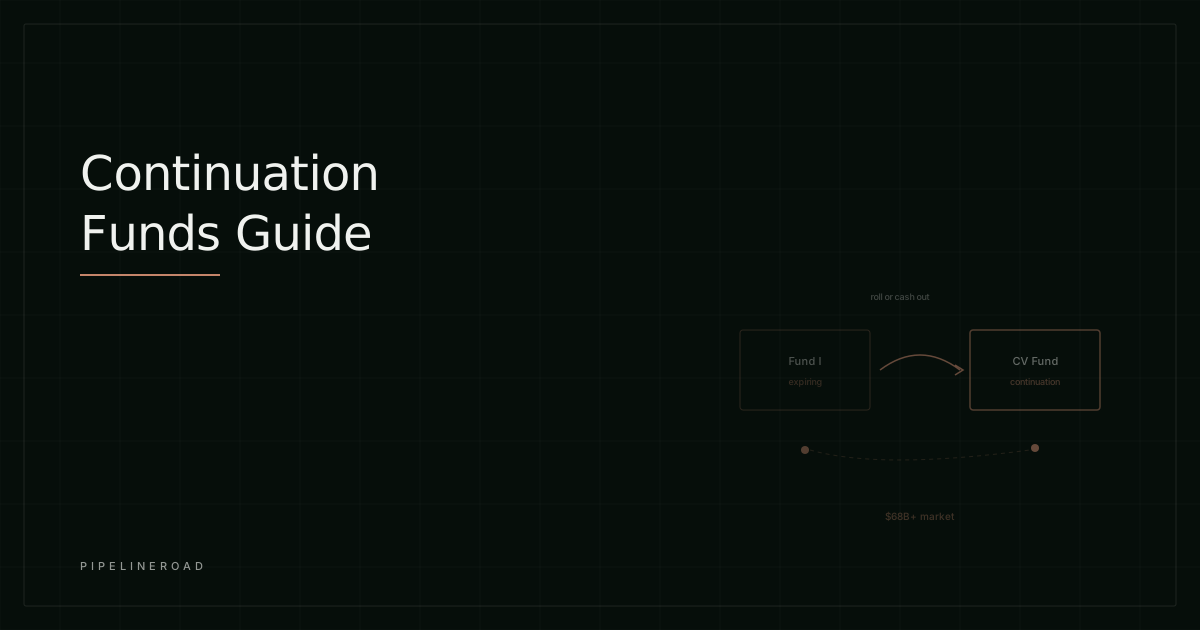
A continuation fund is defined as a new investment vehicle created by an existing general partner to acquire one or more portfolio companies from a fund nearing the end of its term. GP-led secondaries reached approximately $68 billion in transaction volume in 2024, representing roughly 50% of all secondary market activity (Source: Jefferies 2024 Global Secondary Market Review). Continuation funds have moved from a niche restructuring tool to one of the most significant structural innovations in private equity.
If you manage PE funds, you will encounter continuation funds. Either as a tool for your own portfolio, as a transaction your LPs are evaluating from another manager, or as a competitive dynamic that affects how secondary buyers and LPs think about your fund. This guide covers the mechanics, the economics, the conflicts, and the practical considerations that matter.
How Continuation Funds Work
The basic structure is straightforward, even though the execution involves considerable legal and operational complexity.
A continuation fund is a new investment vehicle created by an existing GP to acquire one or more portfolio companies from a fund that is approaching the end of its investment period or fund term. The transaction gives existing LPs two choices: roll their interest into the new vehicle (maintaining their exposure to the portfolio company) or cash out at the transaction price (receiving liquidity).
New investors — typically secondary buyers, but sometimes new LP commitments — provide the capital to buy out LPs who choose to cash out.
Here is the typical transaction flow:
- GP identifies a portfolio company (or companies) in an existing fund where additional hold time could meaningfully increase value, but the fund term limits further investment.
- A secondary advisor (Evercore, Lazard, PJT Park Hill, or others) is engaged to run the process and provide valuation analysis.
- A fairness opinion is obtained from an independent third party to validate the transaction price.
- Existing LPs are notified and given the option to roll or cash out. The LPAC (Limited Partner Advisory Committee) is consulted, and in most cases, LPAC approval is required.
- Secondary buyers provide capital to fund the cash-out portion. They become LPs in the new continuation vehicle alongside any rolling LPs.
- The new vehicle is established with fresh fund terms — typically a 3-5 year term, new fee arrangements, and a reset on carried interest.
The entire process usually takes 3-6 months from initiation to closing, depending on the complexity of the assets and the number of LPs involved.
Why GPs Use Continuation Funds
The motivations are more varied than critics sometimes suggest. While economics certainly play a role, there are several legitimate strategic reasons GPs pursue continuation fund transactions.
More Time with High-Performing Assets
The most defensible reason: the portfolio company is performing well, has a clear path to significantly higher value, but the fund is running out of time. Standard PE fund terms are 10 years with two 1-year extensions. If a company was acquired in year 4 and needs 3 more years to execute its growth plan, a continuation fund provides that runway without forcing a premature exit.
This is particularly common in technology buyouts and healthcare services, where value creation plans (product development, platform acquisitions, geographic expansion) often extend beyond the original fund’s timeline.
Providing Liquidity While Retaining Upside
Exit markets are cyclical. In periods when M&A and IPO activity is depressed — as it has been for portions of 2022 through 2025 — continuation funds offer a third option. LPs who need liquidity can cash out, while those with longer horizons can continue to participate in the company’s growth.
This flexibility has made continuation funds popular during the current exit drought. Rather than selling a strong portfolio company at a compressed multiple, the GP can offer liquidity to LPs who need it while waiting for a more favorable exit environment.
Economic Considerations
This is the part that draws scrutiny, and rightly so. A continuation fund resets the GP’s economics in several ways:
- New management fees. The continuation vehicle charges management fees on the new vehicle’s NAV, providing the GP with a fresh fee stream on an asset they already manage.
- Carry crystallization. The transaction can trigger carried interest on the “sold” asset from the old fund, even though the GP is effectively retaining the investment.
- Carry reset. The new vehicle has its own carried interest waterfall, meaning the GP can earn carry again on future gains from the same asset.
These economic resets are legitimate business considerations for the GP, but they create the conflict of interest that regulators and LPs have increasingly focused on.
The LP Perspective: Roll or Cash Out
For LPs receiving a continuation fund offer, the decision involves several considerations.
Reasons to Roll
- Conviction in the asset. If the LP believes the portfolio company has significant remaining upside, rolling avoids the friction cost of cashing out and redeploying that capital.
- Avoiding re-entry cost. Finding an equivalent PE investment to replace the cash-out proceeds takes time and involves new fees. Rolling maintains exposure without transaction costs.
- Favorable terms. Some continuation fund structures offer rolling LPs improved economics (lower fees, preferential carry splits) as an incentive to maintain their position.
Reasons to Cash Out
- Liquidity needs. LPs who are overallocated to PE, facing their own distribution pressures, or managing portfolio rebalancing may need the cash regardless of the asset’s merits.
- Valuation concerns. If the LP questions whether the transaction price fairly reflects the asset’s value, cashing out removes that risk.
- Fee fatigue. Paying management fees and carry on the same asset for a second fund term increases the total cost of the investment. LPs with strong opinions about fee load may prefer to exit and redeploy elsewhere.
- Conflict concerns. Some LPs have a policy-level reluctance to participate in transactions where the GP is on both sides, regardless of the specific merits.
In practice, roll rates vary widely. According to Evercore data, average roll rates for continuation fund transactions have ranged from 40% to 65% in recent years, meaning that roughly half of existing LPs typically choose to cash out. Higher-quality assets and more attractive rolling terms tend to produce higher roll rates.
Market Size and Growth
The growth of continuation funds over the past five years has been dramatic.
| Year | GP-Led Secondary Volume | % of Total Secondary Market |
|---|---|---|
| 2019 | $26B | 33% |
| 2020 | $24B | 30% |
| 2021 | $68B | 48% |
| 2022 | $52B | 46% |
| 2023 | $52B | 47% |
| 2024 | $68B | ~50% |
Source: Jefferies Global Secondary Market Review, Evercore.
GP-led secondaries now represent approximately half of all secondary market activity, up from roughly a third in 2019. This growth reflects both increased GP comfort with the structure and growing secondary buyer appetite for GP-led deals.
The secondary buyers who dominate this space — Lexington Partners, Ardian, Coller Capital, HarbourVest, Goldman Sachs Asset Management, and Blackstone Strategic Partners — have raised dedicated vehicles and teams specifically for GP-led transactions. Their willingness to provide capital at scale has made continuation funds viable for a wider range of GPs and asset types.
Single-Asset vs. Multi-Asset Continuation Funds
Continuation funds come in two primary structures, and the distinction matters.
Single-Asset Continuation Funds
These involve one portfolio company being transferred to a new vehicle. Single-asset deals have grown faster than multi-asset deals and now represent approximately 50-55% of GP-led secondary volume, according to Jefferies data.
Single-asset deals are cleaner from a diligence perspective — secondary buyers are underwriting one company, not a portfolio. But they concentrate risk, which means secondary buyers demand more diligence, more governance protections, and often a modest valuation discount.
Multi-Asset Continuation Funds
These transfer multiple portfolio companies from one or more existing funds into a new vehicle. Multi-asset deals offer diversification, which secondary buyers generally prefer from a risk standpoint. However, they can be more complex to negotiate because LPs may have different views on the individual assets — wanting to roll on some and cash out on others.
Some multi-asset continuation funds are structured with LP-level flexibility, allowing LPs to make asset-by-asset roll/cash-out decisions. This adds complexity but improves LP satisfaction with the process.
Fee and Carry Structures
The economics of continuation funds have evolved as the market has matured, and LPs and secondary buyers have pushed for more GP-LP aligned structures.
Management Fees
Continuation fund management fees are typically lower than primary fund fees. Common structures include:
- 1.0-1.25% of NAV (compared to 1.5-2.0% in primary funds)
- Fees on invested capital rather than committed capital
- Step-downs built into the fee schedule as the vehicle matures
Carried Interest
Carry structures in continuation funds vary, but two approaches have become standard:
- Full carry reset: The GP earns carry (typically 15-20%) on gains above the transaction price in the new vehicle. This is the most common structure.
- Hurdle rate with catch-up: Some continuation funds include an 8% preferred return hurdle, similar to primary fund structures, to ensure LPs receive a baseline return before the GP earns carry.
GP Commitment
GPs are typically expected to roll 100% of their existing economic interest in the transferred asset(s) and often commit additional capital to the new vehicle — similar to the alignment signaling discussed in our GP commitment guide. This requirement has become a market norm, driven by LP and secondary buyer demand for alignment. A GP that takes cash off the table in a continuation fund sends a negative signal about their conviction in the asset.
Regulatory Scrutiny and Governance
The SEC has taken an active interest in continuation funds, and the regulatory landscape continues to evolve.
SEC Private Fund Adviser Rules
The SEC’s 2023 private fund adviser rules (portions of which are being challenged in court) included provisions specifically addressing GP-led secondaries. Key requirements include:
- Fairness opinions or valuations from independent parties for GP-led secondary transactions
- Enhanced disclosure to LPs about the GP’s conflicts of interest in the transaction
- Detailed reporting on the economics of the new vehicle relative to the old fund
While portions of these rules face legal challenges, the direction of regulatory travel is clear: more transparency, more independent oversight, and more LP protections in GP-led transactions.
ILPA Guidance
The Institutional Limited Partners Association (ILPA) published updated guidance on GP-led secondaries in 2023, recommending:
- LPAC involvement in reviewing and approving continuation fund transactions
- Meaningful election periods for LPs to evaluate the roll/cash-out decision (ILPA recommends at least 20 business days)
- Clear disclosure of all fees, carry resets, and economic terms in the new vehicle
- Independent valuation that is shared with LPs before they make their election
- Status quo option where LPs can choose to remain in the existing fund rather than being forced into a binary roll/cash-out decision
Managing the document flow and LP elections at this stage is significantly easier with dedicated investor portal software that gives each LP a single view of their options, disclosures, and election deadlines.
Most institutional LPs now expect compliance with ILPA guidance as a minimum standard. GPs who structure continuation funds below these standards risk damaging LP relationships.
When a Continuation Fund Makes Sense
Not every portfolio company warrants a continuation fund. The structure works best when specific conditions are met:
Clear value creation runway. The portfolio company has a specific, executable plan that requires 2-4 more years. Vague assertions that the company “has more room to grow” are not sufficient. Secondary buyers will diligence the value creation plan just as rigorously as a primary buyout target.
Strong company performance. Continuation funds for underperforming assets are extremely difficult to execute. Secondary buyers price in the selection bias — they know GPs are more likely to retain winners. If the company’s performance doesn’t justify continued investment, the GP should explore a traditional exit instead.
LP alignment. If the LPAC and major LPs are supportive, the transaction will go smoothly. If key LPs are skeptical or hostile, the GP should reconsider. A continuation fund that creates LP friction can damage the GP’s reputation and affect their next primary fundraise.
Reasonable economics. The fee and carry reset should be defensible relative to the remaining value creation opportunity. GPs who structure aggressive economics that primarily benefit themselves will face pushback from both LPs and secondary buyers.
When It Does Not Make Sense
The company is underperforming. Using a continuation fund to avoid marking down a struggling investment is the worst use of the structure. LPs and secondary buyers see through it, and it damages GP credibility.
The GP’s primary motivation is economic. If the continuation fund is primarily about resetting fees and carry rather than creating value for LPs, the transaction is misaligned. This is exactly the scenario that draws regulatory scrutiny.
LP relationships are strained. If the GP-LP relationship is already contentious, a continuation fund — with its inherent conflicts — is likely to make things worse. Better to pursue a traditional exit and focus on repairing the relationship before the next fundraise.
The exit market is fine. If there are willing buyers at attractive valuations, sell the company. Continuation funds are most valuable when the exit market is unfavorable or when the specific timing is wrong. Using them when conventional exits are available raises questions about GP motivations.
Impact on Future Fundraising
How a GP handles continuation funds directly affects their ability to raise subsequent primary funds.
Done well, a continuation fund demonstrates several things LPs value: conviction in their portfolio, willingness to align economics with LPs, and the ability to attract sophisticated secondary capital. Several GPs have successfully used continuation funds as a bridge to their next fundraise, showing LPs that the asset transferred was indeed a strong performer.
Done poorly, it raises red flags that persist. LPs talk to each other. A continuation fund perceived as self-serving or poorly governed will circulate through the LP network and show up in due diligence on the GP’s next fundraise.
The key factors LPs evaluate:
- Was the process fair? Was there an independent fairness opinion? Were LPs given adequate time and information to decide?
- Were the economics reasonable? Did the GP roll their full interest? Were the new fees and carry market-standard?
- How did the asset perform post-transaction? This is the ultimate test. If the continuation fund asset generates strong returns, the transaction is validated. If it stagnates, questions about GP judgment intensify.
The Bottom Line
- GP-led secondaries hit $68 billion in 2024, representing ~50% of all secondary market activity: Continuation funds have moved from a niche restructuring tool to a structural feature of private equity, up from 33% of secondary volume in 2019.
- 40-65% of existing LPs typically cash out: Roll rates vary widely based on asset quality and rolling terms. LPs who need liquidity, question the valuation, or have policy-level conflict concerns tend to exit.
- Management fees reset at 1.0-1.25% of NAV, lower than primary fund rates: GPs are expected to roll 100% of their existing economic interest and often commit additional capital. Taking cash off the table sends a negative signal about conviction.
- The SEC and ILPA are raising governance standards: Independent fairness opinions, at least 20 business days for LP elections, and clear disclosure of fee and carry resets are becoming minimum expectations. GPs who fall below these standards risk damaging LP relationships and their next primary fundraise.
- The ultimate test is post-transaction performance: If the continuation fund asset generates strong returns, the transaction is validated. If it stagnates, questions about GP judgment and self-dealing intensify — and those questions follow the GP into every subsequent fundraise conversation.
Frequently Asked Questions
What is a continuation fund?
A continuation fund (also called a GP-led secondary) is a new fund vehicle created by the GP to acquire one or more portfolio companies from an existing fund that is approaching the end of its term. Existing LPs can choose to roll their interest into the new vehicle or cash out, while new investors can join.
How large is the continuation fund market?
GP-led secondaries, including continuation funds, represented approximately $68 billion in transaction volume in 2024, up from $26 billion in 2020. They now represent roughly 50% of all secondary market activity, making them a major structural feature of the private equity landscape.
What are the potential conflicts of interest in continuation funds?
The primary conflict is that the GP is effectively on both sides of the transaction, selling from the old fund and buying into the new fund. This creates questions about valuation fairness, fee resets, and whether the transaction benefits LPs or primarily the GP. ILPA and the SEC have both issued guidance addressing these conflicts.
What is the average continuation fund transaction size?
The average single-asset continuation fund transaction ranges from $300 million to $700 million in enterprise value, though the market spans a wide range. According to Jefferies and Evercore data, total GP-led secondary volume reached approximately $68 billion in 2024, with single-asset deals representing roughly 50-55% of that volume. Multi-asset continuation funds tend to be larger, often exceeding $1 billion when transferring portfolios of 3-5 companies. The minimum viable size for a continuation fund is generally around $100-$150 million, below which the transaction costs and advisor fees become disproportionate to the economics.
How do continuation funds affect GP track record reporting?
Continuation funds create significant complexity in track record reporting. When a GP transfers an asset from Fund I to a continuation vehicle, the original fund typically marks the transaction as a realized exit at the transfer price, which crystallizes gross and net IRR for that investment. According to industry data, approximately 40-65% of existing LPs cash out in the average continuation fund transaction, meaning those returns become final. However, the asset continues under the same GP in the new vehicle, so the ultimate outcome is not yet determined. LPs and placement agents increasingly scrutinize whether GPs include continuation fund transfers as realizations or segregate them in track record presentations to avoid overstating actual exit performance.