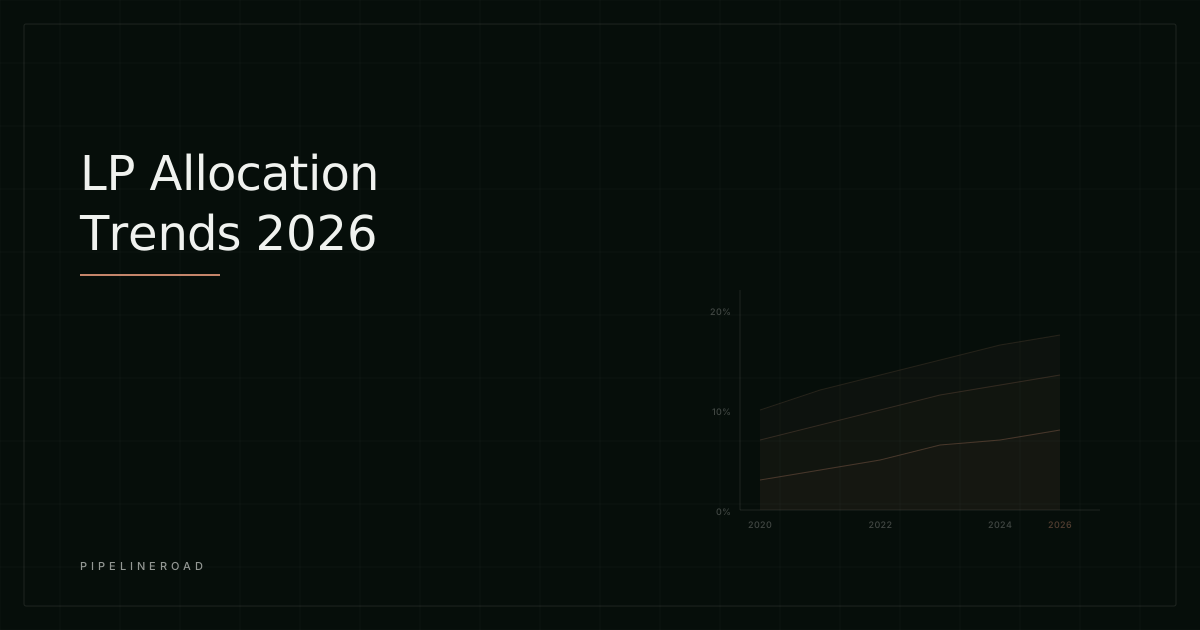
Understanding where institutional capital is flowing is not a nice-to-have. Global pension funds allocate 10–14% to private equity, endowments average 15–20%, and family offices lead at approximately 22% (Source: Preqin 2025 Investor Outlook; UBS/Campden Wealth 2024). It is the single most important input for any fund manager preparing to raise capital. The allocation decisions made inside pension funds, endowments, sovereign wealth funds, and insurance companies directly determine how much LP capital is available, which strategies get funded, and how competitive the fundraising market will be for any given vintage year.
This analysis covers the current institutional allocation landscape heading into 2026, drawing on data from Preqin, PitchBook, Cambridge Associates, and Bain & Company’s annual private equity reports. The goal is straightforward: give fund managers an honest read on where institutional money is going, what is shifting, and what it means for your fundraise.
The Current Allocation Landscape by LP Type
Not all institutional investors think about private equity the same way. Their governance structures, return targets, liquidity needs, and risk tolerances produce meaningfully different allocation patterns.
Public Pension Funds
Public pensions remain the largest source of LP capital in private equity globally. According to Preqin data, the average public pension fund allocated approximately 11.5% to private equity as of year-end 2025, up from roughly 8.2% a decade ago. The largest systems — CalPERS, CalSTRS, CPP Investments, Ontario Teachers’ — have PE allocations ranging from 13% to 17%.
The challenge is that many pension systems are now at or above their target allocations. When public market valuations declined in 2022, the denominator effect pushed actual PE allocations above targets for many systems, even though distributions slowed at the same time. Some pension CIOs have worked through this imbalance by 2025, but others are still managing overweight positions.
What this means for fundraising: public pensions are still committing to PE, but the pace has slowed. They are heavily favoring re-ups with existing GP relationships over first-time commitments. Breaking into a pension fund portfolio as a new manager remains extremely difficult unless you have a differentiated strategy that fills a specific portfolio gap.
Endowments and Foundations
University endowments and private foundations were early adopters of the alternative asset model, and their allocation percentages reflect that. Large endowments (those with over $1 billion in AUM) allocate an average of 30-40% to private equity and venture capital combined. The Yale model, pioneered by David Swensen, has been widely replicated across the endowment world.
Smaller endowments (under $500 million) allocate meaningfully less, typically 10-18%, constrained by liquidity requirements and governance capacity. The gap between large and small endowments in PE exposure has widened over the past decade.
Endowments tend to be more willing than pensions to back emerging managers, particularly in venture capital and growth equity. Many run formal emerging manager programs, and several — including those at Duke, MIT, and the University of Michigan — have publicly stated commitments to allocating a percentage of PE capital to first- and second-time funds.
Sovereign Wealth Funds
Sovereign wealth funds represent some of the largest and most sophisticated LP capital pools in the world. Abu Dhabi Investment Authority (ADIA), GIC, Temasek, and Mubadala each manage hundreds of billions of dollars, with PE allocations typically ranging from 10% to 20% of total assets.
The trend among sovereign wealth funds has been toward co-investment and direct investment. Many SWFs now have in-house deal teams that invest alongside their GP partners, reducing their reliance on blind-pool commitments. According to Preqin, co-investment activity by SWFs has grown approximately 15% annually since 2020.
For fund managers, SWF capital comes with both advantages and complexity. Ticket sizes are large (often $50M-$200M+ per commitment), but the diligence process is lengthy, the relationship development timeline extends over years, and many SWFs have moved toward managed accounts and separately managed vehicles rather than commingled fund commitments.
Insurance Companies
Insurance company allocations to PE have increased steadily, driven by the low-yield environment of the past decade and the search for returns above what fixed-income portfolios can deliver. According to data from the National Association of Insurance Commissioners and Preqin, the average PE allocation among large insurance companies reached approximately 5-8% by the end of 2025.
Regulatory constraints shape insurance company behavior more than any other LP type. Risk-based capital requirements mean that certain PE strategies carry higher capital charges than others. This pushes insurance LPs toward lower-volatility strategies — senior lending, infrastructure, real estate debt, and core buyout — and away from venture capital and distressed.
Apollo, Ares, and KKR have all built significant insurance capital bases through affiliated or captive insurance platforms. This has concentrated a substantial portion of insurance LP capital within a small number of large alternative asset managers, making it harder for smaller GPs to access this capital pool.
Family Offices
Family offices are the fastest-growing LP category in private equity. According to a 2025 survey by UBS and Campden Research, the average single-family office allocates approximately 22% of assets to private equity, up from 16% in 2019. Multi-family offices typically allocate 12-18%.
Family offices offer several advantages as LPs: faster decision-making, fewer governance layers, the ability to write smaller checks (useful for emerging managers), and often a willingness to co-invest. However, they can also be less predictable — family dynamics, generational transitions, and liquidity events can cause sudden changes in investment appetite.
For emerging managers, family offices represent the most accessible institutional capital source. Many will take meetings based on personal referrals, they can commit to funds as small as $30M-$50M, and their due diligence process — while thorough — is typically faster than a pension fund’s investment committee cycle.
Target vs. Actual Allocations: The Gap That Matters
One of the most important dynamics in institutional PE allocations is the gap between target allocations and actual allocations. This gap has been volatile since 2022 and continues to influence fundraising dynamics in 2026.
Here is where things stand across LP categories:
| LP Type | Average Target Allocation | Average Actual Allocation | Status |
|---|---|---|---|
| Public Pensions | 12% | 11.5-13% | At or slightly above target |
| Endowments (Large) | 33% | 30-38% | Mixed; depends on vintage |
| Sovereign Wealth | 15% | 12-16% | Generally at target |
| Insurance | 7% | 5-8% | Room to grow |
| Family Offices | 20-25% | 18-24% | Generally under target |
The institutions that are above target allocations face a specific problem: they need distributions from existing funds before they can commit new capital. With PE exit activity down roughly 40% from 2021 levels, the distribution drought has been a major headwind. LPs who are overallocated are not anti-PE — they simply cannot commit new capital until existing investments return cash.
Conversely, LPs that are under target allocation (many insurance companies and family offices) represent active buyers. They have explicit mandates to increase PE exposure and are actively seeking new GP relationships.
The Denominator Effect, Explained
The denominator effect deserves its own section because it continues to shape LP behavior more than most fund managers appreciate.
The concept is simple: if an LP has a 12% target allocation to PE and their total portfolio is worth $10 billion, the target is $1.2 billion in PE. If public markets decline and the total portfolio drops to $8.5 billion, that same $1.2 billion in PE (which hasn’t been marked down as quickly) now represents 14.1% of the portfolio — above target, without a single new PE commitment.
This effect was pronounced in 2022 when public equities corrected while PE portfolios, valued on a lagged basis, maintained their marks. The result was widespread over-allocation that caused many LPs to pause or slow new commitments throughout 2023 and into 2024.
By early 2026, the denominator effect has partially normalized. Public markets have recovered, increasing the denominator and bringing actual allocations closer to targets. But the experience left a mark on LP behavior. Many allocators have become more conservative about pacing, preferring to stay slightly under target rather than risk another over-allocation episode.
For fund managers, the practical implication is straightforward: always ask about an LP’s current allocation status relative to target before investing significant time in the relationship. An LP that is 200 basis points over target is unlikely to commit, regardless of how compelling your fund is.
LP Portfolio Construction Trends
Beyond top-level allocation percentages, how LPs construct their PE portfolios is shifting in ways that matter for fund managers.
Co-Investments Are No Longer Optional
According to Cambridge Associates, co-investment deal flow has grown approximately 20% annually since 2019. Large LPs now expect co-investment rights as a standard feature of GP relationships, not a perk. Many LPs have built in-house teams specifically to evaluate and execute co-investments, and some are using co-investment as a way to reduce blended fee loads across their PE portfolio.
For fund managers, offering co-investment opportunities is increasingly table stakes in LP conversations. LPs view co-investment access as a signal of GP-LP alignment and as a tool for portfolio construction (sector concentration, vintage year management, etc.).
Secondaries as a Portfolio Management Tool
The secondary market has matured from a niche liquidity tool into a core portfolio construction mechanism. LP-led secondary volume reached approximately $55 billion in 2024, and many institutional investors now actively manage their PE portfolios by buying and selling secondary positions.
This has two implications for fund managers. First, GP-led secondaries (including continuation funds) have become a significant source of deal flow for LPs, meaning your fund is competing for attention with an entirely separate channel. Second, LPs who are active secondary buyers may view your fund through the lens of secondary market pricing — they have a real-time sense of what PE exposure costs on the secondary market, and they use that as a reference point when evaluating new primary commitments.
Direct Investing by LPs
A growing number of large LPs — particularly sovereign wealth funds, large pensions (CPP Investments, Ontario Teachers’, OTPP), and mega family offices — are investing directly in companies, bypassing GP-managed funds entirely. CPP Investments, for example, deploys more than half of its PE capital through direct investments.
This trend predominantly affects larger funds and mega-cap strategies. Emerging managers are less likely to lose LPs to direct investing because the deal sizes and operational requirements of direct investing favor institutions with $50 billion+ in assets. But it does mean that the largest LPs are deploying a smaller share of their PE allocation through blind-pool fund commitments, which tightens the competitive dynamics for fund managers targeting those LPs.
Geographic Allocation Shifts
Institutional LP capital is slowly but meaningfully shifting its geographic allocation patterns.
North America continues to dominate PE allocations, representing approximately 55-60% of global PE capital raised. But Asia-Pacific allocations have grown from roughly 15% of global PE in 2018 to approximately 20% by 2025, driven by growth in India, Southeast Asia, and Japan. China-focused PE has faced headwinds from geopolitical concerns and regulatory uncertainty, but the broader Asia allocation continues to rise.
European PE allocations have been relatively stable at 20-25% of global capital. Nordic buyout strategies and European mid-market funds have attracted consistent LP interest, while Southern European strategies have seen increased attention as allocators look for less competitive markets.
For emerging managers, the geographic shift creates opportunities. LPs building Asia or European exposure for the first time may be more willing to back emerging managers with deep local networks rather than relying solely on established global platforms.
ESG, Impact, and the Allocation Mandate
ESG considerations have moved from a diligence checkbox to an active allocation driver for many institutional LPs. According to PitchBook data, impact and ESG-aligned PE funds raised over $40 billion globally in 2024, representing roughly 8% of total PE capital raised.
European LPs have been the most aggressive in mandating ESG integration, driven by regulatory requirements like the EU Sustainable Finance Disclosure Regulation (SFDR). Many European pensions and insurance companies now require Article 8 or Article 9 classification from their PE managers.
North American LPs have taken a more varied approach. Some large public pensions (CalPERS, New York State Common) have explicit ESG mandates, while others have faced political pressure to avoid ESG-specific allocation policies. The result is a fragmented landscape where ESG positioning helps with some LPs and is neutral or slightly negative with others.
For fund managers, the practical advice is to have a clear, defensible ESG policy and reporting framework regardless of your strategy. The cost of having it and not needing it is low. The cost of not having it when an LP requires it is losing the commitment.
Emerging Manager Programs: Real Opportunity or Token Allocation
Roughly 40% of institutional LPs with over $1 billion in PE allocations now have formal emerging manager programs, according to a 2025 survey by the Institutional Limited Partners Association (ILPA). These programs set aside a portion of PE capital — typically 5-15% of the total PE allocation — specifically for first- and second-time fund managers.
The track record of these programs has been strong. Data from Cambridge Associates shows that first-time and second-time PE funds have outperformed the all-fund median in the majority of vintage years since 2005, with a particularly strong showing in the 2009-2015 vintages. This performance data has helped justify the institutional case for emerging manager programs.
However, the practical reality is more nuanced. Many emerging manager programs are oversubscribed with GP applications, the ticket sizes are often small ($5M-$25M per commitment), and the evaluation process can be nearly as rigorous as a full institutional allocation. Emerging managers should target these programs actively but should not rely on them as a primary fundraising strategy.
The most successful approach is to identify specific programs that align with your strategy (many have sector or geography mandates), build relationships with the program managers well in advance of your fundraise, and understand that these commitments are often seeds that grow into larger re-ups for Fund II and beyond.
The Re-Up vs. New Relationship Dynamic
This is arguably the most important allocation trend for emerging managers to understand: in a tighter fundraising environment, LPs overwhelmingly favor re-ups with existing managers over new relationships.
According to Preqin data, approximately 70% of LP commitments in 2024-2025 went to managers with whom the LP had a prior relationship. This is up from roughly 60% in 2019-2020 when capital was more abundant and LPs were more willing to explore.
The reasons are rational. Re-ups are faster (the LP already knows the manager), lower risk (there is a track record with this specific LP’s capital), and operationally simpler (existing legal frameworks, reporting systems, and relationships are in place). When LP teams are stretched thin — and most are, given headcount constraints at institutional allocators — defaulting to re-ups is efficient.
For emerging managers, this means the path to institutional capital is a long game. The first commitment from an institutional LP is the hardest. It requires differentiation, persistence, and often a warm introduction from someone the LP trusts. But once that first commitment is secured, the re-up dynamic works in your favor for subsequent funds.
What This Means for Your 2026 Fundraise
The allocation data tells a specific story for managers raising capital this year:
LP capital is available but selective. Total PE allocations continue to grow, but the capital is concentrating among established managers and strategies. Standing out requires a clear, differentiated thesis and a targeted approach to LP segments where you have the best fit.
Know your LP segment. The differences between LP types are not academic — they directly affect your fundraising strategy. A manager targeting family offices needs a fundamentally different approach than one targeting public pensions. Match your materials, messaging, and timeline expectations to your target LP base.
The distribution drought matters. Until exit activity picks up and LPs receive meaningful distributions, many allocators will remain cautious about new commitments. Managers who can demonstrate strong exit discipline and a clear path to realizations will have an advantage.
Co-investment and portfolio construction features are table stakes. LPs are building portfolios, not collecting funds. Offering co-investment rights, providing meaningful portfolio data, and positioning your fund as a portfolio construction tool (not just a return vehicle) will resonate more than return projections alone.
Emerging manager programs are a real channel. If you are raising a first or second fund, identify and build relationships with emerging manager programs now, even if your fundraise is 12 months away. These programs are one of the few institutional channels that are explicitly open to new relationships.
The institutional allocation landscape in 2026 is not hostile to emerging managers, but it is demanding. The LPs who are committing capital want to see preparedness, differentiation, and a clear understanding of where you fit in their portfolio. The data in this analysis is your starting point for building that case. From here, it helps to understand the broader state of capital raising and begin building your LP discovery strategy around the specific allocator segments most likely to commit.
The Bottom Line
- Family offices are the fastest-growing LP segment: Single-family offices now allocate approximately 22% to PE (up from 16% in 2019) and offer faster decision cycles, making them the most accessible institutional capital source for emerging managers.
- 70% of LP commitments go to existing GP relationships: In 2024-2025, re-ups dominated new commitments, up from 60% in 2019-2020. Breaking in as a new manager requires differentiation and warm introductions.
- The denominator effect is still shaping LP behavior: Public market recoveries have partially normalized allocations, but many LPs remain cautious about pacing, preferring to stay slightly under target rather than risk overallocation.
- Insurance companies and family offices have room to grow: Insurance allocations sit at 5-8% against 7% targets, and family offices at 18-24% against 20-25% targets, making both active buyers seeking new GP relationships.
- 40% of large LPs now run formal emerging manager programs: These programs carve out 5-15% of PE allocations for Fund I-III managers, and Cambridge Associates data shows first- and second-time funds have outperformed the all-fund median in most vintages since 2005.
Frequently Asked Questions
What is the average institutional allocation to private equity in 2026?
As of early 2026, the average institutional allocation to private equity across all LP types is approximately 12-15% of total portfolio assets. This represents a steady increase from the 8-10% average a decade ago. However, many institutions are at or above their target allocations due to the denominator effect.
What is the denominator effect and how does it impact fundraising?
The denominator effect occurs when public market declines reduce total portfolio value, making existing PE allocations appear proportionally larger than intended. This can cause LPs to slow or pause new PE commitments even when they philosophically support the asset class. It was a significant headwind in 2022-2023 and continues to affect some allocators.
Are institutional LPs increasing or decreasing PE allocations?
The trend is mixed. Target allocations continue to rise (most institutions plan to increase PE exposure), but actual deployment has slowed due to reduced distributions, the denominator effect, and more selective manager evaluation. LPs are being more selective, favoring re-ups with existing managers over new relationships.
How does the denominator effect impact emerging managers specifically?
The denominator effect disproportionately hurts emerging managers because when LPs become overallocated to PE, approximately 70% of their remaining commitments go to re-ups with existing GP relationships, according to Preqin data. Emerging managers compete for a shrinking share of new-relationship capital. When a pension fund's PE allocation jumps from 12% to 14% due to public market declines, their first response is to pause new manager evaluations entirely while continuing commitments to established GPs. This means emerging managers face both reduced total capital availability and a structural preference for incumbents during denominator-driven overallocation periods.
Which LP type is most accessible for first-time fund managers?
Family offices are the most accessible LP type for first-time fund managers. According to UBS and Campden Research, single-family offices allocate approximately 22% of assets to private equity and are growing their PE exposure faster than any other institutional category. They offer faster decision-making cycles, fewer governance layers, and willingness to write checks into funds as small as $30-$50 million. Unlike pension funds, where roughly 70% of commitments go to existing relationships, family offices are more open to new managers through personal referrals and can typically move from initial meeting to commitment in 3-6 months rather than the 12-18 months common at larger institutions.
