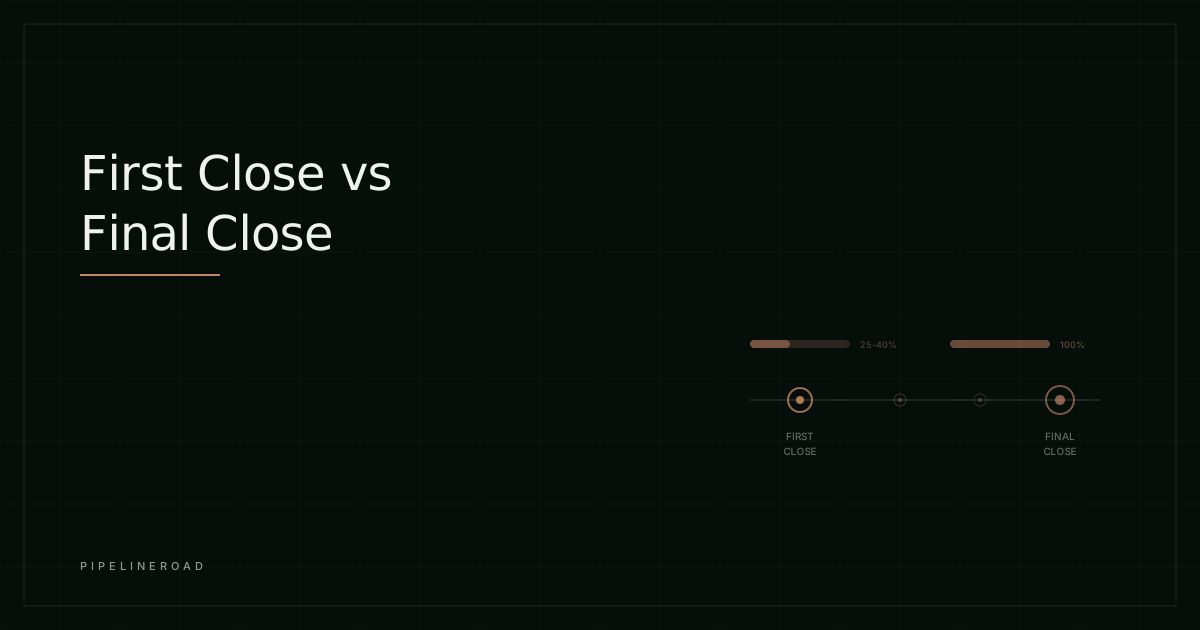
A first close is defined as the initial closing event where LP commitments become legally binding and the GP gains authority to call capital. A final close is the last opportunity for LPs to commit. According to PitchBook data, emerging managers average 14 months between first and final close (Source: PitchBook 2024 Fund Formation Report). Fund closings are the milestones that turn a fundraise from a process into a fund. Every commitment before first close is a promise. After first close, capital is called, investments are made, and the fund is operational. Understanding how closings work, and how to use them strategically, is one of the most practical things an emerging manager can learn.
What a “close” actually is
A fund closing is a legal event. It’s the moment when LP commitments become binding, the limited partnership agreement (LPA) is executed, and the general partner gains the authority to call capital and deploy it.
Before a close, you have soft commitments, verbal agreements, and signed side letters. These matter, but they’re not capital. After a close, you have enforceable subscription agreements backed by LP capital commitments that you can draw down according to the fund’s investment pace.
Most funds have multiple closings: a first close, one or more interim closes, and a final close. Each one brings in a new tranche of LP commitments and triggers specific provisions in the LPA.
The terminology is straightforward, but the strategy behind each close is where things get interesting.
First close: the milestone that changes everything
First close is the most important milestone in any fundraise. It’s the point at which the fund transitions from a concept to a going concern. You can begin investing, you can call capital, and you have an auditable track record starting from day one.
What triggers first close
The LPA specifies a minimum threshold for first close, typically expressed as a percentage of the target fund size or a fixed dollar amount. Common thresholds range from 25% to 50% of the target. For a $100M target fund, that means $25-50M in binding commitments before the fund can hold its first close.
Some funds set the first close threshold lower to create flexibility. A $75M fund with a $15M first close threshold (20%) can begin operations sooner, which matters when you’re racing to deploy before deal flow goes stale. But too low a threshold can signal to prospective LPs that you couldn’t generate enough early momentum.
The strategic case for an early first close
The fastest fundraises tend to have early first closes. There’s a reinforcing logic to this: LPs who are considering your fund want to see that other LPs have committed. A first close creates that social proof. Every subsequent close conversation becomes easier because you’re no longer asking LPs to be the first mover.
Practically, an early first close lets you:
Start building a track record. Every month between first close and final close is a month of investment activity that subsequent LPs can evaluate. If your first deal performs well, it becomes a data point for LPs who are still on the fence.
Demonstrate operational capability. LPs evaluating an emerging manager often worry about whether the team can actually run a fund: handle capital calls, reporting, compliance, and portfolio management simultaneously. A functioning fund answers that question better than any pitch deck.
Create urgency. Once a fund is investing, LPs face a timing calculus. Wait too long, and they miss the best vintage-year economics. The first close starts that clock.
Retain anchor LPs. Your earliest and most supportive LPs don’t want to wait 18 months while you round up the rest of the capital. Closing quickly honors their commitment and keeps the relationship strong.
What LPs evaluate at first close
LPs coming into a fund at first close are making a bet on the manager, not the portfolio. There are no investments yet. The evaluation is based on:
- The GP’s track record and team composition.
- Fund terms and structure relative to market norms.
- The quality and reputation of other first close LPs (anchor investors matter enormously here — see our anchor investor strategy guide).
- The GP’s commitment level and personal capital at risk.
- The realism of the investment thesis and target return profile.
First close LPs often negotiate the most favorable terms (management fee discounts, co-investment rights, advisory board seats) because they’re taking the most risk. These terms are typically documented in side letters rather than the main LPA — our side letter negotiation guide covers the standard provisions.
Interim closes: building momentum
Between first close and final close, most funds hold one to three interim closes. Each interim close brings in additional LP commitments and expands the fund’s capital base.
Interim closes serve two purposes. Operationally, they give the GP access to more capital for deployment. Strategically, they create natural deadlines that help push undecided LPs to commit.
How interim closes work
Each interim close is documented like a mini version of the first close. New LPs execute subscription agreements and become party to the LPA. They’re typically subject to the same terms as first close LPs, though they may miss out on early-bird incentives.
A critical provision: LPs who come in at an interim close are usually required to fund their pro-rata share of capital already called, plus interest. This means a new LP joining at the second close retroactively funds their portion of any investments made between first close and the interim close.
This equalization mechanism ensures that all LPs are treated equally regardless of when they entered. The interest charged on catch-up capital calls varies but typically ranges from 6-10% annually. This compensates first-close LPs for the time value of their capital and incentivizes earlier commitment.
Typical interim close cadence
Most funds hold interim closes every 3-6 months after first close. The cadence depends on the pace of LP commitments and the GP’s deployment schedule. A fund that’s actively investing and generating early results might accelerate interim closes to capitalize on positive momentum.
For emerging managers navigating the full fundraising timeline, planning the interim close schedule is as important as planning the investment pipeline. The two need to stay synchronized. Calling too much capital too fast, before later LPs have come in, can create awkward funding dynamics.
Final close: drawing the line
Final close is exactly what it sounds like: the last opportunity for LPs to commit capital to the fund. After final close, the fund’s capital base is fixed for the life of the vehicle.
LPA provisions for final close
The LPA specifies a deadline for final close, usually expressed as a fixed number of months after first close. Common provisions allow 12-18 months, with some funds extending to 24 months. Extensions beyond the stated deadline typically require LP advisory committee approval or a supermajority LP vote.
The final close deadline creates a natural end to the fundraise. This is a feature, not a bug. Without a hard deadline, fundraising can drag on indefinitely, diverting the GP’s attention from investing and creating uncertainty for existing LPs.
Hard cap vs. target
Most funds establish both a target size and a hard cap. The target is the amount the GP expects to raise. The hard cap is the maximum the fund will accept, regardless of LP demand.
For a fund targeting $100M with a $125M hard cap, the GP can accept up to $125M but won’t go beyond that. Hard caps prevent overdilution. Accepting too much capital relative to the strategy’s capacity degrades returns for everyone.
If demand exceeds the hard cap before final close, the GP faces a good problem: which LPs to allocate to. This typically means scaling back later commitments or creating a co-investment vehicle to accommodate excess demand.
What happens at final close
Final close triggers several important events:
Fee calculations crystallize. Management fees are typically calculated on committed capital during the investment period, so the final close establishes the base for fee calculations going forward.
Investment period parameters lock. The investment period, usually 3-5 years, often starts from first close, meaning final close LPs have less time to benefit from the full deployment cycle. Some LPAs start the investment period clock at final close, but this is less common.
Reporting obligations formalize. After final close, the GP’s reporting cadence to LPs becomes fully operational. Quarterly reports, annual audits, and capital account statements follow a set schedule.
The fundraise is officially over. The GP can dedicate 100% of their time to investing and portfolio management. For emerging managers, this is a significant psychological and operational shift.
Common closing structures
Not all funds follow the same closing pattern. The structure depends on the GP’s strategy, LP base, and market conditions.
Single close
Some funds, typically smaller vehicles or those with a concentrated LP base, hold a single close. All commitments come in at once, and the fund is immediately at its final size. This is common for friends-and-family vehicles, sidecar funds, and SPVs.
The advantage of a single close is simplicity. No equalization calculations, no catch-up capital calls, no staggered fee commencement dates. The disadvantage is that it’s all or nothing. If you can’t get to your target in one shot, you have no fund.
Rolling closes
At the other end of the spectrum, some funds accept commitments on a rolling basis with monthly or quarterly close dates. This is more common in credit funds, real estate funds, and other strategies with continuous deployment.
Rolling closes offer maximum flexibility but create administrative complexity. Each close requires its own set of equalization calculations, and the fund’s capital base is constantly changing during the fundraise period.
Two-close structure
Many emerging managers use a simplified two-close structure: a meaningful first close followed by a single final close 12-18 months later. This reduces administrative burden while still capturing the strategic benefits of an early first close.
Fee implications of multiple closes
The timing of LP entry affects management fee calculations in ways that matter for both GPs and LPs.
First close LPs start paying management fees from the first close date (or the first capital call, depending on the LPA). Their fee obligation covers the full investment period.
Later close LPs typically pay management fees from their close date forward, but are subject to catch-up provisions that retroactively charge fees from the first close date. This creates fee equalization, ensuring all LPs ultimately pay the same amount per dollar committed over the fund’s life.
Some funds offer fee discounts to first close LPs as an incentive for early commitment. A common structure is a 25-50 basis point reduction in management fees for LPs who commit at first close. On a $10M commitment with a 2% management fee, a 25bp discount saves the LP $25,000 annually, meaningful enough to influence timing decisions.
If you’re working with a placement agent to help close later investors, understand how their fee structure interacts with your fund’s close schedule. Some placement agent agreements tie success fees to specific closes rather than total commitments.
Capital call mechanics after first close
Once first close is complete, the GP can issue capital calls, which are formal requests for LPs to fund a portion of their committed capital. Understanding the mechanics matters because they directly affect your investment pace and LP relations.
How capital calls work
Capital calls are typically issued 10-15 business days before the funding date. The notice specifies the amount, the purpose (investment, fees, expenses), and the funding instructions. LPs are contractually obligated to fund their pro-rata share.
Most funds call capital incrementally over the investment period rather than all at once. A typical pattern might call 15-20% of commitments in the first year, 25-30% in year two, and the remainder over years three through five. This pacing matches the fund’s deployment schedule and gives LPs time to manage their own liquidity.
The bridge financing option
Between first close and when capital calls are funded, timing gaps can delay investments. Many funds establish subscription credit facilities (short-term lines of credit secured by LP commitments) to bridge these gaps.
Subscription facilities allow the GP to move quickly on deals without waiting for capital call funding cycles. The facility is repaid when the capital call is settled, usually within 30-90 days. Interest costs are borne by the fund.
These facilities have become standard practice across the industry. For emerging managers, establishing a subscription facility at first close signals operational sophistication and gives you competitive flexibility in deal execution.
The timeline in practice
Bringing this together with real-world timing, here’s what a typical emerging manager fundraise looks like across the close milestones:
Month 0: Fund formation, legal documentation, pre-marketing begins.
Months 3-6: Active marketing, LP meetings, initial soft commitments accumulate.
Month 6-9: First close at 25-40% of target. Fund begins investing. Capital calls issued.
Months 9-15: Interim closes every 3-4 months. Fund deploys capital from first close commitments while continuing to raise.
Months 18-24: Final close. Fundraise ends. Full capital base established.
The entire arc from first close to final close typically spans 12-18 months for emerging managers. PitchBook data suggests the median is approximately 14 months for debut funds, compared to 16-18 months for larger successor funds.
This timeline has strategic implications for the broader fundraising plan. Every month between first close and final close is a month where you’re simultaneously investing and fundraising, two demanding, full-time jobs running in parallel.
Common mistakes and how to avoid them
Setting the first close threshold too high. A $50M first close on a $100M fund sounds ambitious. But if you can’t get there, you have no fund. Set the threshold at the minimum needed to begin investing credibly, typically 25-30% of target, and build from there.
Letting the fundraise drag past the LPA deadline. Every extension request signals to existing LPs that the fundraise isn’t going as planned. Build a realistic timeline with buffer, and structure your LP outreach to hit final close before the deadline, not on it.
Neglecting existing LPs while chasing new ones. Your first close LPs are your best references for prospective investors. Keep them informed, deliver strong reporting, and make them feel like partners, not stepping stones to a larger fund.
Ignoring the equalization math. Later close LPs who owe catch-up capital calls and interest sometimes balk at the amount. Model out the equalization scenarios early and make them transparent during the commitment process so there are no surprises.
The Bottom Line
- Emerging managers average 14 months between first and final close: PitchBook data shows debut funds typically hold 2-3 interim closes in that window, each adding 10-20% of total commitments.
- Target 25-40% of fund size at first close: This threshold is large enough to begin investing credibly and create social proof, but achievable enough to avoid a stalled fundraise that signals weak demand.
- First-close LPs take the most risk and negotiate the best terms: Roughly 70% of funds offer early-closer incentives such as fee discounts of 25-50 basis points. These terms are typically documented in side letters rather than the main LPA.
- Equalization interest of 6-10% keeps later-close LPs honest: New LPs joining at interim closes must fund their pro-rata share of capital already called, plus interest, ensuring all LPs are treated equally regardless of entry timing.
- The fundraise period has a hard deadline for a reason: LPA provisions typically allow 12-18 months from first to final close. Every extension request signals to existing LPs that things are not going as planned. Build a realistic timeline with buffer and hit your deadlines.
Frequently Asked Questions
How long does it typically take between first close and final close?
Most fund managers allow 12-18 months between first close and final close. The LPA typically specifies a maximum period (often 18-24 months). Emerging managers average 14 months between closes according to industry data.
What percentage of the target fund size should be committed at first close?
Industry best practice is to reach 25-40% of target fund size at first close. This signals sufficient LP support to begin deploying capital and creates momentum for subsequent closes.
Can a fund begin making investments before final close?
Yes, most funds begin deploying capital after first close. The partnership agreement typically authorizes investment activity once a minimum threshold is met. This is one of the strategic advantages of structuring an early first close.
How do interim closes work between first and final close?
Interim closes are additional closing events held every 3-6 months after first close, each bringing in new LP commitments. New LPs joining at an interim close must fund their pro-rata share of capital already called, plus equalization interest typically ranging from 6-10% annually. This catch-up mechanism ensures all LPs are treated equally regardless of entry timing. According to PitchBook data, emerging manager funds hold an average of 2-3 interim closes before final close, with each close typically adding 10-20% of total fund commitments.
What happens to LP commitments between first close and final close?
LP commitments made at first close are immediately binding and callable. The GP can issue capital calls to first-close LPs to fund investments, fees, and expenses while the fundraise continues. Approximately 15-25% of first-close commitments are typically called within the first 12 months. LPs who join at later closes retroactively fund their share of previously called capital through equalization payments. This structure means first-close LPs bear higher liquidity risk, which is why roughly 70% of funds offer early-closer incentives such as fee discounts of 25-50 basis points to compensate for that timing risk.