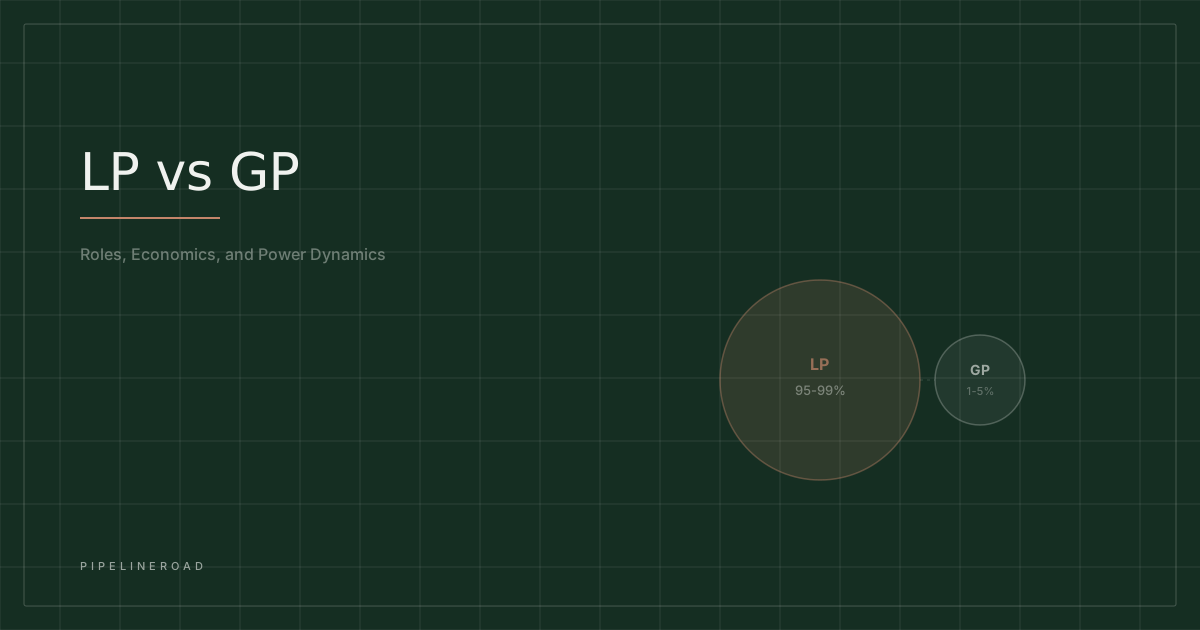
The distinction between limited partners and general partners defines the entire governance and economics of private fund structures. According to Preqin’s 2024 Global Private Capital Report, over 17,000 active private capital funds collectively manage $13.3 trillion in assets, and every one of them is built on the LP-GP relationship (Source: Preqin Global Report 2024). Whether you are evaluating a fund commitment or structuring one, understanding how these roles differ is foundational.
This guide breaks down the core differences: who does what, who earns what, who bears what risk, and how the limited partnership agreement governs the relationship.
The fundamental division
A private fund is organized as a limited partnership. Two classes of partners share in the fund’s economics but have fundamentally different roles:
The general partner (GP) manages the fund. The GP sources deals, makes investment decisions, manages portfolio companies, and handles fund operations including capital calls, reporting, and compliance. The GP has unlimited liability for the fund’s obligations, though in practice this is mitigated by organizing the GP entity as an LLC.
The limited partner (LP) provides capital. LPs commit money to the fund, receive periodic reports, and collect distributions when investments are realized. LPs have limited liability, meaning their maximum loss is capped at their committed capital. In exchange for this liability protection, LPs give up control over investment decisions.
This separation of management and capital is not just structural. It is the legal basis for limited liability protection. If an LP begins making investment decisions or exercising control over the fund, they risk losing their limited liability status under partnership law.
Roles and responsibilities compared
| Dimension | General Partner (GP) | Limited Partner (LP) |
|---|---|---|
| Primary role | Manages the fund, makes investment decisions | Provides capital, receives returns |
| Liability | Unlimited (mitigated by entity structure) | Limited to committed capital |
| Capital contribution | GP commitment: typically 1-5% of fund size | 95-99% of total fund capital |
| Compensation | Management fee + carried interest | Share of profits after preferred return |
| Decision rights | Full authority over investments and operations | Governance votes only (key person, term extensions, removal for cause) |
| Time commitment | Full-time, active management | Passive; quarterly review of reports |
| Fiduciary duty | Owes duties to LPs and the fund | No fiduciary obligation to the GP or fund |
| Fund term control | Manages within LPA constraints | Votes on extensions beyond initial term |
For a deeper look at what GPs commit financially, see our GP commitment guide.
Economics: management fee vs carried interest
The economic split between LPs and GPs is where the alignment of interests either works or breaks down.
GP economics
GPs earn revenue from two sources:
Management fee. Typically 1.5 to 2% of committed capital annually during the investment period, stepping down to 1 to 1.5% of invested capital after the investment period ends. This fee covers salaries, office costs, travel, and fund administration. On a $200M fund at 2%, the GP earns $4M per year in management fees before making a single profitable investment.
Carried interest. The GP’s share of fund profits, typically 20%, earned only after LPs receive back their committed capital plus a preferred return (usually 8% annually). Carry is where real GP wealth is created. On a $200M fund that returns 2.5x, the GP’s carry is approximately $20M (20% of $100M in profits above the preferred return hurdle), assuming a European-style waterfall.
The key nuance: management fees are earned regardless of performance. Carry is earned only on success. This creates a natural tension that the LPA is designed to manage. See our LPA essentials guide for how these provisions are negotiated.
LP economics
LPs receive distributions according to the fund’s waterfall structure. In a standard European (whole-fund) waterfall:
- Return of capital. LPs receive back 100% of their contributed capital.
- Preferred return. LPs receive an 8% annualized return on their contributed capital (the “hurdle rate”).
- GP catch-up. The GP receives distributions until they have received 20% of total profits (catching up to their carry percentage).
- Carried interest split. Remaining profits are split 80/20 between LPs and the GP.
This structure means LPs get paid first. The GP’s carry is subordinate to LP capital return and preferred return. This priority is the core economic protection LPs receive in exchange for giving up investment control.
Risk profiles
The risk each party takes is different in kind, not just degree.
GP risk is primarily reputational and operational. A GP who loses LP capital may never raise another fund. The GP’s personal capital at risk through the GP commitment is typically small relative to total fund size, but it is large relative to the GP’s personal net worth. GPs also face clawback risk: if early distributions overstate the fund’s ultimate performance, the GP may be required to return previously received carry.
LP risk is financial. LPs can lose up to 100% of their committed capital, though total loss is rare in diversified fund portfolios. The more practical risk for institutional LPs is opportunity cost. Capital locked in a poorly performing fund for 10+ years cannot be redeployed. LPs also face blind pool risk, meaning they commit capital before knowing what the GP will invest in.
Decision rights and governance
The LPA defines exactly what each party can and cannot do.
GP authority. The GP has sole discretion over investment decisions, portfolio management, timing of exits, and fund operations. This broad authority is what makes fund investing efficient but also what makes LP protections necessary.
LP governance rights. LPs typically vote on a limited set of matters:
- Key person events. If a named key person (usually the lead GP) leaves or reduces their time commitment, LPs can vote to suspend the investment period.
- Fund term extensions. The GP can request 1-2 year extensions beyond the initial 10-year term, subject to LP approval.
- GP removal for cause. LPs can remove the GP in cases of fraud, gross negligence, or material breach of the LPA. This is a nuclear option rarely exercised.
- Conflicts of interest. The LP Advisory Committee reviews situations where the GP’s interests may conflict with the fund’s interests, such as cross-fund investments or co-investment allocation.
LPs who want more influence over specific deals often negotiate co-investment rights through side letters, which give them the option to invest alongside the fund in particular transactions.
How the relationship works in practice
On paper, the LP-GP relationship is clean: GPs manage, LPs invest. In practice, it is more nuanced.
LP due diligence is ongoing. Sophisticated LPs do not simply write a check and wait for distributions. They review quarterly reports, attend annual meetings, monitor portfolio company developments, and benchmark their GP’s performance against peers. The best LP-GP relationships involve regular communication and transparency, not just contractual compliance.
GP reporting obligations are substantial. GPs provide quarterly financial statements, annual audited financials, capital account statements, and portfolio company updates. Many LPs also require ESG reporting, diversity metrics, and risk analytics. The administrative burden on GPs has increased significantly over the past decade as institutional LPs have professionalized their monitoring practices.
Re-ups depend on the relationship. When a GP raises their next fund, existing LPs decide whether to re-commit. This re-up decision is based on performance, but also on the quality of the relationship: transparency, responsiveness, and alignment. GPs who treat LP relations as an afterthought often struggle to raise successor funds regardless of returns.
When the lines blur
Several situations complicate the clean LP-GP distinction:
GP-led secondaries. In a GP-led secondary transaction, the GP creates a continuation vehicle and offers existing LPs the choice to cash out or roll into the new vehicle. The GP effectively becomes both buyer and seller, creating conflicts that require careful LPAC oversight.
LP co-investments. When LPs co-invest alongside the fund, they take on more direct exposure to individual deals. Co-investment blurs the passive investor role, though LPs still rely on the GP for deal sourcing, due diligence, and portfolio management.
Emerging manager seeding. Some large LPs seed emerging managers by providing anchor capital and operational support in exchange for economics (a share of management fees or carry). This creates a hybrid relationship where the LP has more influence than a typical passive investor.
The bottom line
The LP-GP relationship is the operating system of private capital. LPs provide the fuel. GPs provide the direction. The LPA is the contract that keeps both sides accountable.
If you are raising a fund, understanding what LPs expect from this relationship is not optional. It shapes your terms, your reporting, your governance provisions, and ultimately your ability to build a franchise. If you are committing capital as an LP, understanding the GP’s incentives and constraints is how you make better allocation decisions.
For fund managers building their LP outreach strategy, our institutional investor database covers allocation data across 570,000+ investors, filterable by strategy, geography, and fund size preference. You can also browse our LP and GP directory to find investors and managers by strategy, geography, and fund size.
The Bottom Line
- LPs provide 95-99% of fund capital but have no authority over investment decisions: The separation of capital and control is the legal foundation of the limited partnership structure, and if an LP exercises control, they risk losing their limited liability protection.
- GP economics come from two sources with different incentive structures: Management fees (1.5-2% of committed capital) are earned regardless of performance, while carried interest (20% of profits above the 8% hurdle) is earned only on success. On a $200M fund returning 2.5x, carry is approximately $20M.
- The average GP commitment is 2.55% of fund size: Anything below 1% raises alignment questions with institutional LPs, while above 3-5% is a strong signal. LPs will ask how the commitment is funded and whether it comes from personal wealth.
- Over 80% of buyout funds now use European (whole-fund) waterfalls: This structure protects LPs from paying carry on early winners while later investments lose money. ILPA Principles strongly favor it, and deviating invites pushback from sophisticated LPs.
- Re-ups depend on the relationship, not just returns: GPs who treat LP relations as an afterthought often struggle to raise successor funds. Transparency, responsiveness, and reporting quality influence re-up decisions alongside investment performance.
Frequently Asked Questions
Can someone be both an LP and a GP in the same fund?
Yes. GPs almost always commit their own capital to the fund alongside LPs, which is called the GP commitment. This typically ranges from 1-5% of total fund size. When a GP commits capital, they hold a dual role: managing the fund as GP while also having an economic interest as a limited partner. This alignment of interests is something LPs actively look for during due diligence, as it ensures the GP has personal capital at risk alongside their investors.
What happens if an LP wants to exit the fund early?
LP interests in closed-end funds are generally illiquid. The limited partnership agreement typically restricts transfers without GP consent, and most LPAs include right-of-first-refusal provisions. If an LP needs liquidity before the fund's natural wind-down, they can sell their interest on the secondary market, usually at a discount to NAV ranging from 5-30% depending on fund quality and market conditions. The GP must approve any transfer, and the new buyer assumes the original LP's remaining unfunded commitment.
How are GPs compensated compared to LPs?
GPs earn two forms of compensation: a management fee (typically 1.5-2% of committed capital annually) that covers operating expenses, and carried interest (typically 20% of profits above a preferred return hurdle, usually 8%). LPs receive the remaining 80% of profits after the preferred return is met. This '2 and 20' structure means GPs earn ongoing fees regardless of performance, while their real upside comes from carry on successful funds. LPs bear the capital risk but receive priority distributions through the preferred return mechanism.
What are the fiduciary duties of a GP toward LPs?
GPs owe LPs fiduciary duties including the duty of loyalty (acting in the fund's best interest, not self-dealing) and the duty of care (making informed, prudent investment decisions). These duties are defined and sometimes modified in the LPA. Common provisions include disclosure requirements for conflicts of interest, restrictions on co-investment allocation, and limitations on GP activities outside the fund. Breach of fiduciary duty can result in GP removal, fee clawback, or legal liability, though most LPAs include exculpation clauses that limit liability to cases of gross negligence or willful misconduct.
Do LPs have any say in investment decisions?
In most fund structures, LPs have no authority over individual investment decisions. That authority is delegated exclusively to the GP through the LPA. However, LPs do have governance rights including voting on key person events, fund term extensions, GP removal for cause, and conflicts of interest. The LP Advisory Committee (LPAC), typically composed of the fund's largest LPs, reviews conflict situations and provides non-binding input on fund matters. Some LPs negotiate co-investment rights through side letters, giving them the option (not obligation) to invest alongside the fund in specific deals.
