Getting a meeting with an institutional LP is one of the hardest things an emerging fund manager will do. Warm introductions convert at 3–5x the rate of cold outreach, with conference meetings converting to second meetings at 35–45% compared to 15–25% for cold email (Source: PitchBook 2024 Fund Formation Report). Not because the ask is unreasonable, but because institutional allocators are drowning in requests. A mid-sized pension fund’s investment staff might receive 300–500 inbound meeting requests per year. A large endowment could see double that. They take meetings with maybe 10–15% of those.
The question isn’t whether your fund deserves a look. It’s whether you can cut through the noise in a way that earns 30 minutes on someone’s calendar.
The meeting funnel: Understanding the math
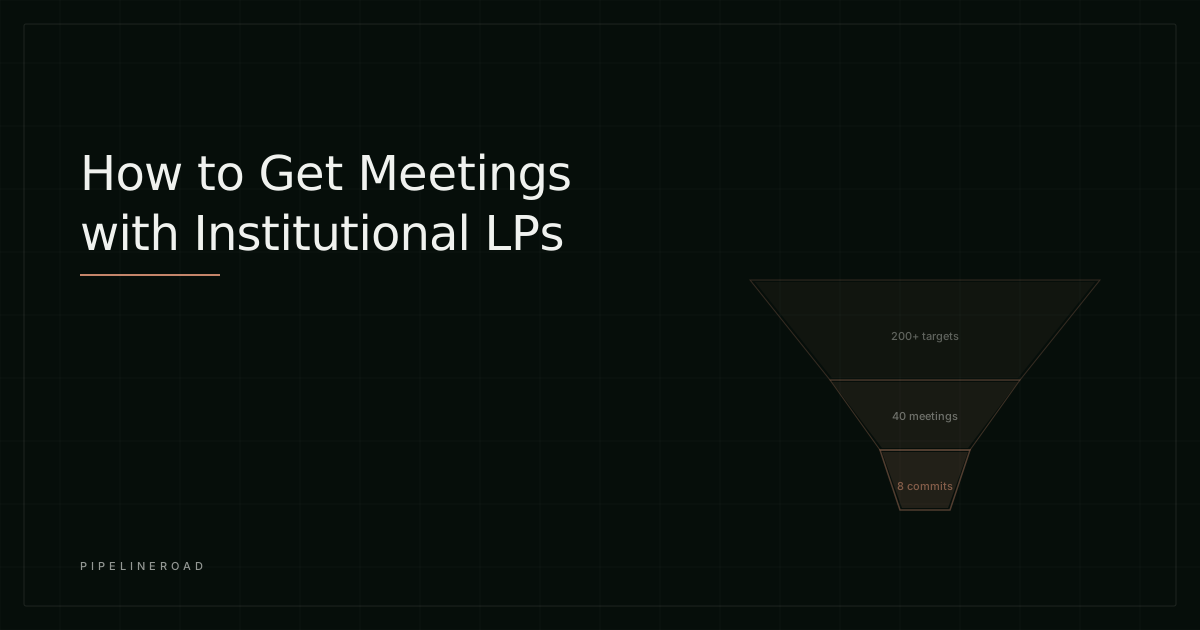
Before you build your outreach strategy, understand the funnel you’re working with. The numbers are sobering but useful.
For a typical emerging manager raising a $75-150M fund:
- Target universe: 300-500 institutional LPs from your institutional investor database who could theoretically invest in your strategy.
- Qualified targets: 100-200 after filtering for mandate fit, fund size preferences, and allocation capacity.
- Meeting requests sent: 150-250 across warm and cold channels.
- First meetings secured: 30-60 (a 20-30% hit rate on warm intros, 3-8% on cold outreach).
- Second meetings: 15-30 (roughly half of first meetings advance).
- Commitments: 8-20 (conversion from first meeting to commitment runs 10-20%).
The managers who close their funds aren’t the ones who find a magic channel. They’re the ones who run enough volume at the top while maintaining quality throughout the funnel. A 5% improvement in meeting conversion rate compounds into meaningfully more commitments at the bottom.
This is why tracking matters. Every LP interaction generates data about what’s working. Managers who treat their pipeline like a black box leave money on the table. Those who track response rates by LP type, channel, and message variant learn faster and close faster. Fundraising automation keeps this data flowing without manual entry, and a well-structured investor pipeline ensures no conversation falls through the cracks. A good fundraising CRM makes this trackable without drowning in spreadsheets.
Warm introductions: The highest-converting channel
Warm introductions convert at 3-5x the rate of cold outreach. That’s not a rough estimate. It’s a consistent finding across fundraising data. When an LP hears about you from someone they trust, the first meeting becomes a confirmation exercise rather than a cold evaluation.
The challenge is knowing who to ask and how to ask them.
Your best introduction sources
Existing LPs. If you’re raising a successor fund, your current LPs are your most powerful referral source. An LP who is re-upping in your fund has every incentive to help you close the raise faster. They want you deploying capital, not spending months on the road. Ask specifically: “Who in your network allocates to strategies like ours and might have capacity in the next 6-12 months?”
Portfolio company executives. Your CEOs and CFOs interact with institutional investors in contexts you don’t see. Board members, strategic partners, and investors in adjacent companies all have LP relationships. A CEO who has built a successful company inside your portfolio is a powerful reference. When they make an introduction, the LP hears “this manager helped build something real,” not “this manager wants your money.”
Fund administrators and auditors. They work across dozens of funds and interact with hundreds of LPs. They won’t make cold introductions for you. But if you’ve been a good client and you ask thoughtfully, they can mention your fund to allocators they have relationships with. This is a long-game channel, not a quick fix.
Legal counsel. Fund formation attorneys, particularly at firms like Debevoise, Simpson Thacher, Ropes & Gray, or Kirkland, sit at the center of the LP-GP ecosystem. They see capital flowing before anyone else. A partner who knows your work and respects your fund structure can make introductions that carry significant weight.
Placement agents. Even if you don’t engage a placement agent formally, some agents will make selective introductions on a success-fee basis for LP segments you can’t reach on your own. The economics of placement agent fees need to pencil out, but the access can be worth it for specific institutional segments.
How to ask for introductions
The worst way to ask for an introduction: “Can you introduce me to anyone who might want to invest?”
The best way: “I’m looking to connect with [specific person] at [specific institution]. I noticed they’ve been allocating to [your strategy type]. Would you be comfortable making an introduction? I can draft a short email you can forward.”
Three principles make the ask effective:
- Be specific. Name the person. Name the institution. Show you’ve done your homework.
- Make it easy. Draft the introduction email yourself. The person making the intro should have to do nothing more than add a sentence and hit send.
- Provide an out. “If the timing isn’t right or you’d rather not, no pressure at all.” This reduces social friction and paradoxically makes people more willing to help.
Cold outreach that actually gets responses
Cold outreach to institutional LPs has low base rates. You’re looking at 3-8% response rates even with well-crafted messages. But 5% of 200 targeted emails is 10 meetings, and 10 meetings with the right LPs can change a fundraise.
The key is specificity. Generic outreach gets ignored. Specific outreach earns attention.
What works in a cold email
Lead with relevance, not credentials. The LP doesn’t care about your bio. They care about whether you’re relevant to their portfolio. Open with something that demonstrates you understand their allocation strategy.
Example: “I noticed CalSTRS increased its emerging manager PE allocation by 15% last year and added two new mid-market buyout managers. We’re raising a $100M mid-market buyout fund focused on industrial services, which sits directly in that mandate.”
Reference a specific investment they’ve made. “I saw your commitment to [Fund X] in your most recent annual report. Our strategy is complementary in that we focus on [adjacent sector] with a similar deal size range.”
Keep it short. Three paragraphs maximum. The goal is a 30-minute call, not a full pitch. The LP should be able to read the entire email in under 60 seconds and know exactly what you’re asking for.
Include one data point that creates curiosity. Not a full performance summary. One number that makes them want to learn more. “Our attributed track record across 14 deals shows a 2.8x gross MOIC with no losses” does more work than three paragraphs of strategy description.
What doesn’t work
- Mass emails that aren’t personalized. Allocators can spot a mail merge from across the room.
- Subject lines that say “Investment Opportunity” or “Fund Introduction.” These are the fundraising equivalent of “Dear Sir/Madam.”
- Attaching your pitch deck to the first email. That’s a second-meeting document, not an icebreaker.
- Following up four times in two weeks. That signals desperation, not persistence.
Conference strategy: Making events worth the investment
Conferences are expensive. Between registration fees ($2,000-5,000), travel, hotels, and the opportunity cost of being away from your fund, a single conference can cost $5,000-10,000. Multiply that by 6-8 events per year and you’re investing $40,000-80,000 in conference attendance.
That investment pays off only if you approach conferences as a structured meeting channel, not a networking exercise.
Which conferences matter
Not all conferences are created equal. The ones that generate LP meetings share a few characteristics:
Allocator-focused events. ILPA Summit, Institutional Investor Allocator Summit, and strategy-specific conferences (UNPRI for ESG-focused funds, SuperReturn for European-focused strategies) attract the people you need to meet.
Events with pre-arranged meeting programs. Many institutional conferences offer one-on-one meeting scheduling platforms. You submit your profile, request meetings with specific allocators, and get a schedule before you arrive. This is dramatically more efficient than hoping to meet someone at a cocktail reception.
Smaller, curated gatherings. A 200-person event where 50% of attendees are allocators is often more valuable than a 2,000-person conference where allocators are outnumbered 10-to-1 by managers and service providers.
How to maximize conference ROI
Book meetings before you arrive. Use the conference app, email allocators directly, and ask your network for introductions to attendees. Your calendar should be 60-80% booked before you get on the plane.
Bring the right materials. Not a stack of pitch decks. A one-pager that can be left behind and a phone loaded with your data room link. Institutional allocators at conferences are in intake mode. They want to remember you, not carry your documents.
Follow up within 48 hours. Not a week later. Not “great meeting you” with no substance. Reference something specific from the conversation and propose a concrete next step. “You mentioned your board is reviewing emerging manager allocations in Q3. I’d like to send over our DDQ and attribution data before that cycle. Would the second week of April work for a 30-minute call?”
Timing LP outreach to allocation cycles
Institutional LPs don’t allocate capital continuously. They operate on cycles, and understanding those cycles determines whether your outreach lands at the right moment or gets filed away for “next year.”
Pension funds
Most US public pension funds operate on fiscal years ending June 30 or September 30. Their investment staff typically presents new manager recommendations to the investment committee 2-4 months before the fiscal year starts. This means the best time to begin outreach to pension fund staff is 9-15 months before their allocation cycle opens.
For a pension with a June 30 fiscal year end, that means initial outreach in the spring of the prior year, with the goal of being in their pipeline for committee review by late fall.
Endowments and foundations
University endowments and large foundations typically operate on June 30 fiscal years and make allocation decisions in the fall for deployment in the following calendar year. Staff-level engagement during summer and early fall positions you for the decision window.
Family offices
Family offices are less cyclical. Many can make allocation decisions at any time, which is one reason they’re attractive targets for emerging managers. But even family offices tend to cluster investment activity around tax planning seasons (Q4) and annual portfolio reviews (Q1).
Fund-of-funds
Fund-of-funds managers typically raise their own vehicles on 18-24 month cycles. The best time to engage them is when they’re actively deploying a new fund, not when they’re in fundraising mode themselves. Watch for new fund announcements as timing signals.
The role of gatekeepers: Consultants and OCIOs
For many institutional LPs, you don’t just need to convince the LP. You need to convince their consultant.
Investment consultants (Cambridge Associates, Meketa, NEPC, Aon, Mercer) and outsourced CIO firms advise or manage PE allocations for pensions, endowments, and foundations. In many cases, these consultants have veto power over new manager selections. An LP might love your fund, but if their consultant hasn’t vetted you, the commitment doesn’t happen.
Getting on a consultant’s radar requires a separate outreach strategy:
- Request a manager introduction meeting. Most consultants have formal processes for evaluating new managers. Ask for the submission requirements and complete them thoroughly.
- Understand their research taxonomy. Consultants categorize managers by strategy, geography, and size. Know how they’d classify your fund and make sure your materials align with their framework.
- Be patient. Consultant evaluation processes can take 6-12 months. Getting approved as a “recommended” or “research-rated” manager opens doors across the consultant’s entire client base.
The managers who invest time in consultant relationships early in their fundraise often see the payoff compound across multiple fund cycles. Being on a consultant’s approved list for Fund I makes Fund II significantly easier.
Follow-up cadence after the first meeting
You’ve secured a first meeting. It went well. Now what?
The follow-up window is where most emerging managers lose momentum. They either follow up too aggressively (daily emails) or too passively (waiting for the LP to reach out). Neither works.
A disciplined follow-up cadence looks like this:
Within 24 hours: Send a brief thank-you email referencing one specific topic from the conversation. Attach anything you promised to send (attribution data, a white paper, an operational DDQ).
Week 2: Share a relevant piece of content. Not your content necessarily. An industry report, a deal announcement in your sector, or a data point that relates to something you discussed. This positions you as a peer, not a salesperson.
Week 3-4: Propose the second meeting. Be specific about the agenda: “I’d like to walk you through our attribution data and our pipeline for Fund II deployments. Would a 45-minute call during the week of [date] work?”
Monthly thereafter: If the LP is in a longer evaluation cycle, maintain monthly touchpoints. Alternate between portfolio updates, market insights, and operational milestones. Each touch should provide standalone value, not just remind them you exist.
Quarter-end: Send a brief portfolio update. Even if they haven’t committed, treating them like an LP keeps them engaged and signals confidence in the relationship.
The managers who run this cadence systematically convert meetings to commitments at materially higher rates than those who wing it. The institutional investor outreach playbook covers the full multi-touch sequence in detail, and a clear LP targeting strategy ensures you’re running this cadence with the right prospects in the first place.
Virtual vs. in-person first meetings
The post-2020 fundraising landscape permanently changed LP meeting dynamics. Virtual first meetings are now standard, but in-person meetings still convert at higher rates.
The data suggests:
- Virtual first meetings are 2-3x easier to schedule. LPs will take a 30-minute Zoom call far more readily than a 90-minute in-person meeting that requires travel coordination.
- In-person meetings convert to second meetings at roughly 60-70%, compared to 40-50% for virtual first meetings. The gap likely reflects the higher bar LPs set for agreeing to in-person meetings in the first place, but the relationship depth from face-to-face interaction is real.
- Hybrid sequences work best for most managers. Start with a virtual introduction to establish relevance, then propose an in-person deep-dive for the second meeting.
The exception is conferences, where in-person first meetings are natural and expected. If you’re both attending the same event, an in-person meeting has no incremental cost and significantly higher conversion potential.
What separates managers who get meetings from those who don’t
After watching hundreds of fundraises, the pattern is consistent. The managers who fill their calendars with LP meetings do five things:
They start before they’re “ready.” Building LP relationships 12-18 months before launch means warm introductions are available when the fund goes to market. The managers who wait until they have a final PPM to start outreach are already behind.
They lead with insight, not pitch. Every interaction with an LP, from the first email to the fifth meeting, demonstrates that the manager thinks deeply about their market. LPs meet hundreds of managers. The ones who stand out are the ones who teach them something in every conversation.
They ask for specific introductions. Not “do you know anyone?” but “would you introduce me to Sarah Chen at MIT’s endowment?” Specific asks get specific results.
They track and iterate. They know their response rates by channel, their meeting-to-advance rates by LP type, and their conversion rates by stage. When something isn’t working, they change it.
They respect the LP’s time. Short emails. Clear agendas. Punctual meetings. No-pressure follow-ups. These are table stakes, but a surprising number of managers fail at the basics.
Getting LP meetings is not about having the best fund in the market. It’s about running a disciplined investor outreach process that puts you in front of the right allocators at the right time with the right message. The fund still needs to be good. But plenty of good funds fail to raise because the managers behind them couldn’t get in the room.
The meeting is where it all starts. Everything else, the due diligence, the committee presentation, the commitment, depends on earning that first 30 minutes.
The Bottom Line
- Warm introductions convert at 3-5x the rate of cold outreach: The best sources are existing LPs, portfolio company executives, fund formation attorneys at top firms, and fund administrators. Always ask for specific introductions by name and institution, not “anyone who might be interested.”
- Cold email response rates sit at 3-8%, but 5% of 200 targeted emails is 10 meetings: Lead with a specific insight about the LP’s portfolio or allocation strategy, include one curiosity-creating data point, and keep the email under 60 seconds of reading time. Never attach the pitch deck to a first email.
- Conference meetings convert to second meetings at 35-45% vs. 15-25% for cold email: But conferences cost $5,000-$10,000 per event. The most efficient approach combines both — use cold email to warm up prospects before the conference, then convert them in person with pre-scheduled meetings.
- Start LP relationship building 12-18 months before you need capital: The average time from initial LP meeting to commitment is 12-18 months for first-time managers. If you are meeting an LP for the first time in March 2026, you are unlikely to receive a commitment before mid-2027.
- Investment consultants can make or break institutional access: Firms like Cambridge Associates, Meketa, and NEPC often have veto power over new manager selections. Getting rated as a recommended manager opens doors across the consultant’s entire client base, but the evaluation process takes 6-12 months.
Frequently Asked Questions
What is the best way to get a first meeting with an institutional LP?
Warm introductions convert at 3-5x the rate of cold outreach. The most effective sources are existing LPs, portfolio company executives, fund administrators, and legal counsel who work with institutional investors. If cold outreach is necessary, lead with a specific insight relevant to their portfolio, not a pitch.
How many meetings does it take to get an LP commitment?
On average, emerging managers need 3-5 meetings with a single LP before securing a commitment. The first meeting is typically a 30-minute screen, followed by a deeper dive, a team meeting, and potentially an on-site visit or reference check period.
Should emerging managers attend LP conferences?
Selectively, yes. Events like ILPA Summit, Institutional Investor Allocator conferences, and strategy-specific gatherings provide direct access to allocators. Focus on events where you can secure pre-arranged meetings rather than hoping for hallway conversations.
What are the conversion rates for conference meetings vs cold outreach to LPs?
Conference meetings convert to second meetings at approximately 35-45%, compared to 15-25% for cold email outreach, based on fundraising pipeline data from emerging managers tracked by PitchBook. The difference is driven by context: conference meetings are pre-qualified (both parties opted in), face-to-face, and benefit from the informal social environment. Cold outreach response rates sit at 3-8% for a first reply, with only about half of those converting to an actual meeting. However, conferences cost $5,000-10,000 per event in travel and registration, so the per-meeting cost often exceeds cold outreach. The most efficient approach combines both: use cold email to warm up prospects before a conference, then convert them in person.
When should an emerging manager use a placement agent instead of direct LP outreach?
Placement agents are most valuable when a manager lacks direct access to institutional LP segments that represent a meaningful portion of their target capital. According to Preqin data, approximately 35-40% of sub-$500M funds use placement agents, and those that do raise an average of 25% more capital than comparable funds relying solely on direct outreach. Consider a placement agent when your target LP base includes pension funds or endowments where you have no existing relationships, when you need to access European or Asian LP markets from a US base, or when your fundraise is stalling after first close. Direct outreach is typically more effective for family offices and fund-of-funds where personal relationships drive decisions. Many managers use a hybrid approach: direct outreach for warm network LPs and a placement agent for institutional segments outside their reach.