B2B SaaS GTM Strategy: The Complete Go-to-Market Playbook for 2026
The complete B2B SaaS GTM strategy guide - market sizing, ICP definition, channel selection, pricing, launch timelines, and decision frameworks for product-led vs sales-led.
Every SaaS founder has a go-to-market strategy. It usually fits on a napkin and sounds like this: “We are going to build the product, do some content marketing, hire two SDRs, maybe run LinkedIn Ads, and grow to $10M ARR in 18 months.”
That is not a GTM strategy. That is a wish list with a timeline attached.
A real GTM strategy answers specific, uncomfortable questions. Who exactly are you selling to, and why will they buy from you instead of the twelve other companies solving the same problem? What are you charging, and can you defend that price against a competitor who charges half as much? Which channels will you use to reach buyers, and do you have the budget and team to execute on those channels? What is your sales motion, and have you validated that buyers actually want to buy the way you are selling?
Most SaaS companies skip these questions because answering them requires making tradeoffs. And tradeoffs are scary because they mean saying no to revenue you could theoretically capture. The result is a GTM strategy that tries to sell to everyone through every channel with generic messaging and a pricing model copied from the last SaaS company the founder worked at.
This guide is the complete GTM playbook we use at PipelineRoad with our clients. Market sizing that investors and operators actually trust. ICP definition that goes beyond “mid-market B2B companies.” Channel selection based on data, not hope. Pricing frameworks. Launch timelines. And the decision tree for product-led vs. sales-led vs. hybrid that every SaaS company between $0 and $20M ARR needs to make.
Part 1: Market Sizing That Actually Means Something
Every pitch deck has a slide that says “TAM: $47 billion” with a Gartner logo in the corner. Nobody believes that number. Not the investors who see it. Not the operators who have to build against it. And definitely not the sales rep who needs to know how many actual companies they can sell to this quarter.
Market sizing needs to answer one question: “How many companies can realistically buy our product at the price we plan to charge?”
Top-Down vs. Bottom-Up: Use Both, Trust Bottom-Up
Top-down sizing starts with an analyst report (“The global CRM market is $69B”) and narrows down by applying filters. “B2B CRM is 40% of that ($27.6B). SMB B2B CRM is 30% of that ($8.3B). Our addressable geography is 60% of that ($5B).” This gives you a TAM number that looks impressive on a slide and has no operational value.
Bottom-up sizing starts with actual companies. “There are 847,000 B2B SaaS companies in the US with 20-500 employees. 23% of them (195,000) are in our target verticals. Our product is relevant to companies spending more than $500K/year on sales and marketing, which is approximately 40% of them (78,000). At our average ACV of $18K, the bottom-up SAM is $1.4B.”
The bottom-up number is smaller and more credible. It tells you something useful: there are 78,000 companies that could buy your product. Now you can calculate how many of those you need to reach, convert, and retain to hit your revenue target.
The Three Tiers
| Tier | Definition | How to Calculate |
|---|---|---|
| TAM (Total Addressable Market) | Every company that could theoretically use your product | Industry size x your price point. Use analyst reports as a starting point, but validate with your own filters. |
| SAM (Serviceable Addressable Market) | Companies you can actually reach with your current product, geography, and go-to-market | Count companies matching your ICP. Use LinkedIn Sales Navigator, ZoomInfo, or Apollo to get actual numbers. Multiply by your ACV. |
| SOM (Serviceable Obtainable Market) | Companies you can realistically win in the next 12-24 months | SAM x market penetration rate (typically 1-5% for early-stage, 5-15% for growth-stage). This is your revenue planning number. |
Example for a pipeline management SaaS:
| Tier | Calculation | Result |
|---|---|---|
| TAM | 2.1M B2B companies in US with 20+ employees x $12K average ACV | $25.2B |
| SAM | 195,000 B2B SaaS companies in target verticals x $18K ACV | $3.5B |
| SOM | 195,000 x 2% penetration in Year 1 x $18K ACV | $70.2M |
The SOM is the number that matters for GTM planning. $70M in obtainable market means you need to capture roughly 4-7% of it to hit a $3-5M ARR target. That is your strategic context.
Market Sizing Mistakes
Using TAM for planning. TAM is for investor slides, not for GTM planning. If you are planning headcount and budget against a $25B TAM, you are operating in fantasy.
Counting companies, not buyers. A company with 500 employees might have one buyer for your product or fifty. If your product is sold to individual teams, count teams, not companies.
Ignoring competitive reality. Your SAM assumes the entire market is available to you. It is not. If two incumbents own 60% of the market, your effective SAM is 40% of your calculated SAM.
Static sizing. Markets grow. Run your sizing exercise annually. A market that was $500M when you started might be $2B three years later due to macro trends, new buyer personas, or category expansion.
Part 2: ICP Definition That Goes Beyond Demographics
“Our ICP is mid-market B2B SaaS companies” is not an ICP. It is a category. An ICP should be specific enough that your SDR can look at a company and say “yes, this is our customer” or “no, this is not” in under 30 seconds.
The ICP Stack
Build your ICP in layers, from broadest to most specific:
Layer 1: Firmographic fit
- Company size (employee count or revenue)
- Industry or vertical
- Geography
- Business model (SaaS, marketplace, services, etc.)
- Funding stage or ownership (VC-backed, PE-backed, bootstrapped, public)
Layer 2: Technographic fit
- What tools do they use? (CRM, marketing automation, sales engagement)
- What integrations matter? (Do they use tools your product connects to?)
- What is their tech maturity? (Modern stack vs. legacy systems)
Layer 3: Situational fit
- Are they hiring for the role your product supports? (Job postings as intent signal)
- Are they growing? (Revenue growth, employee growth, funding events)
- Have they recently changed leadership? (New VP of Sales = new tool evaluation)
- Do they have the problem your product solves?
Layer 4: Behavioral fit (discovered post-contact)
- Do they acknowledge the problem?
- Do they have budget allocated or can they create budget?
- Is there a champion who will drive internal evaluation?
- Is there a compelling event (contract renewal, board meeting, new fiscal year)?
Most companies stop at Layer 1. The best GTM strategies go through all four layers and prioritize companies that match across all of them.
Building the ICP: Interview Your Best 15 Customers
Your ICP already exists in your customer base. You just need to extract it.
Pull your top 15 customers by a combination of: lifetime value, NPS, speed to close, and expansion revenue. Interview them with these questions:
- What was happening in your business when you started looking for a solution? (Reveals the trigger event)
- What were you using before us? (Reveals the competitive alternative)
- Who else was involved in the buying decision? (Reveals the buying committee)
- What almost stopped you from buying? (Reveals the primary objection)
- What do you use our product for most? (Reveals the core use case)
- What would you do if you could not use us anymore? (Reveals the real value)
The patterns that emerge from 15 interviews will define your ICP more accurately than any market research report.
The Anti-ICP: Who You Should NOT Sell To
Equally important: define who is not your customer. This prevents your sales team from spending time on deals that will never close or customers who will churn in 90 days.
| Disqualifier | Why |
|---|---|
| Company has fewer than [X] employees | Too small to need your product, will churn |
| Company has more than [X] employees | Too complex, sales cycle too long for your current motion |
| Industry is [excluded industries] | Product does not fit their workflow or compliance requirements |
| No budget owner identified | Deal will stall in procurement |
| Currently in a contract with competitor | Locked in for 12+ months, low probability of switching |
| Primary use case is [something you do not solve well] | Will be disappointed and churn |
Write the Anti-ICP down. Share it with every SDR and AE. Make it a hard disqualification rule, not a suggestion.
Part 3: The Product-Led vs. Sales-Led Decision Tree
This is the most consequential GTM decision you will make. It determines your pricing, your team structure, your marketing strategy, your product roadmap, and your unit economics. Get it wrong and you will spend 18 months building the wrong motion before pivoting.
Product-Led Growth (PLG)
How it works: Users sign up for a free trial or freemium plan, experience the product value, and upgrade to paid when they hit a limit or want premium features. The product is the primary acquisition, conversion, and expansion engine.
Works best when:
- ACV is under $10K (self-serve purchase decision)
- The end user is the buyer or strong influencer
- The product delivers value quickly (minutes to hours, not weeks)
- The product is simple enough to onboard without human help
- The use case is frequent (daily or weekly usage)
- Network effects exist (more users = more value for each user)
Examples: Slack, Notion, Figma, Calendly, Loom, Airtable, Canva
Team structure:
- Growth engineering (optimizing signup, onboarding, activation, conversion)
- Product management (building self-serve features, upgrade prompts)
- Growth marketing (content, SEO, viral loops, community)
- Customer success (reactive, helping users who ask for help)
- Sales (small team handling inbound upgrade requests and expansion)
Key metrics:
- Free-to-paid conversion rate (benchmark: 2-5% for freemium, 10-25% for free trial)
- Time-to-activation (how quickly do users reach the “aha moment”?)
- Product-qualified lead (PQL) volume
- Net revenue retention (expansion from existing accounts)
Sales-Led Growth (SLG)
How it works: Marketing generates leads. SDRs qualify them. AEs run demos, proposals, and negotiations. Customers are onboarded with human assistance. The sales team is the primary conversion engine.
Works best when:
- ACV is above $25K (requires human involvement to close)
- The buyer is not the end user (VP/C-level buys for their team)
- The product requires customization or implementation
- The sales cycle involves multiple stakeholders
- The buying process is complex (security review, legal, procurement)
- The value proposition is hard to demonstrate in a self-serve trial
Examples: Salesforce, Gong, Outreach, 6sense, Demandbase, Clari
Team structure:
- SDRs/BDRs (qualifying inbound leads and running outbound)
- Account Executives (running the full sales cycle)
- Sales Engineers/Solutions Consultants (technical validation)
- Marketing (demand generation, content, events, ABM)
- Customer Success (proactive, managing onboarding and expansion)
- RevOps (CRM, analytics, process optimization)
Key metrics:
- MQLs and SQLs generated
- Sales cycle length
- Win rate
- Average deal size
- Pipeline coverage (3-4x quota)
- CAC payback period
Hybrid (PLG + SLG)
How it works: Users can start with a free trial or freemium plan (PLG). When they show buying signals - hitting usage limits, inviting team members, viewing pricing - a sales rep reaches out to help them evaluate paid plans. High-ACV deals get the full sales treatment.
Works best when:
- You serve multiple segments (SMB self-serve, mid-market and enterprise sales-assisted)
- ACV ranges from $5K to $100K+
- The product has a clear “aha moment” in the trial but needs human help for enterprise deployment
- You have both individual user adoption and team/org-level purchasing
Examples: HubSpot, Atlassian, Zoom, Datadog, Snowflake, MongoDB
Team structure: Combination of PLG and SLG teams, with the addition of a PLG-to-SLG handoff mechanism (PQL routing to sales).
The Decision Framework
Answer these questions to determine your primary motion:
| Question | If Yes: PLG | If Yes: SLG |
|---|---|---|
| Can a user experience core value without talking to a human? | PLG | - |
| Is the buyer the same person as the end user? | PLG | - |
| Is your ACV under $10K? | PLG | - |
| Can onboarding happen in under an hour? | PLG | - |
| Does your product require implementation or data migration? | - | SLG |
| Is the buying decision made by committee (3+ stakeholders)? | - | SLG |
| Does your product need customization per customer? | - | SLG |
| Is your ACV above $25K? | - | SLG |
If you answered “yes” to questions on both sides, you are a candidate for the hybrid model.
The mistake most companies make: Choosing PLG because it sounds cheaper and more modern, even when their product requires human-assisted onboarding and their buyers are executives who will never sign up for a free trial. PLG is not inherently better than SLG. It is better for specific products, price points, and buyer types.
Part 4: Channel Strategy - Where to Find Your Buyers
The Channel Selection Matrix
Not every channel works for every GTM motion. Here is a decision framework:
| Channel | Best ACV Range | Time to Impact | Cost to Test | PLG? | SLG? |
|---|---|---|---|---|---|
| SEO / Content Marketing | Any | 6-12 months | $2-5K/mo | Yes | Yes |
| Paid Search (Google Ads) | $5K+ ACV | 1-2 weeks | $5-15K/mo | Yes | Yes |
| LinkedIn Ads | $15K+ ACV | 4-8 weeks | $5-20K/mo | No | Yes |
| LinkedIn Organic | Any | 3-6 months | Time only | Yes | Yes |
| Outbound (Email + Phone) | $10K+ ACV | 2-4 weeks | $3-8K/mo | No | Yes |
| Product-Led (Free Trial/Freemium) | Under $10K | 2-6 months | Engineering time | Yes | No |
| Partnerships / Integrations | Any | 3-6 months | $2-5K/mo | Yes | Yes |
| Events / Conferences | $25K+ ACV | 1-3 months | $5-25K/event | No | Yes |
| ABM (Account-Based Marketing) | $50K+ ACV | 3-6 months | $10-30K/mo | No | Yes |
| Community | Any | 6-12 months | Time + $1-3K/mo | Yes | Yes |
| G2 / Review Sites | Any | 1-3 months | $1-5K/mo | Yes | Yes |
| Referral / Word of Mouth | Any | 6-12 months | Minimal | Yes | Yes |
The Two-Channel Rule
Do not try to do everything at once. Pick two channels and master them before adding a third.
Your first channel should be the highest-intent, fastest-to-validate channel for your motion:
- PLG: Product-led acquisition (free trial + onboarding optimization)
- SLG under $25K ACV: Content marketing + SEO
- SLG over $25K ACV: Outbound sales
Your second channel should be the highest-leverage complementary channel:
- PLG: Content marketing / SEO (to drive free signups)
- SLG under $25K ACV: Paid search (to capture existing demand while content compounds)
- SLG over $25K ACV: LinkedIn Ads + ABM (to warm up target accounts)
When to add a third channel: When your first two channels are generating predictable pipeline and you have the team capacity to execute a third without degrading the first two. For most companies, this happens at $3-5M ARR.
Channel-Specific Playbooks
SEO / Content Marketing (see our full B2B SaaS content strategy guide)
- Timeline to meaningful traffic: 6-12 months
- What to publish first: comparison pages (“your product vs. competitor”), problem-solution content, and use case pages
- What NOT to publish first: thought leadership (you need authority before anyone cares about your opinions)
- Budget: One full-time content person or $3-5K/month for an agency
- How to accelerate: Build topic clusters, earn backlinks through original research, target low-competition long-tail keywords first
Outbound Sales
- Timeline to first meetings: 2-4 weeks
- What you need: Target account list (200-500 companies), verified contact data, email sequences, and a clear value proposition
- Volume: One SDR should send 50-80 personalized emails per day, make 30-50 calls, and book 8-15 meetings per month
- What does not work: Mass email blasts, generic templates, and “just checking in” follow-ups
- Budget: One SDR costs $60-80K/year (base + benefits) plus $5-10K/year in tools (sequencing, data, phone)
Paid Search
- Timeline to data: 2-4 weeks
- What to bid on first: High-intent keywords (“product category + pricing,” “product category + reviews,” “competitor + alternative”)
- What NOT to bid on: Broad informational keywords (“what is [category]”) - these convert at 0.1-0.5% and drain budget
- Budget: Start with $5K/month to gather data, scale to $15-30K/month once you know which keywords convert
- Benchmark: B2B SaaS cost-per-click on high-intent Google keywords ranges from $5-$25. If your ACV is under $5K, paid search math is hard to make work.
LinkedIn Ads
- Timeline to meaningful data: 4-8 weeks
- What to run first: 60-90 days of thought leadership and engagement ads to build a retargeting audience. Then run conversion campaigns against that warm audience.
- Targeting: Job title + company size + industry is the minimum. Add seniority, function, and company list targeting for precision.
- Budget: $5K/month minimum to get meaningful data. $15-20K/month for a full-funnel LinkedIn program.
- Benchmark: LinkedIn CPM is $30-80+. CPC is $5-15. Cost per lead is $50-200. This only works when ACV is $15K+.
Part 5: Messaging and Positioning (The Short Version)
Full positioning frameworks are covered in our competitive positioning guide. Here is the GTM-specific version:
The Messaging Hierarchy
Build your messaging from the bottom up:
Level 1: Positioning statement (internal) “For [target customer] who [key problem], [product name] is the [category] that [key differentiator]. Unlike [competitive alternative], we [unique value].”
Level 2: Value propositions (3 max) Three specific, verifiable claims about the outcomes your product creates. Not features. Outcomes.
- “Reduce manual data entry by 80%”
- “Close deals 30% faster with real-time pipeline visibility”
- “Onboard in 48 hours, not 6 months”
Level 3: Supporting proof points For each value proposition, you need evidence: customer case study, data point, or verifiable demonstration.
Level 4: Objection handling The top 5 objections buyers raise and the responses that address them. This is for sales enablement, not marketing copy.
The Message Testing Framework
Before you lock in messaging, test it:
-
LinkedIn post test: Write 5 LinkedIn posts, each built around a different value proposition. Run them as organic posts from the founder’s account. The one with the highest engagement ratio (comments / impressions) is resonating.
-
Email subject line test: Send cold outbound emails with 3 different subject lines, each reflecting a different angle. The one with the highest reply rate (not open rate) is the strongest message.
-
Landing page test: Build 2-3 landing page variants, each leading with a different value prop. Run $500 in paid traffic to each. The one with the highest conversion rate wins.
-
Sales call test: Have your AEs open calls with different value props for two weeks. Track which opener leads to the most second calls or demos.
You should be able to validate messaging in 2-4 weeks with $2-5K in spend. Do this before committing to a full marketing campaign.
Part 6: Pricing - The Decision Most Founders Agonize Over and Get Wrong
Pricing is a GTM strategy decision, not a finance exercise. Your pricing determines who can buy, how they evaluate you, and whether your unit economics work.
Pricing Models for B2B SaaS
| Model | How It Works | Best For | Risk |
|---|---|---|---|
| Per-seat | Charge per user per month | Collaboration tools, CRMs, project management | Customers minimize seats, reducing revenue |
| Usage-based | Charge based on consumption (API calls, events, records) | Infrastructure, analytics, APIs | Revenue is unpredictable, hard to forecast |
| Flat-rate | Fixed monthly fee regardless of usage or users | Simple products with uniform use cases | No expansion revenue, hard to capture value from large accounts |
| Tiered | Multiple plans at fixed prices with feature gates | Most B2B SaaS products | Feature gates must feel natural, not arbitrary |
| Per-outcome | Charge based on results (per resolved ticket, per qualified lead) | Products with measurable outcomes | Risk shifts to the vendor, margins vary |
| Hybrid | Combination of base fee + usage or per-seat + usage | Complex products with variable consumption | Harder to explain, requires more sales education |
How to Set Your Initial Price
Most founders under-price. They are afraid that a higher price will scare away customers. It will scare away some customers - the ones who were never going to pay enough to make your business work.
The 10x rule: Your product should deliver at least 10x the value of its price. If you save a company $200K/year in manual labor, charging $20K/year is reasonable. Charging $2K/year is leaving money on the table. Charging $50K/year will require you to prove the value more rigorously, but the customers who pay it will be more committed.
The competitive anchor: Know what alternatives cost. If the incumbent charges $50K/year and you charge $5K/year, buyers will assume your product is inferior. If you charge $40K/year with a differentiated value prop, you are taken seriously as an alternative. Pricing signals quality in B2B.
The willingness-to-pay interview: Ask your target buyers directly. Not “how much would you pay?” (they will always say less). Instead, ask the Van Westendorp questions:
- “At what price would this product be so cheap you would question its quality?” (Too cheap)
- “At what price would this product be a great deal?” (Cheap / good value)
- “At what price would this product be getting expensive but you would still consider it?” (Expensive but acceptable)
- “At what price would this product be too expensive to consider?” (Too expensive)
Plot the responses. The intersection of “too cheap” and “too expensive” curves gives you the acceptable price range. The intersection of “cheap” and “expensive” curves gives you the optimal price point.
Interview 15-20 target buyers. The data will be more useful than any pricing consultant’s framework.
Pricing Page Strategy
Covered in depth in our SaaS pricing pages guide. The key GTM decisions:
- Show pricing or hide it? Show it if ACV is under $50K. Hide it only if every deal is genuinely custom.
- Monthly or annual? Offer both. Default to annual with a clear savings callout.
- How many tiers? Three for most companies. Two for simple products. Four if you serve genuinely distinct segments.
- Free trial or freemium? Free trial (14-30 days) for products that require time to set up. Freemium for products with instant value and clear upgrade triggers.
Part 7: The GTM Launch Timeline
Whether you are launching a new product, entering a new market, or rebuilding a broken GTM motion, here is the timeline.
Phase 0: Foundation (Weeks 1-4)
Week 1-2: Research and Analysis
- Complete market sizing (TAM, SAM, SOM)
- Interview 15 best customers for ICP validation
- Map competitive landscape (direct competitors, adjacent products, manual alternatives)
- Analyze win/loss data from the past 12 months
- Document current funnel conversion rates as a baseline
Week 3-4: Strategy Decisions
- Finalize ICP definition (all four layers)
- Write the anti-ICP
- Choose primary sales motion (PLG, SLG, or hybrid)
- Select two primary channels
- Draft positioning statement and three value propositions
- Set initial pricing and packaging
- Define MQL/PQL criteria and lead scoring model
Phase 1: Build (Weeks 5-8)
Week 5-6: Infrastructure
- Set up CRM with lifecycle stages and lead scoring
- Build marketing automation workflows (MQL routing, nurture sequences)
- Create sales deck and competitive battlecards
- Build or redesign website homepage, pricing page, and product pages
- Set up analytics and attribution tracking
Week 7-8: Content and Assets
- Write first 5-10 content pieces targeting high-intent keywords
- Build email sequences for outbound (if SLG)
- Create product demo flow and trial onboarding (if PLG)
- Design paid media creative and landing pages
- Set up review site profiles (G2, Capterra)
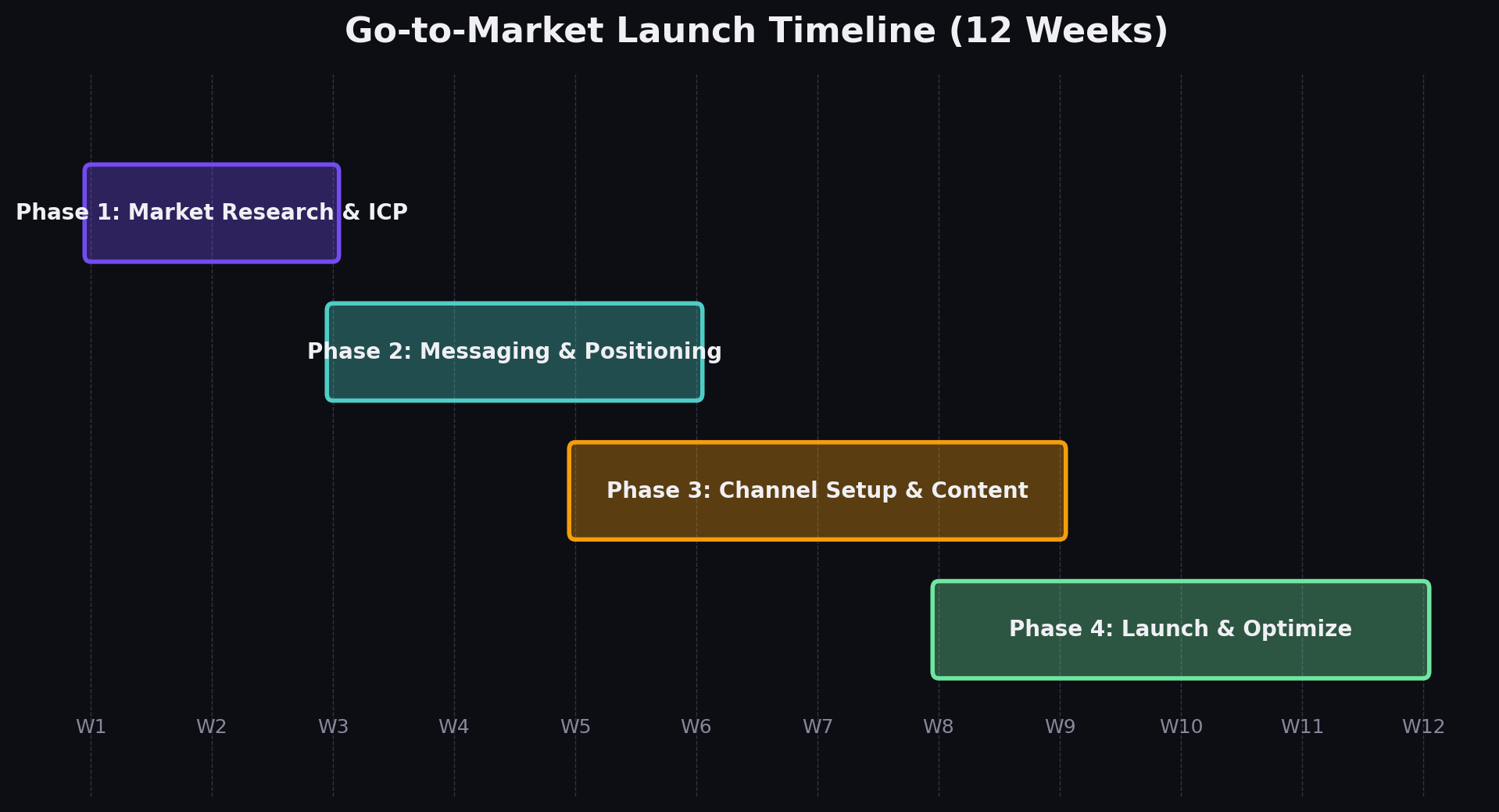
Phase 2: Launch (Weeks 9-12)
Week 9-10: Soft Launch
- Begin outbound to 50-100 target accounts (learning mode, not revenue mode)
- Publish first batch of content
- Launch paid search on 10-15 high-intent keywords with $3-5K budget
- Activate free trial or freemium (if PLG)
- Track everything: response rates, conversion rates, objections, feedback
Week 11-12: Iterate and Scale
- Analyze first two weeks of data
- Adjust messaging based on sales call feedback
- Optimize email sequences based on reply rates
- Adjust paid spend toward highest-converting keywords
- Refine ICP based on early pipeline data (who is converting vs. who is not)
Phase 3: Scale (Months 4-6)
- Hire additional SDRs if outbound is working
- Scale paid media budget on proven channels
- Add third channel once first two are predictable
- Implement ABM for top 50-100 target accounts (if enterprise)
- Build partnership pipeline (integrations, co-marketing)
- Publish case studies from first batch of customers
- Run first quarterly GTM review (win rates, conversion rates, CAC, payback)
Part 8: GTM Metrics - What to Measure and When
Month 1-3: Activity Metrics (Are We Executing?)
| Metric | Target | Why |
|---|---|---|
| Outbound emails sent per SDR per day | 50-80 | Ensures sufficient volume |
| Meetings booked per SDR per month | 8-15 | Validates messaging and targeting |
| Website traffic growth | 10-20% month-over-month | Content and SEO traction |
| Free trial signups (PLG) | Depends on traffic | Validates acquisition flow |
| Paid media CPC and CTR | CPC under $15, CTR above 1% | Validates ad targeting and creative |
Month 4-6: Efficiency Metrics (Is It Working?)
| Metric | Target | Why |
|---|---|---|
| MQL-to-SQL conversion rate | 13-15%+ | Validates lead quality |
| SQL-to-Opportunity conversion rate | 60-70%+ | Validates qualification process |
| Free-to-paid conversion rate (PLG) | 5-15% (trial), 2-5% (freemium) | Validates product value and onboarding |
| Average sales cycle length | Consistent with ACV benchmarks | Validates sales motion |
| CAC (customer acquisition cost) | Recoverable within 12-18 months | Validates unit economics |
Month 7-12: Outcome Metrics (Is It Sustainable?)
| Metric | Target | Why |
|---|---|---|
| CAC payback period | Under 18 months | Unit economics must work |
| Net revenue retention | 100%+ (ideally 110-130%) | Expansion must offset churn |
| Win rate | 20-30% | Competitive health |
| Pipeline coverage | 3-4x quota | Predictability |
| Marketing-sourced pipeline % | 40-60% for inbound-heavy, 20-40% for outbound-heavy | Channel health |
The One Metric That Matters Most
At every stage, there is one metric that tells you whether your GTM is working:
- Pre-PMF: Retention (are customers staying?)
- Post-PMF, pre-$1M ARR: Conversion rate (are leads becoming customers?)
- $1M-$5M ARR: CAC payback (can you acquire customers profitably?)
- $5M-$20M ARR: Net revenue retention (are existing customers growing?)
- $20M+ ARR: Efficiency ratio (revenue growth rate / burn rate)
If the one metric is healthy, you can tolerate weakness elsewhere. If the one metric is broken, nothing else matters until you fix it.
What Does Not Work: GTM Anti-Patterns
The “Spray and Pray” Launch
Trying to launch on every channel simultaneously: outbound, inbound, paid, events, partnerships, product-led, and ABM. All at once. With a team of three. The result is poor execution on every channel because nobody has the bandwidth to do any channel well. Pick two. Master them. Expand later.
The “We Need More Leads” Reflex
Pipeline is short, so leadership demands more MQLs. Marketing loosens targeting and scoring to hit the number. Sales gets flooded with garbage leads. Win rate drops. Pipeline is still short. The solution is usually not more leads. It is better leads, faster follow-up, or stronger middle-of-funnel content that converts existing leads.
The Premature Hire
Hiring a VP of Marketing or VP of Sales before you have validated your ICP, messaging, and initial channel. A VP-level hire is an operator, not an explorer. They are good at scaling what works. They are not designed to figure out what works from scratch. Founders should run the first 20-50 sales conversations personally before hiring someone to scale the motion.
The Channel-Product Mismatch
Running enterprise ABM campaigns for a $5K ACV product. Building a PLG motion for a product that requires a 6-week implementation. The channel must match the product’s price point, complexity, and buyer persona. If it does not, no amount of optimization will fix the fundamental mismatch.
The Copy-the-Leader Trap
“Slack does PLG, so we should do PLG.” “Gong does outbound, so we should do outbound.” What works for a $500M company with a known brand and a 200-person sales team will not work for a $2M company with three people. Build your GTM based on your own product, price, buyer, and resources. Not someone else’s.
Skipping the Feedback Loop
Launching and not adjusting. The first version of every GTM strategy is wrong in some way. The company that wins is the one that gathers feedback fastest and iterates. Build a weekly review rhythm from day one: What did we learn this week? What do we need to change?
The GTM Strategy Document: What to Include
Your GTM strategy should be a living document that the entire company references. Here is the structure:
Page 1: Executive Summary
- One paragraph: who we sell to, what we sell, how we sell it
- Target revenue for the next 12 months
- Primary and secondary channels
- Key hires needed
Page 2: Market and ICP
- Market sizing (TAM, SAM, SOM)
- ICP definition (all four layers)
- Anti-ICP
- Top 50 target accounts (if SLG)
Page 3: Positioning and Messaging
- Positioning statement
- Three value propositions with proof points
- Competitive landscape and battlecard summaries
Page 4: Pricing and Packaging
- Pricing model and tiers
- Pricing rationale (competitive context, willingness-to-pay data)
- Packaging decisions (what is in each tier, what are add-ons)
Page 5: Channel Strategy
- Primary and secondary channels with budgets
- Channel-specific KPIs and targets
- 90-day channel playbooks
Page 6: Team and Timeline
- Current team and roles
- Hiring plan with timing
- 12-month launch timeline with milestones
Page 7: Metrics and Review Cadence
- Key metrics by phase
- Weekly, monthly, and quarterly review structure
- Decision triggers (what metrics would cause a pivot)
This document should be updated monthly for the first six months and quarterly after that. If it is gathering dust in a Google Drive folder, it is not a strategy. It is a report nobody reads.
GTM Is an Operating System, Not a Document
The difference between SaaS companies that scale and SaaS companies that stall is not the quality of their strategy document. It is the rigor of their execution and their willingness to adapt based on data.
Every SaaS company has roughly the same playbook options. The winners execute two or three of them exceptionally well. The losers try to execute all of them mediocrely.
Pick your ICP. Pick your motion. Pick your channels. Commit for 90 days. Measure relentlessly. Adjust based on what you learn. Repeat.
That is the entire GTM strategy, reduced to six sentences. Everything else in this guide is implementation detail. Important detail, but detail nonetheless.
The strategy is the easy part. The execution is the hard part. And the discipline to keep executing the same strategy for 12 months instead of pivoting every quarter is the hardest part of all.
Further Reading
- B2B SaaS Lead Generation: The Channel-by-Channel Playbook - Detailed playbooks for every channel mentioned in Part 4.
- B2B SaaS Sales Funnel: Stages and Benchmarks - How to build the funnel your GTM strategy feeds into.
- B2B SaaS Marketing Metrics - The KPIs to track once your GTM is running.
- BDR vs SDR - How to structure the sales development team for your GTM motion.
- PipelineRoad Agency Services - How we help SaaS companies build and execute GTM strategies.
Frequently Asked Questions
What is a GTM strategy for B2B SaaS?
A GTM (go-to-market) strategy is the plan for how a B2B SaaS company will reach its target customers and achieve competitive advantage. It covers five core decisions: who to sell to (ICP), what to charge (pricing and packaging), how to reach them (channels), what to say (messaging and positioning), and how to convert them (sales motion). A GTM strategy is not a marketing plan - it is a cross-functional blueprint that aligns product, marketing, sales, and customer success.
What is the difference between product-led and sales-led growth?
Product-led growth (PLG) uses the product itself as the primary acquisition and conversion engine - think free trials, freemium tiers, and self-serve onboarding. Sales-led growth (SLG) uses human sales reps as the primary conversion engine - think demos, proposals, and negotiation. PLG works best for products under $10K ACV with simple onboarding. SLG works best for products over $25K ACV with complex implementation. Most successful SaaS companies in 2026 use a hybrid approach.
How long does it take to build a SaaS GTM strategy?
A rigorous GTM strategy takes 4-8 weeks to build from scratch. Week 1-2 covers market sizing and ICP research. Week 3-4 covers positioning, messaging, and pricing. Week 5-6 covers channel strategy and sales motion design. Week 7-8 covers operational setup and launch planning. Rushing this process leads to a strategy built on assumptions instead of data, which means expensive pivots three months later.
How do you size a SaaS market?
Use bottom-up market sizing, not top-down. Instead of starting with a TAM number from an analyst report, count the actual companies that match your ICP, multiply by your expected ACV, and apply a realistic penetration rate. A bottom-up SAM of $50M that you can defend is more useful than a top-down TAM of $10B that means nothing. Board-level market sizing should show TAM, SAM, and SOM with clear assumptions for each.
What channels work best for B2B SaaS go-to-market?
The best channels depend on your ACV and buyer persona. For products under $10K ACV: content marketing, SEO, product-led growth, and paid search. For $10K-$50K ACV: outbound sales, content marketing, LinkedIn ads, and partnerships. For $50K+ ACV: account-based marketing, outbound sales, events, and executive referrals. The mistake most companies make is trying to use all channels simultaneously instead of mastering one or two before expanding.
When should a SaaS company launch its GTM motion?
Launch your GTM motion only after you have validated product-market fit with at least 10-20 paying customers who were not personal connections. Launching GTM before PMF means you are scaling a product that has not been validated, which burns cash on acquiring customers who churn. The exception is a small-scale 'learning GTM' motion (cold outreach to 50-100 targets) used specifically to test messaging and gather feedback, not to drive revenue.
Ready to build your SaaS marketing machine?
We've run these plays at 40+ B2B SaaS companies. Let's talk about yours.
Book a Strategy Call