B2B SaaS Sales Funnel: Stages, Benchmarks, and the Handoff That Breaks Everything
The complete B2B SaaS sales funnel guide - stages, conversion benchmarks, MQL vs SQL definitions, handoff process, tool stack, and how to fix the leaks killing your pipeline.
Most B2B SaaS companies do not have a sales funnel. They have a series of disconnected spreadsheets, a CRM nobody trusts, and a marketing team that calls everything an MQL because the VP of Sales yelled about pipeline in the last all-hands.
The result is predictable. Marketing celebrates hitting their MQL target. Sales ignores 60% of those MQLs because they are garbage. Revenue misses the quarter. The CEO schedules a “marketing and sales alignment workshop” where everyone agrees to communicate better, and nothing changes.
This is not a communication problem. It is an architecture problem.
Your funnel needs clear stage definitions, agreed-upon entry and exit criteria, conversion benchmarks you actually track, and a handoff process with teeth. Not a slide deck with circles and arrows. An operating system.
This guide covers every stage of the B2B SaaS sales funnel, the conversion benchmarks you should measure against, the exact definitions for MQL and SQL that prevent the marketing-sales blame game, the handoff process that actually works, and the tool stack for each stage. If you are building a B2B SaaS marketing agency partnership or running marketing in-house, getting these definitions right is foundational. It also covers the five most common funnel leaks and how to fix them - because your funnel has at least three of them right now.
Why Most SaaS Funnels Are Broken Before They Start
Before we get into stages and benchmarks, we need to address the root cause of funnel dysfunction: misaligned incentives.
Marketing is incentivized on MQLs. Sales is incentivized on closed revenue. Nobody is incentivized on the handoff quality in between.
This creates a predictable failure pattern:
- Marketing loosens MQL criteria to hit their number
- Sales gets flooded with low-quality leads
- Sales stops following up on MQLs
- Marketing says sales is lazy
- Sales says marketing sends garbage
- Revenue suffers
- Leadership adds more top-of-funnel budget
- Repeat
The fix is structural. You need shared definitions, shared metrics, and a Service Level Agreement (SLA) between marketing and sales that has actual consequences. More on this later. First, the stages.
The Six Stages of a B2B SaaS Sales Funnel
Every company names their stages differently. Some use seven stages. Some use four. The names do not matter. What matters is that every person in your organization can answer two questions about each stage: “What criteria must a contact meet to enter this stage?” and “What criteria must they meet to exit?”
If you cannot answer those questions for every stage in your funnel, you do not have a funnel. You have a vibes-based pipeline.
Here is the framework that works for B2B SaaS companies from $1M to $50M ARR:
Stage 1: Visitor (Anonymous)
Owner: Marketing Entry criteria: Visits your website, interacts with any digital property Exit criteria: Provides an email address or identifiable contact information
This is the widest part of your funnel and the one most companies pay the least attention to. A visitor is anonymous. You know nothing about them except their behavior - pages viewed, time on site, referral source.
Most SaaS companies treat visitors as a homogeneous blob. They are not. A visitor who lands on your pricing page from a Google search for “[your category] pricing” is fundamentally different from someone who read a blog post and bounced.
What to track at this stage:
- Total unique visitors (vanity, but directionally useful)
- Traffic by source (organic, paid, direct, referral, social)
- Pricing page views as a percentage of total traffic
- High-intent page views (pricing, demo, case studies, comparisons)
- Visitor-to-subscriber conversion rate
Benchmark: 1-3% of visitors should convert to subscribers (known contacts). If you are below 1%, your CTAs are weak, your content is not relevant to your ICP, or your forms are creating too much friction. If you are above 5%, you might be attracting the wrong audience or your definition of “visitor” is too narrow.
Tool stack: Google Analytics 4, Clearbit Reveal (for de-anonymizing company-level data), heatmap tools (Hotjar, FullStory, or Microsoft Clarity).
Stage 2: Subscriber (Known Contact)
Owner: Marketing Entry criteria: Provides email address through any channel - newsletter signup, content download, webinar registration, event attendance, product signup Exit criteria: Matches ICP criteria (firmographic fit)
A subscriber is a known contact. You have their email. That is it. You do not know if they are a decision-maker at a target account or an intern at a company that will never buy your product.
This is the stage where most funnels start leaking. Companies treat every email address the same. They dump everyone into the same nurture sequence - the SDR intern who downloaded a report to write a college paper and the VP of Sales at a $20M ARR company who is actively evaluating solutions.
What to do at this stage:
Enrich. The moment someone gives you their email, enrich their profile with firmographic and technographic data. Tools like Clearbit, ZoomInfo, Apollo, or Clay can tell you their company size, industry, role, tech stack, and funding stage within seconds. This enrichment data determines whether they are a Lead (ICP fit) or a subscriber who will never convert.
What to track:
- Total subscribers
- Subscriber-to-Lead conversion rate
- Enrichment match rate (percentage of subscribers that return valid firmographic data)
- Email engagement rate (opens, clicks)
Benchmark: 20-40% of subscribers should match your ICP and progress to Lead status. If less than 20% match, your content and acquisition channels are attracting the wrong audience. If more than 50% match, you are likely under-investing in top-of-funnel and only reaching people who already know you.
Tool stack: HubSpot or Marketo (marketing automation), Clearbit or ZoomInfo (enrichment), your CRM.
Stage 3: Lead (ICP-Fit Contact)
Owner: Marketing Entry criteria: Subscriber matches ICP firmographic criteria - right company size, industry, role, and geography Exit criteria: Reaches lead scoring threshold based on engagement + fit
A Lead is a subscriber who fits your ICP. They work at the right kind of company, in the right kind of role. They might buy your product. They have not shown buying intent yet - they are just the right type of person.
This distinction matters enormously. A Lead is someone who could buy. An MQL is someone who is showing signs that they might buy soon.
The ICP criteria that define a Lead:
- Company size (employee count or revenue range)
- Industry or vertical
- Job title or role
- Geography (if relevant)
- Tech stack (if relevant - do they use tools you integrate with?)
- Funding stage (for venture-backed SaaS)
Be specific. “Companies with 50-500 employees in B2B SaaS” is better than “mid-market technology companies.” The more specific your ICP definition, the higher your downstream conversion rates.
What to do at this stage:
Nurture with persona-specific content. A VP of Sales cares about pipeline coverage and rep productivity. A VP of Marketing cares about attribution and demand gen. A CFO cares about ROI and payback period. Send them different content.
What to track:
- Total Leads
- Lead-to-MQL conversion rate
- Average time in Lead stage
- Content engagement by persona
Benchmark: 15-25% of Leads should convert to MQLs within 90 days. If the rate is lower, your nurture content is not driving engagement, or your ICP definition is too broad. If it is higher, your ICP might be too narrow and you are missing addressable market.
Tool stack: Marketing automation (HubSpot, Marketo), CRM, content management, personalization tools.
Stage 4: Marketing Qualified Lead (MQL)
Owner: Marketing (creation), SDR/BDR (follow-up) Entry criteria: Lead exceeds scoring threshold based on fit + engagement signals Exit criteria: SDR confirms the lead is worth pursuing and schedules a meeting with an Account Executive
This is the stage that causes the most arguments in B2B SaaS. The MQL.
An MQL is not someone who downloaded a whitepaper. It is not someone who attended a webinar. It is not someone who matches your ICP. An MQL is a lead who has demonstrated sufficient fit AND engagement to warrant direct sales outreach.
The key word is “sufficient.” And the definition of sufficient must be agreed upon by both marketing and sales before a single lead is passed.
Building a lead scoring model that does not suck:
Most lead scoring models are broken because they over-weight engagement signals and under-weight fit signals. Someone who downloads five ebooks but works at a 3-person startup is not an MQL. Someone who visits your pricing page once but is the VP of Revenue at a $30M ARR company in your target vertical might be.
Here is a scoring framework that works:
| Signal Category | Signal | Points |
|---|---|---|
| Fit - Role | C-suite / VP | +30 |
| Fit - Role | Director / Manager | +20 |
| Fit - Role | Individual contributor | +5 |
| Fit - Company Size | Sweet spot (e.g., 50-500 employees) | +25 |
| Fit - Company Size | Adjacent (e.g., 20-49 or 501-1000) | +10 |
| Fit - Industry | Target vertical | +20 |
| Fit - Industry | Adjacent vertical | +10 |
| Engagement | Pricing page view | +25 |
| Engagement | Demo request | +50 (auto-MQL) |
| Engagement | Case study download | +15 |
| Engagement | Webinar attendance (live) | +15 |
| Engagement | Blog post view | +2 |
| Engagement | Email open | +1 |
| Engagement | Email click | +3 |
| Negative | Competitor company | -50 |
| Negative | Student email domain | -100 |
| Negative | Unsubscribed from emails | -30 |
| Negative | No engagement in 90 days | -20 |
MQL threshold: 75 points (adjust based on your volume and conversion data).
Notice that fit signals carry heavy weight. A perfect-fit contact who visits your pricing page once (30 + 25 + 20 + 25 = 100 points) becomes an MQL faster than an individual contributor at a small company who downloads everything you publish (5 + 10 + 10 + 15 + 15 + 15 = 70 points - not an MQL).
What to track:
- Total MQLs generated
- MQL-to-SQL conversion rate (the single most important metric in your funnel)
- Average lead score at conversion
- SDR follow-up time (time from MQL creation to first outreach)
- MQL rejection rate and rejection reasons
Benchmark: Your MQL-to-SQL conversion rate should be 13-15% at minimum. Top-performing SaaS companies hit 25-35%. If you are below 10%, your MQL definition is too loose. If you are above 40%, you are being too conservative and leaving pipeline on the table.
Tool stack: CRM with lead scoring (HubSpot, Salesforce + Pardot/Marketo), enrichment tools, SDR notification system (Slack alerts work fine).
Stage 5: Sales Qualified Lead (SQL)
Owner: Sales (AE) Entry criteria: SDR has conducted a qualification call and confirmed the lead has BANT (Budget, Authority, Need, Timeline) or equivalent criteria Exit criteria: AE creates a formal Opportunity with a projected close date and deal value
An SQL is an MQL that has been verified by a human being. An SDR has talked to this person, confirmed they have a real problem, and determined that an Account Executive conversation is worth everyone’s time.
This is where the algorithm meets reality. Your lead scoring model said this person was ready. The SDR confirms (or rejects) that assessment.
Qualification frameworks that work:
BANT (Budget, Authority, Need, Timeline) - The classic. Works for transactional sales cycles. Less effective for enterprise where budget is created, not allocated.
MEDDIC (Metrics, Economic Buyer, Decision Criteria, Decision Process, Identify Pain, Champion) - Better for enterprise SaaS. Forces reps to understand the buying process, not just the buyer.
SPICED (Situation, Pain, Impact, Critical Event, Decision) - A newer framework that focuses on the buyer’s journey rather than the seller’s qualification checklist.
Pick one. Train your SDRs on it. Make them log the qualification data in your CRM. If an SDR cannot articulate why this SQL is worth an AE’s time using the framework, it is not an SQL.
The SQL acceptance rate problem:
If your AEs are rejecting more than 20% of SQLs passed to them, you have a qualification gap. Either your SDRs are not asking the right questions, your qualification criteria are unclear, or there is a misalignment between what marketing considers qualified and what sales considers qualified.
Track the rejection reasons. The data will tell you exactly what to fix.
What to track:
- Total SQLs
- SQL-to-Opportunity conversion rate
- SQL rejection rate by AE
- Average days from MQL to SQL
- Qualification framework completion rate
Benchmark: 60-70% of SQLs should convert to Opportunities. If below 50%, your SDR qualification is weak. If above 85%, your SDRs might be cherry-picking only the easiest leads and ignoring borderline opportunities that could close.
Tool stack: CRM (Salesforce or HubSpot Sales Hub), sales engagement (Outreach, Salesloft, or Apollo), call recording (Gong, Chorus, or Fireflies), scheduling (Calendly or Chili Piper).
Stage 6: Opportunity (Active Deal)
Owner: Sales (AE) Entry criteria: AE creates an Opportunity record with projected close date, deal value, and assigned deal stage Exit criteria: Closed Won or Closed Lost
An Opportunity is a real deal. There is a projected dollar amount. There is an expected close date. There is a buying process underway.
Opportunity management is beyond the scope of a funnel guide, but here are the sub-stages most B2B SaaS companies use:
| Sub-Stage | Description | Probability |
|---|---|---|
| Discovery | Understanding needs, mapping stakeholders | 10% |
| Demo/Evaluation | Product demonstration, technical validation | 20% |
| Proposal | Pricing and terms presented | 40% |
| Negotiation | Terms being finalized, legal review | 60% |
| Verbal Commit | Verbal agreement, awaiting signature | 80% |
| Closed Won | Contract signed | 100% |
| Closed Lost | Deal did not close | 0% |
What to track:
- Total pipeline value
- Pipeline coverage ratio (pipeline / quota - should be 3-4x)
- Average deal size
- Win rate (Closed Won / total Opportunities)
- Average sales cycle length
- Stage-to-stage conversion rates
- Closed Lost reasons
Benchmark: Overall win rates for B2B SaaS typically range from 15-30% depending on deal size and competition. Enterprise deals (>$50K ACV) tend toward the lower end. SMB deals (<$10K ACV) tend toward the higher end.
Tool stack: CRM (Salesforce or HubSpot), deal intelligence (Gong, Clari, or Aviso), proposal software (PandaDoc, Proposify), contract management (DocuSign, Ironclad).
The Complete Funnel Benchmark Table
Here are the conversion benchmarks you should measure against, based on aggregated data from SaaS companies between $1M and $50M ARR:
| Stage Transition | Median | Top Quartile | Bottom Quartile |
|---|---|---|---|
| Visitor to Subscriber | 2.1% | 3.5% | 0.8% |
| Subscriber to Lead | 30% | 45% | 15% |
| Lead to MQL | 18% | 28% | 8% |
| MQL to SQL | 14% | 30% | 6% |
| SQL to Opportunity | 65% | 80% | 45% |
| Opportunity to Closed Won | 22% | 32% | 12% |
| Overall: Visitor to Closed Won | 0.011% | 0.034% | 0.003% |
These benchmarks will vary by your ACV, sales motion (self-serve vs. sales-assisted vs. enterprise), and industry vertical. Use them as a starting point, not as gospel.
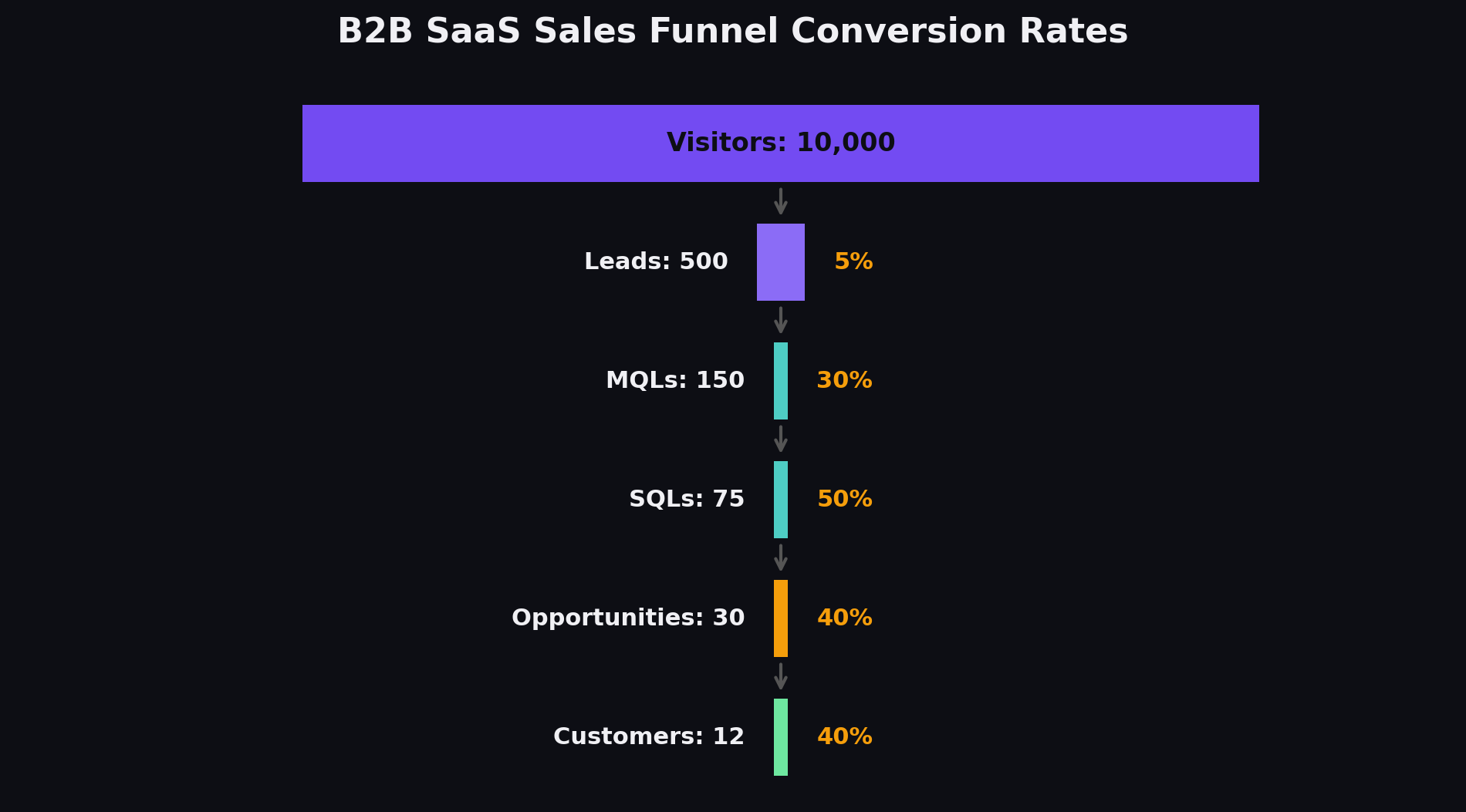
The most important thing is not where you fall relative to benchmarks. It is identifying which transition has the biggest gap between your performance and the benchmark - because that is where your funnel is leaking the most pipeline.
The Marketing-to-Sales Handoff: Where Pipelines Go to Die
The MQL-to-SQL handoff is the most fragile point in your entire revenue operation. It is where two teams with different incentives, different tools, different vocabularies, and often different interpretations of “qualified” must execute a precise transfer of context.
Most companies handle this handoff with a Slack message. “Hey, got a hot one for you.” That is not a handoff. That is a prayer.
Here is the handoff process that works:
Step 1: Automated Routing and Notification
When a lead hits MQL threshold, three things should happen automatically:
- CRM status update - The lead’s lifecycle stage changes to MQL in your CRM
- SDR assignment - Round-robin or territory-based routing assigns the MQL to a specific SDR
- Real-time notification - The assigned SDR gets a Slack alert with the lead’s name, company, lead score, and the specific actions that triggered MQL status
The notification should include context, not just a name. “Sarah Chen at Acme Corp (VP Revenue Ops, 200 employees, Series B) hit MQL. Score: 92. Recent activity: visited pricing page 3x this week, downloaded the ROI calculator, opened last 4 emails.” That gives the SDR everything they need to craft a relevant first touch.
Step 2: The SLA
Marketing and sales need a written Service Level Agreement. This is not optional. This is the single document that prevents the blame game.
Marketing commits to:
- Deliver X MQLs per month meeting the agreed-upon scoring criteria
- Provide enriched contact data (title, company, phone when available)
- Flag high-priority MQLs (demo requests, pricing inquiries) separately
Sales commits to:
- First outreach within defined timeframes:
- Demo requests: within 5 minutes during business hours
- High-score MQLs: within 1 hour
- Standard MQLs: within 4 hours
- Minimum 5 touch attempts before disqualifying an MQL
- Log disposition in CRM with a specific reason for every MQL (accepted, rejected with reason, no contact after 5 attempts)
- Provide weekly feedback on MQL quality
Both teams commit to:
- Monthly review of MQL-to-SQL conversion rates
- Quarterly recalibration of lead scoring model based on closed-won data
Step 3: Feedback Loop
The handoff is not a one-way transfer. It is a loop. Sales must provide structured feedback on MQL quality, and marketing must use that feedback to adjust scoring and targeting.
Track three metrics to monitor handoff health:
-
SDR follow-up time - How quickly are SDRs reaching out to new MQLs? Research from InsideSales.com (now XANT) shows that responding within 5 minutes makes you 21x more likely to qualify the lead than responding after 30 minutes.
-
MQL acceptance rate - What percentage of MQLs does sales accept? This should be above 80%. Below 70% means your MQL definition needs tightening.
-
MQL rejection reasons - Categorize every rejection: wrong persona, wrong company size, no budget, not decision-maker, bad contact info, already a customer, competitor. The distribution of rejection reasons tells you exactly what to fix.
Tool Stack by Funnel Stage
You do not need 47 tools. Most SaaS companies between $1M and $10M ARR can run their entire funnel on four to six tools. Here is what you actually need at each stage:
The Minimum Viable Stack (Under $5M ARR)
| Function | Tool | Annual Cost |
|---|---|---|
| CRM + Marketing Automation | HubSpot Professional | $10,800/yr |
| Enrichment | Apollo.io or Clay | $3,600-6,000/yr |
| Sales Engagement | Built into HubSpot or Apollo | $0-2,400/yr |
| Analytics | Google Analytics 4 | Free |
| Call Recording | Fireflies.ai or Otter.ai | $1,200/yr |
| Scheduling | Calendly | $600/yr |
| Total | $16,200-21,000/yr |
The Growth Stack ($5M-$20M ARR)
| Function | Tool | Annual Cost |
|---|---|---|
| CRM | Salesforce or HubSpot Enterprise | $18,000-36,000/yr |
| Marketing Automation | HubSpot, Marketo, or Pardot | $12,000-24,000/yr |
| Enrichment + Intent | ZoomInfo or 6sense | $24,000-60,000/yr |
| Sales Engagement | Outreach or Salesloft | $12,000-24,000/yr |
| Conversation Intelligence | Gong or Chorus | $12,000-24,000/yr |
| Analytics + BI | Looker, Metabase, or Tableau | $6,000-18,000/yr |
| ABM Platform | Demandbase or Terminus | $24,000-48,000/yr |
| Total | $108,000-234,000/yr |
The jump from minimum viable to growth stack is steep. Do not make it until your sales team has more than five AEs and your marketing team is generating enough volume to justify the tooling investment.
What Not to Buy
Intent data platforms before $5M ARR. The data is useful but expensive, and you do not have enough pipeline volume to act on the signals effectively. Use free intent signals first - G2 buyer intent alerts, LinkedIn engagement, pricing page visits.
ABM platforms before you have a working outbound motion. Demandbase and Terminus are powerful but they amplify what already works. If your outbound sequences are broken, an ABM platform will amplify broken outbound at scale.
AI SDR tools as a replacement for humans. Tools like Regie.ai, Conversica, and others can supplement your SDR team but should not replace them. The conversion rates on fully automated outreach are 30-50% lower than human-crafted outreach for deals above $10K ACV.
The Five Most Common Funnel Leaks (and How to Fix Them)
Every funnel leaks. The question is where and how badly. Here are the five leaks we see most often in B2B SaaS, ranked by revenue impact:
Leak 1: Slow MQL Follow-Up (Revenue Impact: High)
The problem: SDRs take 24-48 hours to follow up on MQLs. By then, the lead has moved on, talked to a competitor, or lost the urgency that triggered their engagement.
The data: Research from InsideSales.com (now XANT) shows that responding within 5 minutes makes you dramatically more likely to connect with and qualify a lead than waiting even 30 minutes. Industry data consistently shows that 35-50% of deals go to the vendor that responds first.
The fix:
- Automated Slack notifications the instant a lead hits MQL
- Auto-schedule a meeting using Chili Piper or Calendly routing (zero SDR involvement for demo requests)
- SLA with consequences - if an SDR misses the follow-up window, the MQL gets reassigned
- Track median response time on a dashboard visible to the whole team
Leak 2: Loose MQL Definition (Revenue Impact: High)
The problem: Marketing defines MQLs too broadly to hit their number. Content downloads, webinar registrations, and newsletter signups get counted as MQLs. Sales gets buried in low-quality leads and stops trusting the funnel.
The fix:
- Require both fit AND engagement criteria for MQL status
- Weight high-intent actions (pricing page, demo request, ROI calculator) heavily
- Weight low-intent actions (blog view, email open) minimally
- Review the lead scores of Closed Won deals retroactively - what did their journey look like? Calibrate your scoring model to match
- Set a minimum fit score as a hard gate - no matter how engaged someone is, if they do not meet ICP fit criteria, they cannot become an MQL
Leak 3: No Stage-Exit Criteria (Revenue Impact: Medium)
The problem: Leads sit in stages forever. An MQL from six months ago is still labeled “MQL” in your CRM. Your pipeline report says you have 500 MQLs but 400 of them are stale.
The fix:
- Set maximum time limits for each stage (e.g., MQL status expires after 14 days without SDR contact, SQL expires after 30 days without AE activity)
- Auto-recycle leads that exceed time limits back to the appropriate nurture stage
- Build a “recycled leads” workflow that re-engages these contacts with new content before re-qualifying them
- Never manually extend stage deadlines just to keep pipeline numbers looking healthy
Leak 4: Missing Middle-of-Funnel Content (Revenue Impact: Medium)
The problem: Your content strategy has blog posts (top-of-funnel) and a demo page (bottom-of-funnel) with nothing in between. Leads enter the funnel but have no content that moves them toward a buying decision.
The fix:
- Create comparison pages (you vs. competitors, you vs. the status quo)
- Build ROI calculators and assessment tools
- Publish case studies organized by industry, company size, and use case
- Develop buyer’s guides that help prospects evaluate solutions (including yours)
- Map every piece of content to a funnel stage and identify the gaps
Leak 5: No Closed-Lost Analysis (Revenue Impact: Long-Term)
The problem: When a deal is lost, the AE marks it Closed Lost, selects a generic reason (“budget” or “timing”), and moves on. Nobody analyzes the patterns. The same mistakes repeat quarter after quarter.
The fix:
- Require detailed Closed Lost notes with specific competitor, specific objection, and specific point of failure
- Review Closed Lost deals monthly as a team - look for patterns
- Build a win/loss analysis by competitor, deal size, industry, and sales cycle length
- Use the data to adjust messaging, pricing, and product roadmap
- Re-engage Closed Lost deals 90 days later with new content or product updates - 15-20% will re-enter the pipeline
What Does Not Work: Funnel Anti-Patterns
Knowing what to build is half the battle. Knowing what to avoid is the other half.
Overcomplicating stages. If you have more than seven funnel stages, you are adding friction. Every additional stage is another point where a lead can stall. Start with the six stages outlined above. You can split stages later when you have the data to justify it.
Letting marketing define MQLs without sales input. An MQL definition created in a marketing silo is worth nothing. Sales must agree to the criteria. If they did not help build the definition, they will not respect it.
Scoring based on content consumption alone. A blog reader who visits 50 pages but works at a company with 3 employees is not an MQL. Fit must carry at least 40% of the total score weight.
Treating all MQLs equally. A demo request is not the same as a whitepaper download, even if both score above the MQL threshold. Create separate routing for high-intent MQLs (demo requests, pricing inquiries) with faster SLAs and direct AE routing if appropriate.
Building the funnel in a spreadsheet instead of your CRM. If your funnel stages do not live in your CRM with automated stage transitions, lifecycle tracking, and reporting, you do not have a funnel. You have a conceptual framework. These are different things.
Ignoring negative scoring. If your model only adds points, a competitor employee who reads every blog post will eventually become an MQL. Add negative signals: competitor domains, student emails, unsubscribes, geographic exclusions, wrong company size.
Never recalibrating. Your lead scoring model should be reviewed quarterly. Pull the lead scores of every Closed Won deal from the past quarter. Pull the scores of every Closed Lost deal. If your scoring model is working, Closed Won leads should have consistently higher scores than Closed Lost leads at the point of MQL creation. If the scores overlap significantly, your model is not predictive and needs adjustment.
Setting Up Your Funnel: The Implementation Checklist
If you are building or rebuilding your B2B SaaS funnel, here is the order of operations:
Week 1: Define
- Document your ICP with specific firmographic criteria
- Define each funnel stage with entry and exit criteria
- Build your lead scoring model (start simple, iterate)
- Draft the marketing-sales SLA
- Get sign-off from marketing leadership, sales leadership, and the CEO
Week 2: Build
- Configure lifecycle stages in your CRM
- Set up lead scoring rules
- Build automated stage transitions
- Create notification workflows for MQL handoffs
- Set up round-robin or territory-based lead routing
Week 3: Populate
- Enrich existing contacts with firmographic data
- Score and re-stage your existing database
- Identify and recycle stale leads
- Build reporting dashboards for each stage transition
Week 4: Launch and Monitor
- Turn on automated workflows
- Brief the entire sales and marketing team
- Monitor conversion rates daily for the first two weeks
- Hold a week-one retrospective to identify early issues
- Schedule monthly funnel reviews
Advanced: Multi-Touch Attribution for Funnel Optimization
Once your funnel is running, the next question is: which marketing activities are actually driving pipeline?
Last-touch attribution (crediting the last thing someone did before becoming an MQL) is the default in most CRMs. It is also wildly inaccurate. It gives all the credit to demo request pages and none of the credit to the 14 blog posts, 3 LinkedIn ads, and 2 webinars the prospect engaged with over six months.
Here are the attribution models worth considering:
| Model | How It Works | Best For |
|---|---|---|
| First-touch | 100% credit to the first interaction | Understanding acquisition channels |
| Last-touch | 100% credit to the last interaction before conversion | Understanding conversion triggers |
| Linear | Equal credit to every touchpoint | Balancing the full journey |
| Time-decay | More credit to recent touchpoints | Long sales cycles |
| U-shaped | 40% first touch, 40% lead creation, 20% distributed | B2B SaaS with clear conversion points |
| W-shaped | 30% first, 30% lead creation, 30% opportunity creation, 10% distributed | Enterprise SaaS with multiple conversion points |
For most B2B SaaS companies, a U-shaped or W-shaped model provides the most actionable data. It gives significant credit to the activities that created initial awareness and the activities that triggered conversion, while acknowledging that the touches in between contributed too.
Do not spend six months building a perfect attribution model. Start with first-touch and last-touch reports (your CRM provides these out of the box), identify the biggest discrepancies between the two, and use that to inform budget allocation.
Funnel Math: Working Backward from Revenue
The most practical application of funnel benchmarks is working backward from your revenue target to calculate how many leads, MQLs, SQLs, and opportunities you need.
Here is an example for a SaaS company targeting $3M in new ARR:
| Metric | Value |
|---|---|
| Revenue target | $3,000,000 |
| Average ACV | $24,000 |
| Deals needed | 125 |
| Win rate | 25% |
| Opportunities needed | 500 |
| SQL-to-Opportunity rate | 65% |
| SQLs needed | 769 |
| MQL-to-SQL rate | 15% |
| MQLs needed | 5,128 |
| Lead-to-MQL rate | 20% |
| Leads needed | 25,641 |
| Visitor-to-Lead rate | 2% |
| Visitors needed | 1,282,051 |
Now you know your targets at every stage. If any stage looks unrealistic (1.28M visitors might be ambitious for a Series A company), you know you need to either improve your conversion rates or adjust your revenue target.
This math also shows you where to focus. If improving your MQL-to-SQL rate from 15% to 25% is easier than doubling your traffic (it usually is), that is where your investment should go.
The Funnel Is Not Linear (And That Is Fine)
One last reality check. The B2B SaaS buying journey is not linear. Buyers do not move neatly from Visitor to Subscriber to Lead to MQL to SQL to Opportunity.
They visit your site six times before subscribing. They download a case study, disappear for three months, come back, read a competitor comparison, leave again, see your CEO on a podcast, and then request a demo. The funnel is a useful mental model for organizing your go-to-market operation. It is not a description of how buyers actually behave.
This is why your system needs to handle re-engagement (contacts moving backward in stages), multi-threading (multiple contacts at the same account in different stages), and dark funnel influence (activities you cannot track, like internal Slack conversations where someone recommends your product).
Build the funnel. Staff it. Measure it. Optimize it. But never mistake the map for the territory.
The companies that win do not have the prettiest funnel diagrams. They have the fastest follow-up times, the tightest MQL definitions, the best middle-of-funnel content, and a marketing and sales team that reviews the numbers together every month and adjusts based on what the data says instead of what their assumptions were.
That is the whole game. Everything else is decoration.
Further Reading
- B2B SaaS Marketing Metrics - The KPIs to track at every funnel stage.
- B2B SaaS Lead Generation - How to fill the top of the funnel.
- BDR vs SDR - The roles that staff the MQL-to-SQL handoff.
- B2B SaaS Email Marketing - The sequences that nurture leads through the funnel.
- PipelineRoad Agency Services - How we help SaaS companies build and optimize their sales funnels.
Frequently Asked Questions
What are the stages of a B2B SaaS sales funnel?
A standard B2B SaaS sales funnel has six stages: Visitor (anonymous traffic), Subscriber (known contact), Lead (ICP-fit contact), Marketing Qualified Lead (MQL - meets scoring threshold), Sales Qualified Lead (SQL - confirmed by sales), and Opportunity (active deal in pipeline). Some companies add a Sales Accepted Lead (SAL) stage between MQL and SQL to track handoff acceptance rates separately.
What is a good MQL to SQL conversion rate for SaaS?
The median MQL-to-SQL conversion rate for B2B SaaS is 13-15%. Top-performing companies with tight ICP alignment and strong lead scoring hit 25-35%. If you are below 10%, your MQL definition is too loose or your scoring model needs recalibration. If you are above 40%, you are likely under-qualifying and missing potential pipeline.
How long should a B2B SaaS sales cycle be?
B2B SaaS sales cycles vary dramatically by ACV. SMB deals under $10K ACV average 14-30 days. Mid-market deals ($10K-$50K ACV) average 30-90 days. Enterprise deals ($50K+ ACV) average 90-180 days, with some stretching to 12+ months. If your sales cycle exceeds these benchmarks by more than 50%, you likely have a qualification or demo process problem.
What is the difference between a marketing qualified lead and a sales qualified lead?
An MQL is a lead that meets marketing's scoring threshold based on fit (firmographic data) and engagement (behavioral signals like content downloads, pricing page visits, demo requests). An SQL is a lead that has been vetted by a sales rep through direct conversation and confirmed to have budget, authority, need, and timeline. The critical difference is that MQL is algorithm-driven while SQL is human-verified.
What tools do you need for a B2B SaaS sales funnel?
The core stack includes a CRM (HubSpot or Salesforce), marketing automation (HubSpot, Marketo, or Pardot), sales engagement (Outreach, Salesloft, or Apollo), enrichment (Clearbit, ZoomInfo, or Clay), intent data (Bombora, G2, or 6sense), and analytics (Google Analytics 4 plus a BI tool like Looker or Metabase). Most Series A companies can run effectively on HubSpot Professional plus one enrichment tool.
How do you fix a leaky sales funnel?
First, identify where the leak is by calculating stage-to-stage conversion rates and comparing to benchmarks. Common leaks include low visitor-to-lead conversion (fix with better CTAs and landing pages), low MQL-to-SQL conversion (fix with tighter lead scoring), and low SQL-to-opportunity conversion (fix with better qualification criteria or sales training). The fastest fix is almost always tightening your MQL definition to improve downstream conversion rates.
Ready to build your SaaS marketing machine?
We've run these plays at 40+ B2B SaaS companies. Let's talk about yours.
Book a Strategy Call