B2B SaaS Lead Generation: The Channel-by-Channel Playbook for 2026
Channel-by-channel breakdown of B2B SaaS lead generation with real conversion data, cost per lead benchmarks, and a scaling playbook from seed to Series B+.
Most B2B SaaS companies do not have a lead generation problem. They have a lead quality problem disguised as a volume problem.
They run LinkedIn Ads to a gated ebook, collect 200 email addresses, hand them to sales as “leads,” and then wonder why the close rate is under 2%. They generated 200 names. They generated zero leads.
A lead is someone who has a problem you solve, the budget to pay for a solution, and some level of intent to act. Everything else is a name in a database.
This guide breaks down every major lead generation channel for B2B SaaS - the real conversion data, what it costs, what works at each stage, and how to build a system that scales. This is the playbook we use at PipelineRoad to build lead gen engines for our clients. This is based on building lead gen programs across dozens of SaaS companies, from pre-revenue startups to companies doing $30M+ ARR. Not theory. Not “best practices” from a blog post that cites other blog posts. Actual performance data from actual programs.
The Lead Generation Landscape for B2B SaaS in 2026
The lead generation landscape has shifted more in the past 18 months than in the previous five years. Three forces are reshaping how B2B SaaS companies generate pipeline:
Buyers are more self-educated than ever. Gartner’s 2025 B2B Buying Survey found that buyers spend only 17% of their total purchase journey interacting with sales reps. The rest is independent research - reading content, asking peers, testing products, and comparing options without ever talking to a human. Your lead gen strategy has to meet buyers where they are, not where you wish they were.
Outbound is harder but not dead. Email deliverability standards have tightened (Google and Yahoo’s bulk sender requirements, stricter spam filtering, DMARC enforcement). The spray-and-pray era is over. But well-targeted, well-written outbound still works - it just requires better data, better personalization, and better sequencing than it did two years ago. Our guide on B2B SaaS email marketing covers the infrastructure and deliverability fundamentals.
AI is changing the math. AI tools have made it possible to produce high volumes of content, personalized outbound, and competitive intelligence at a fraction of the previous cost. The companies that use AI to enhance their quality are winning. The ones using AI to increase quantity of mediocre output are filling the internet with noise and wondering why nobody responds.
Channel-by-Channel Breakdown
1. Outbound Email
Outbound email remains the fastest way to generate pipeline for B2B SaaS. Nothing else lets you choose exactly who sees your message, control the timing, and iterate in real time.
How it works in practice:
You build a target account list. You identify the right contacts at those accounts (usually 3-5 personas per account). You write sequences tailored to each persona’s specific pain points. You send. You follow up. You book meetings.
Real conversion benchmarks (2025-2026 data):
| Metric | Bottom Quartile | Median | Top Quartile |
|---|---|---|---|
| Open rate | 25-35% | 45-55% | 60-75% |
| Reply rate | 1-2% | 3-5% | 7-12% |
| Positive reply rate | 0.3-0.8% | 1.5-3% | 4-7% |
| Meeting book rate (from send) | 0.1-0.3% | 0.5-1.5% | 2-4% |
| Cost per meeting | $400-800 | $150-350 | $50-150 |
The gap between bottom and top quartile is enormous. The difference is not budget. It is targeting quality, copy quality, and sequence design.
What separates top-quartile outbound from the rest:
- Targeting precision. Top performers spend 60% of their time on list building and 40% on copywriting. Bad outbound does the inverse. If you are emailing the wrong people, the best copy in the world will not save you.
- Relevant pain points, not product features. “Our platform integrates with Salesforce” is a feature. “Your sales team is updating Salesforce manually because your current tool doesn’t sync bidirectionally, and that’s costing you 5 hours per rep per week” is a pain point. The first gets deleted. The second gets a reply.
- Multi-channel sequencing. Email alone is a single-threaded approach. The best outbound programs layer email with LinkedIn connection requests, LinkedIn comments on the prospect’s posts, and occasionally direct mail for high-value targets.
- Proper infrastructure. Dedicated sending domains (not your primary domain), warmed-up mailboxes, SPF/DKIM/DMARC authentication, and sending volume that stays under 50 emails per day per inbox. Skip any of these and you will end up in spam.
What doesn’t work:
- Sending 500+ emails per day from a single inbox. Your deliverability will crater within weeks.
- Generic templates. “Hi {first_name}, I noticed {company_name} is growing fast…” is the opening line of 90% of cold emails. Prospects can smell a merge tag from the subject line.
- Emailing the wrong persona. If your product is used by marketing teams but you are emailing the CTO, you are wasting everyone’s time.
- Buying “verified” email lists from data vendors without validating them yourself. Bounce rates above 3% will destroy your sender reputation.
PipelineRoad Take: We have run outbound for SaaS companies across a range of ACVs and verticals. The single biggest factor in outbound performance is not copy or tools - it is ICP accuracy. When we rebuild a client’s ICP from scratch using actual closed-won analysis rather than assumptions, reply rates typically increase 2-3x. Most SaaS companies have never done this exercise rigorously. They are emailing a persona they invented in a strategy session two years ago rather than the persona that actually buys.
Cost structure:
| Component | Monthly Cost | Notes |
|---|---|---|
| Prospecting data (Apollo, ZoomInfo, LinkedIn Sales Nav) | $200-2,000 | Apollo covers most SMB/mid-market needs at $99/mo |
| Sending infrastructure (Instantly, Smartlead, Woodpecker) | $100-500 | Multiple inboxes, warm-up, rotation |
| Copywriting and strategy | $2,000-8,000 | In-house or agency |
| SDR/BDR (if in-house) | $5,000-8,000 | Base salary. OTE adds 30-50% |
| Total (outsourced model) | $3,000-10,000 | Without in-house headcount |
| Total (in-house SDR model) | $8,000-18,000 | With one dedicated SDR |
2. SEO and Content Marketing
SEO is the highest-ROI lead generation channel in B2B SaaS - but only if you measure ROI over 12+ months. For a deep dive on building the content engine, see our B2B SaaS content strategy guide. It is a compounding asset. Every blog post, landing page, and resource you publish continues generating leads indefinitely. The content you publish in March is still generating leads in December.
Real conversion benchmarks:
| Metric | Bottom Quartile | Median | Top Quartile |
|---|---|---|---|
| Organic traffic to lead conversion rate | 0.5-1% | 1.5-3% | 4-7% |
| Cost per organic lead (fully loaded) | $200-400 | $80-150 | $30-80 |
| Time to first page ranking (new domain) | 8-14 months | 5-8 months | 3-5 months |
| Time to first page ranking (established domain) | 3-6 months | 2-4 months | 1-3 months |
| Content pieces needed for meaningful traffic | 50-100 | 30-50 | 15-30 (with high DA) |
The content that generates leads vs the content that generates traffic:
These are not the same thing. Top-of-funnel content like “What is [industry term]” generates traffic but low conversion. Bottom-of-funnel content like “Best [product category] for [use case]” and comparison pages generate fewer visitors but much higher conversion rates.
The right mix for lead generation:
| Content Type | % of Content Mix | Traffic Potential | Lead Conversion Rate | Example |
|---|---|---|---|---|
| Bottom-of-funnel (comparison, alternatives) | 20-25% | Low-medium | 5-15% | “Best CRM for startups 2026” |
| Middle-of-funnel (how-to, tactical guides) | 40-50% | Medium-high | 2-5% | “How to build a sales pipeline” |
| Top-of-funnel (educational, awareness) | 20-30% | High | 0.5-2% | “What is revenue operations” |
| Programmatic/tool pages | 5-10% | Medium | 3-8% | “[Tool] ROI calculator” |
What doesn’t work:
- Publishing 800-word posts that rehash the same information available on the first page of Google. If your content does not add original perspective, data, or depth, it will not rank and it will not convert.
- Targeting only high-volume keywords. A keyword with 5,000 monthly searches and KD 70 is a waste of time for a startup. Target keywords with 50-500 monthly searches and KD under 20. The traffic is smaller but the conversion rates are higher because the intent is more specific.
- Ignoring GEO (generative engine optimization). AI search tools are increasingly answering queries directly. Your content needs to be structured as the authoritative source that AI systems cite. This means original data, clear definitions, and structured formatting.
3. LinkedIn (Organic and Paid)
LinkedIn is the single most important platform for B2B SaaS lead generation in 2026. Not because of LinkedIn Ads (though those work). Because of organic LinkedIn - founders and executives posting thought leadership content that builds trust and drives inbound interest.
Organic LinkedIn benchmarks:
| Metric | Average | Strong Performer |
|---|---|---|
| Impressions per post (1K-5K followers) | 1,000-3,000 | 5,000-15,000 |
| Engagement rate | 2-4% | 5-10% |
| Profile views per week (active poster) | 50-150 | 300-1,000 |
| Inbound connection requests per week | 5-15 | 20-50 |
| Inbound demo requests per month (from organic) | 0-2 | 5-15 |
The math on organic LinkedIn is compelling. A SaaS founder posting 3-4x per week, consistently, for 6+ months will generate more qualified pipeline than $10K/month in LinkedIn Ads. The content costs nothing but time. The trust it builds cannot be bought.
LinkedIn Ads benchmarks:
| Metric | Average | Top Quartile |
|---|---|---|
| CPM (cost per 1,000 impressions) | $30-80 | $20-45 |
| CPC (cost per click) | $5-12 | $3-7 |
| CTR (click-through rate) | 0.4-0.7% | 0.8-1.5% |
| Cost per lead (content download) | $50-150 | $30-80 |
| Cost per lead (demo request) | $200-500 | $100-250 |
| Lead-to-opportunity rate | 5-15% | 15-30% |
What works:
- Thought leadership ads running to your ICP for 60-90 days before any conversion campaigns. Build audience familiarity first. Then retarget with demo offers.
- Single-image ads with clear, specific value propositions outperform carousel ads and video ads for lead generation in most B2B contexts.
- Lead Gen Forms (native LinkedIn forms) convert at 2-3x the rate of landing page forms because they auto-fill contact data. The trade-off is lower lead quality. Use lead gen forms for content offers and landing pages for demo requests.
What doesn’t work:
- Running demo-request ads to cold audiences. Nobody clicks “Request a Demo” from a company they have never heard of. The CPL will be $500+ and the lead quality will be poor.
- Boosting posts. LinkedIn’s boost feature optimizes for engagement, not leads. You are paying for likes from people who will never buy.
- Targeting audiences over 300K. LinkedIn’s algorithm works best with tightly defined audiences of 20K-100K. Broader targeting wastes budget on irrelevant impressions.
4. Product-Led Growth (PLG)
Product-led growth turns your product into your primary lead generation engine. Users sign up, experience value, and either convert to paid or bring in colleagues who do.
When PLG works for lead gen:
- ACV under $15K (the product is simple enough for self-serve)
- Time-to-value under 10 minutes (users can experience the core value quickly)
- Natural virality (the product is more useful when shared - Figma, Slack, Notion)
- Large addressable market (enough volume to sustain a self-serve funnel)
When PLG does not work:
- Complex enterprise products that require configuration or integration
- Products where the buyer and user are different people (the VP buys it, the analyst uses it)
- Markets with fewer than 10,000 potential customers (not enough volume for self-serve economics)
PLG conversion benchmarks:
| Metric | Bottom Quartile | Median | Top Quartile |
|---|---|---|---|
| Visitor-to-signup rate | 1-3% | 4-7% | 8-15% |
| Free-to-paid conversion rate | 1-2% | 3-5% | 7-15% |
| Time to paid conversion | 30-90 days | 14-30 days | 3-14 days |
| Expansion rate (net revenue retention) | 95-105% | 110-120% | 125-150% |
Cost per lead in PLG models:
PLG leads are the cheapest leads in SaaS - if you have product-market fit. The marginal cost of a new signup is essentially zero (infrastructure costs aside). The real cost is the product and engineering investment required to build a self-serve experience that actually converts.
Typical fully loaded cost per PLG lead (including product/engineering amortized): $5-30.
5. Referral Programs
Referrals are the highest-converting lead source in every SaaS company we have worked with. The conversion rate from referral to closed deal is typically 3-5x higher than any other channel.
Why referrals convert:
- Pre-built trust (the prospect already trusts the person who referred them)
- Pre-qualified (the referrer naturally filters for relevance)
- Shorter sales cycle (less education needed)
- Higher ACV (referral deals are typically 15-25% larger than non-referral deals)
Referral program benchmarks:
| Metric | Without Structured Program | With Structured Program |
|---|---|---|
| % of customers who refer | 2-5% | 10-25% |
| Referrals per referring customer | 1-2 | 2-5 |
| Referral-to-opportunity rate | 30-50% | 40-60% |
| Referral close rate | 25-40% | 35-55% |
| Average deal size vs non-referral | Same or slightly higher | 15-25% higher |
What works:
- Double-sided incentives (both referrer and referred get value - account credits, extended features, gift cards)
- Asking for referrals at peak satisfaction moments (after a strong QBR, after a support win, after hitting a milestone)
- Making the referral process frictionless (one-click sharing, pre-written messages, unique referral links)
- Tracking and attributing referrals properly in your CRM
What doesn’t work:
- Waiting for referrals to happen organically. They won’t at scale.
- Offering incentives that only benefit the referrer. The referred prospect needs a reason to engage too.
- Asking for referrals during onboarding. Wait until the customer has experienced real value.
6. Paid Search (Google Ads)
Google Ads captures existing demand. When someone searches “best project management tool for remote teams,” they are actively looking for a solution. Intercepting that search with a well-targeted ad is lead capture in its purest form.
Benchmarks for B2B SaaS Google Ads:
| Metric | Average | Top Quartile |
|---|---|---|
| CPC (non-branded) | $5-15 | $3-8 |
| CPC (branded) | $1-4 | $0.50-2 |
| CTR (search ads) | 3-5% | 6-10% |
| Landing page conversion rate | 2-5% | 6-12% |
| Cost per lead | $100-300 | $40-120 |
| Lead-to-opportunity rate | 10-20% | 20-35% |
What works:
- Bidding on high-intent keywords (“best [category] software,” “[competitor] alternative,” “[category] pricing”)
- Building dedicated landing pages for each ad group (not sending traffic to your homepage)
- Using negative keywords aggressively to filter out irrelevant searches
- Running branded campaigns to protect your brand terms from competitor bidding
What doesn’t work:
- Bidding on broad, informational keywords (“what is CRM”). These are content marketing keywords, not paid search keywords. The CPL will be high and the intent will be low.
- Using Google’s automated bidding without enough conversion data. You need 30-50 conversions per month per campaign for automated bidding to work. Before that, use manual CPC.
- Sending all ad traffic to the same landing page regardless of keyword intent. Someone searching “[competitor] vs [your product]” needs a comparison page, not your generic demo request page.
7. Events and Webinars
Events are making a comeback because digital channels are getting noisier and more expensive. In-person and virtual events generate leads with higher conversion rates and shorter sales cycles than almost any digital channel.
Event benchmarks:
| Event Type | Cost per Event | Leads per Event | Cost per Lead | Lead-to-Opp Rate |
|---|---|---|---|---|
| Hosted dinner (15-25 attendees) | $3,000-8,000 | 15-25 | $200-400 | 30-50% |
| Industry conference (booth) | $15,000-50,000 | 50-200 | $150-500 | 5-15% |
| Industry conference (speaking slot) | $2,000-10,000 | 20-100 | $50-200 | 15-30% |
| Virtual webinar (own audience) | $500-2,000 | 50-300 | $5-20 | 5-15% |
| Virtual webinar (co-hosted) | $500-1,500 | 100-500 | $3-10 | 3-10% |
The ROI on hosted dinners is absurd for enterprise SaaS. You spend $5K-8K, get 20 ICP-fit executives in a room, and generate $200K-500K in pipeline. The unit economics are unbeatable. The limitation is scalability - you can only run so many dinners per quarter.
What doesn’t work:
- Conference booths where your team scans badges and counts them as leads. Badge scans are not leads. They are people who walked past your booth and accepted a pen.
- Webinars that are thinly disguised product demos. The attendance will drop off within 5 minutes.
- Hosting events without a follow-up sequence. The event generates interest. The follow-up converts it. Without a follow-up plan, you are leaving 80% of the value on the table.
The Outbound vs Inbound vs Product-Led Decision
Every SaaS company eventually asks: should we focus on outbound, inbound, or product-led growth? The answer depends on your stage, ACV, and market.
| Factor | Outbound | Inbound (SEO + Content) | Product-Led Growth |
|---|---|---|---|
| Time to first lead | 2-4 weeks | 4-8 months | 2-6 months (requires product investment) |
| Cost per lead (at scale) | $100-350 | $30-150 | $5-30 |
| Lead quality | High (you choose who to target) | Medium-high (depends on content intent) | Medium (self-selected, may not be ICP) |
| Scalability | Linear (more reps = more leads) | Compounding (content works forever) | Exponential (if you have virality) |
| Best for ACV | $15K+ | Any ACV | Under $15K |
| Best for market size | Defined, niche markets | Large, searchable markets | Very large markets |
| Dependency | Requires skilled SDRs or agency | Requires content expertise and patience | Requires product investment |
| CAC trajectory | Flat to increasing | Decreasing over time | Decreasing over time |
The Stage-Based Framework
Pre-PMF / Under $500K ARR:
- 70% outbound, 20% founder-led sales, 10% content
- You do not know your ICP well enough for scalable inbound. Use outbound to learn.
- Every founder call is market research disguised as a sales call.
Post-PMF / $500K-3M ARR (Series A):
- 50% outbound, 30% inbound (SEO + LinkedIn), 20% paid/events
- Start building the content engine now. It takes 6-12 months to compound.
- Outbound keeps pipeline flowing while inbound ramps up.
$3M-10M ARR (Series B):
- 35% outbound, 40% inbound, 15% paid, 10% events/partnerships
- Inbound should be generating consistent pipeline by now.
- Outbound shifts from broad prospecting to strategic ABM.
$10M+ ARR (Growth):
- 25% outbound (ABM), 40% inbound, 20% paid/events, 15% partnerships/PLG
- The inbound engine is the primary growth driver.
- Outbound is surgical - targeted at strategic accounts, not volume plays.
Cost Per Lead Benchmarks by Channel
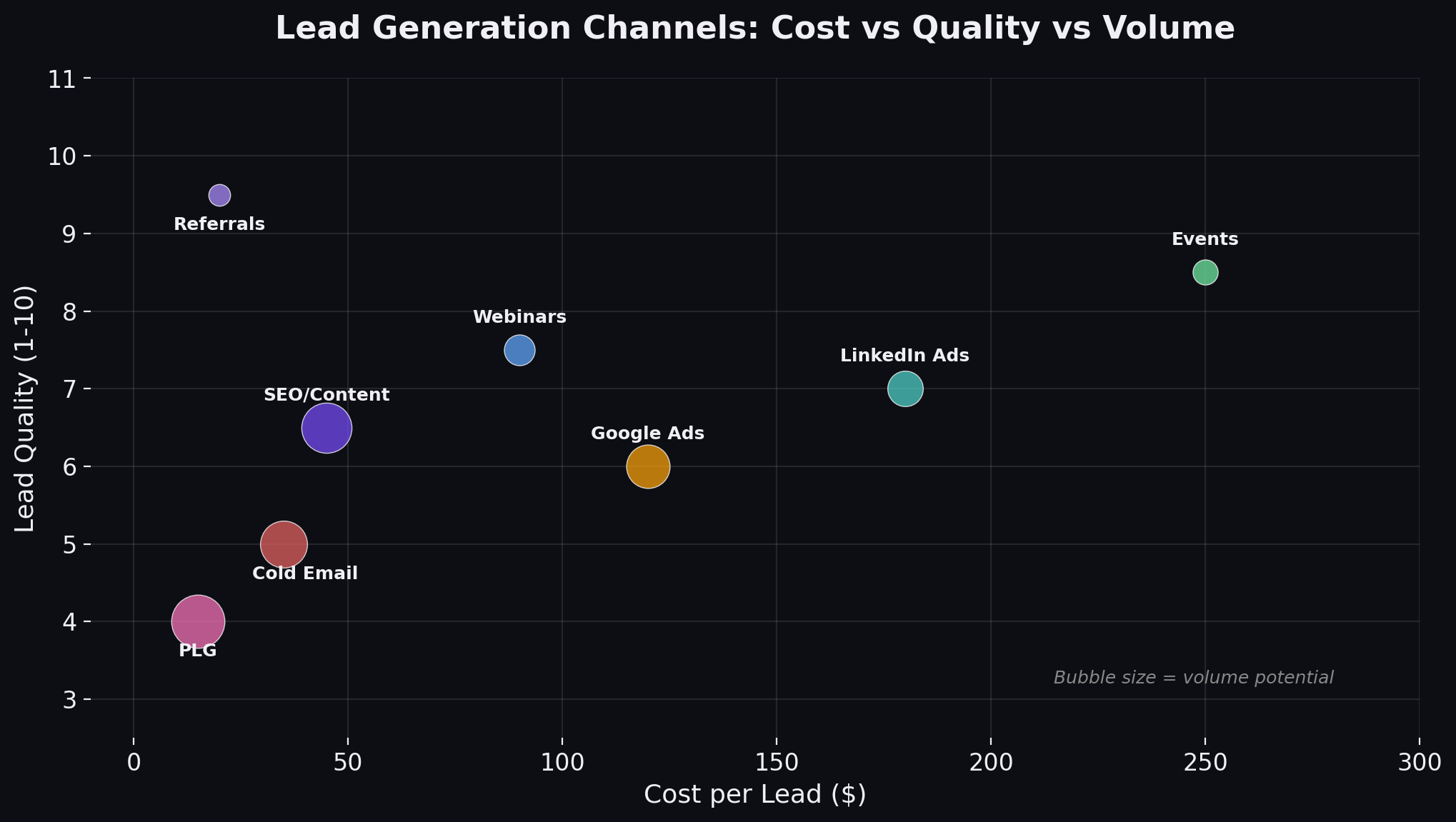
This is the data everyone wants and nobody publishes honestly. Here are real cost per lead benchmarks for B2B SaaS, based on aggregate data from programs we have run and industry benchmarks from the HubSpot State of Marketing Report (2025), LinkedIn B2B Benchmark Report (2025), and Gartner Digital Marketing Survey (2025).
| Channel | CPL Range | Median CPL | Lead Quality | Best For |
|---|---|---|---|---|
| Outbound email | $30-350 | $120 | High | $15K+ ACV, defined ICP |
| SEO / organic | $30-150 | $80 | Medium-high | Any ACV, long-term play |
| LinkedIn Ads | $100-500 | $200 | Medium-high | $10K+ ACV, B2B audiences |
| Google Ads (search) | $40-300 | $130 | High | Active buyers, high-intent keywords |
| Referrals | $20-50 | $35 | Very high | Any ACV, requires happy customers |
| Events (owned) | $150-400 | $250 | Very high | $25K+ ACV, enterprise |
| Webinars | $3-20 | $10 | Medium | Any ACV, audience building |
| PLG / free trial | $5-30 | $15 | Medium | Under $15K ACV |
| Content syndication | $30-80 | $50 | Low | Brand awareness, volume |
| Social organic | $0-10 | $5 | Low-medium | Brand building, thought leadership |
Important caveat: CPL is a misleading metric in isolation. A $200 CPL from outbound that converts at 25% to opportunity is worth far more than a $50 CPL from content syndication that converts at 2%. Always measure cost per qualified opportunity and cost per closed-won deal alongside CPL.
Tech Stack Recommendations
The Starter Stack (Under $500/month)
For seed-stage and early Series A SaaS companies with limited budget.
| Category | Tool | Monthly Cost | What It Does |
|---|---|---|---|
| CRM | HubSpot (free tier) | $0 | Contact and deal management |
| Outbound | Apollo.io | $99 | Prospecting, email sequences, contact data |
| Email marketing | Brevo | $45 | Marketing email, automation |
| SEO | Ahrefs (Lite) | $99 | Keyword research, rank tracking |
| Analytics | GA4 | $0 | Website analytics |
| Landing pages | Carrd or Webflow | $12-29 | Dedicated landing pages |
| Total | $255-272 |
The Growth Stack ($2,000-5,000/month)
For Series A/B companies with a dedicated marketing team.
| Category | Tool | Monthly Cost | What It Does |
|---|---|---|---|
| CRM + automation | HubSpot Pro | $800 | Full CRM, marketing automation, reporting |
| Outbound | Apollo.io (Professional) + Instantly | $250 | Multi-inbox sending, advanced prospecting |
| Intent data | G2 Buyer Intent or Bombora | $1,000-2,000 | Know who is in-market |
| SEO | Ahrefs (Standard) | $199 | Full SEO toolkit |
| LinkedIn Ads | LinkedIn Campaign Manager | Ad spend varies | B2B paid social |
| Analytics | GA4 + Amplitude | $0-500 | Web + product analytics |
| Attribution | HockeyStack | $1,000 | Multi-touch attribution |
| Total | $3,249-4,749 | (excluding ad spend) |
The Scale Stack ($10,000+/month)
For growth-stage companies doing $10M+ ARR.
| Category | Tool | Monthly Cost | What It Does |
|---|---|---|---|
| CRM | Salesforce or HubSpot Enterprise | $1,500-5,000 | Enterprise CRM |
| Automation | HubSpot or Marketo | $800-3,000 | Advanced automation, scoring |
| ABM | Demandbase or 6sense | $3,000-8,000 | Account-based targeting |
| Outbound | Outreach or SalesLoft | $1,200-3,000 | Enterprise sales engagement |
| Intent | Bombora + G2 | $3,000-5,000 | Multi-source intent signals |
| SEO | Ahrefs or SEMrush | $199-399 | Full SEO toolkit |
| Attribution | Dreamdata or HockeyStack | $1,500-3,000 | Full-funnel attribution |
| Enrichment | Clearbit or ZoomInfo | $1,000-5,000 | Data enrichment |
| Total | $12,199-32,399 |
Scaling Your Lead Gen: The Operational Playbook
Month 1-3: Foundation
Goal: Generate first 10-20 qualified leads per month.
- Build your ICP from closed-won data. Analyze your last 20 closed deals. What industry, company size, job title, and pain points are most common? This becomes your target profile.
- Launch outbound. Build a list of 500 target accounts. Identify 2-3 contacts per account. Write 3-4 email sequences (one per persona). Send 30-50 emails per day per inbox.
- Start publishing content. One long-form post per week targeting a bottom-of-funnel keyword. Repurpose each post into 3-5 LinkedIn posts.
- Set up tracking. UTM parameters on everything. Self-reported attribution (“How did you hear about us?”) on demo request forms. Weekly pipeline review.
Month 4-6: Acceleration
Goal: Reach 30-50 qualified leads per month.
- Optimize outbound based on data. Which sequences have the highest reply rates? Which personas respond best? Double down on what works.
- Launch LinkedIn Ads. Start with thought leadership ads to build audience awareness. Budget: $2,000-5,000/month.
- Expand content to middle-of-funnel. How-to guides, case studies, tactical playbooks. Build topic clusters around your core keywords.
- Launch a referral program. Simple structure: customers get a $100 gift card or account credit for each qualified referral. The referred prospect gets an extended trial or onboarding bonus.
Month 7-12: Scale
Goal: Reach 75-150 qualified leads per month.
- Add Google Ads for high-intent keywords. Bid on “[competitor] alternative” and “best [category] software” keywords. Dedicated landing pages for each ad group.
- Shift outbound to ABM. Instead of broad prospecting, focus outbound on top 100-200 target accounts with multi-channel sequences.
- Content should be compounding. If it is not, audit your SEO strategy. Are you targeting the right keywords? Is your content better than what currently ranks?
- Launch owned events. Monthly webinars. Quarterly dinners or roundtables for enterprise prospects.
- Hire or outsource. You need dedicated lead gen resources - either an in-house SDR team or an agency partner. Founder-led outbound does not scale.
What Doesn’t Work: Common Lead Gen Mistakes
Buying email lists and blasting them. This is not lead generation. This is spam. You will destroy your domain reputation, violate CAN-SPAM/GDPR, and generate zero pipeline. Build your lists with first-party data from prospecting tools.
Over-investing in top-of-funnel. If 90% of your content targets awareness keywords and 10% targets buying keywords, you will generate lots of traffic and very few leads. Flip the ratio in the first 6 months. Start with bottom-of-funnel content that converts, then expand upward.
Treating all leads the same. A whitepaper download is not the same as a demo request. A webinar attendee is not the same as a pricing page visitor. Build lead scoring that reflects actual buying intent, and route leads to the right follow-up path.
Measuring MQLs instead of pipeline. MQLs are a marketing metric. Pipeline is a business metric. Our guide on B2B SaaS marketing metrics covers exactly which KPIs to track at each stage. If your lead gen team is measured on MQLs, they will optimize for volume over quality. Measure pipeline generated, cost per opportunity, and cost per closed deal.
Ignoring lead velocity. It is not just about how many leads you generate. It is about how fast they convert. If your average lead-to-opportunity time is 90 days and your competitor’s is 30 days, they are closing deals with prospects you are still nurturing. Speed matters.
Running channels in isolation. Outbound works better when the prospect has already seen your content on LinkedIn. Content converts better when prospects have heard of you from a webinar. Events produce more pipeline when followed by personalized outbound. The channels are force multipliers for each other. Run them as a system, not as independent experiments.
Hiring SDRs before defining the process. If you do not have a proven outbound playbook - sequences that book meetings, an ICP that converts, a tech stack that works - hiring an SDR will not solve your lead gen problem. It will make it more expensive. Build the system first, then hire people to run it.
Lead Generation Metrics Dashboard
Track these metrics weekly to stay on top of your lead gen performance.
| Metric | How to Calculate | Healthy Benchmark | Warning Sign |
|---|---|---|---|
| Lead velocity rate (LVR) | (Leads this month - leads last month) / leads last month | 10-20% month-over-month growth | Negative or flat for 2+ months |
| MQL-to-SQL conversion rate | SQLs / MQLs | 25-40% | Under 15% (quality issue) |
| SQL-to-opportunity rate | Opportunities / SQLs | 30-50% | Under 20% (qualification issue) |
| Cost per qualified opportunity | Total spend / opportunities | Varies by ACV, but under 10% of ACV | Over 20% of ACV |
| Channel-specific CPL | Channel spend / channel leads | See benchmarks table above | 2x above median for channel |
| Time to first response | Avg hours from lead to first outreach | Under 5 minutes for inbound | Over 24 hours |
| Pipeline coverage ratio | Pipeline / quota | 3-4x coverage | Under 2x |
The Bottom Line
B2B SaaS lead generation is not about finding the one magic channel. It is about building a system where multiple channels work together, each reinforcing the others.
Outbound gives you control and speed. Content gives you scale and compounding returns. LinkedIn gives you trust and thought leadership. PLG gives you viral growth. Referrals give you the highest-quality leads at the lowest cost. Events give you relationship density.
The companies that win at lead gen do not pick one. They build a system that uses the right channels at the right stage, measured by the right metrics, and optimized based on real data rather than assumptions.
Start with outbound to learn your market and generate early pipeline. Build content in parallel for long-term compounding. Add paid and events as you scale. And never stop asking your customers for referrals.
The best lead gen engine is one where you could turn off any single channel and still hit your pipeline targets. That is resilience. That is a system. That is what separates companies that grow from companies that stall.
Data in this guide is sourced from HubSpot State of Marketing Report (2025), LinkedIn B2B Benchmark Report (2025), Gartner Digital Marketing Survey (2025), OpenView SaaS Benchmarks (2025), and aggregate performance data from B2B SaaS lead generation programs designed and managed by PipelineRoad. Updated March 2026.
PipelineRoad builds lead generation engines for B2B SaaS companies - outbound, inbound, and everything in between. If your pipeline is flat and your CPL is climbing, let’s talk.
Further Reading
- B2B SaaS Sales Funnel: Stages and Benchmarks - How leads flow through your funnel after generation.
- B2B SaaS GTM Strategy - The broader GTM framework that lead gen plugs into.
- Account-Based Marketing for SaaS - The ABM approach to lead gen for enterprise targets.
- Best B2B SaaS Marketing Agencies - If you need help building your lead gen engine.
Frequently Asked Questions
What is the best lead generation channel for B2B SaaS?
There is no single best channel. The right answer depends on your ACV, sales cycle, and ICP. For SaaS with ACV under $10K, SEO and product-led growth tend to deliver the lowest cost per lead. For ACV above $25K, outbound email and ABM consistently outperform other channels on pipeline generation. The most effective programs use 3-4 channels simultaneously, with SEO and content as the compounding base and outbound or paid as the acceleration layer.
What is a good cost per lead for B2B SaaS?
B2B SaaS cost per lead varies wildly by channel and ACV. Organic search averages $50-150 per lead. LinkedIn Ads run $100-350. Outbound email is $30-80 per lead but $200-500 per qualified opportunity. Referrals average $20-50 per lead with the highest conversion rates. A blended CPL under $200 is strong for most B2B SaaS companies, but focus on cost per qualified opportunity and cost per closed deal rather than raw CPL.
How many leads does a SaaS company need to hit revenue targets?
Work backward from revenue. If your target is $1M in new ARR, your ACV is $20K, and your close rate is 20%, you need 250 qualified opportunities. If your SQL-to-opportunity rate is 40%, you need 625 SQLs. If your MQL-to-SQL rate is 30%, you need roughly 2,100 MQLs. The exact numbers depend on your specific conversion rates, but this reverse-funnel math is the only honest way to set lead targets.
Should SaaS companies focus on inbound or outbound lead generation?
Both, but the mix depends on your stage. Early-stage SaaS companies (pre-$3M ARR) should lean 60-70% outbound because it generates pipeline faster. As content and SEO compound, shift to 50/50 by Series B. Mature companies often run 60-70% inbound with outbound reserved for strategic accounts. The mistake is going all-in on either one. Outbound without inbound is a treadmill. Inbound without outbound is a slow burn.
How long does it take for SaaS lead generation to produce results?
Outbound can generate qualified conversations within 2-4 weeks of launch. Paid ads typically need 60-90 days to optimize. SEO and content marketing take 4-8 months to generate meaningful organic leads. Referral programs produce results within 30-60 days if you have happy customers. Build your lead gen plan with outbound and paid for short-term pipeline and SEO for long-term compounding.
What tools do you need for B2B SaaS lead generation?
The minimum viable stack is a CRM (HubSpot free tier), an email platform (Apollo or Brevo), a prospecting tool (Apollo, LinkedIn Sales Navigator, or ZoomInfo), and analytics (GA4). As you scale, add intent data (Bombora, G2 Buyer Intent), marketing automation (HubSpot Pro), and attribution (HockeyStack or Dreamdata). Do not buy tools you will not fully implement - a half-used $50K martech stack is worse than a fully utilized $500/month setup.
Ready to build your SaaS marketing machine?
We've run these plays at 40+ B2B SaaS companies. Let's talk about yours.
Book a Strategy Call