RevOps for SaaS: What It Actually Is, How to Implement It, and Why Most Companies Get It Wrong
A practitioner's guide to RevOps for SaaS - team structure, tool stack, metrics, and implementation playbook by company stage. No buzzwords, just what works.
RevOps is the most overhyped and most underimplemented function in SaaS.
Everyone talks about it. LinkedIn is full of posts about “RevOps transformation.” Consultants sell six-figure engagements around it. Tool vendors position their products as “the RevOps platform.” Job postings for RevOps roles have grown significantly since 2022 (Source: LinkedIn Talent Insights, 2025).
And yet most SaaS companies that claim to “do RevOps” have simply renamed their Sales Ops person and called it a day. The CRM is still a mess. Marketing and sales still blame each other for pipeline gaps. Customer success still operates on a different planet with different tools and different definitions of what an “at-risk” account looks like.
That is not RevOps. That is a title change.
This guide covers what RevOps actually is, how to implement it at different stages of your SaaS company, the tool stack that makes it work, the metrics that matter, and the mistakes that will waste your time and money. This is from running revenue operations programs across SaaS companies at every stage, not from reading about it on a blog.
What RevOps Actually Is (And What It Is Not)
Revenue Operations is the operational function that aligns your entire revenue engine - marketing, sales, and customer success - under a single framework of shared data, consistent processes, and unified goals.
Before RevOps, the typical SaaS company looks like this:
- Marketing Ops manages the marketing automation platform, runs lead scoring, and reports on MQLs.
- Sales Ops manages the CRM, builds reports for sales leadership, and handles territory planning.
- CS Ops (if it exists at all) manages the customer success platform, tracks NPS, and reports on churn.
Each team has its own tools, its own data definitions, its own reporting, and its own incentives. They meet at the handoff points - marketing hands leads to sales, sales hands closed deals to customer success - and that is where everything breaks.
RevOps eliminates those silos by putting all three operational functions under one roof. One team. One data model. One set of definitions. One set of dashboards.
What RevOps is not:
RevOps is not a tool. No software platform is “RevOps.” Tools enable RevOps, but RevOps is a function - people, processes, and governance. Buying Clari does not give you RevOps any more than buying a stethoscope makes you a doctor.
RevOps is not just Sales Ops with a new name. If your “RevOps team” only supports the sales team, you have Sales Ops. RevOps spans the entire revenue lifecycle from first marketing touch to customer renewal.
RevOps is not a strategy role. RevOps is operational, not strategic. The VP of Revenue or CRO sets revenue strategy. RevOps builds the infrastructure, processes, and data that execute that strategy.
RevOps is not a data team. RevOps uses data extensively, but its job is not to build dashboards. Its job is to make the revenue engine run smoothly. Data and reporting are means, not ends.
Why RevOps Matters for SaaS (The Numbers)
The case for RevOps is not philosophical. It is mathematical.
Companies with aligned revenue operations grow 12-15% faster than those without it (Source: Forrester Research, 2025). That growth advantage comes from three sources:
-
Fewer pipeline leaks. In a typical SaaS company without RevOps, 20-30% of qualified leads never receive a follow-up because of routing failures, handoff gaps, or CRM data issues. RevOps fixes the plumbing.
-
Better forecast accuracy. SaaS companies without RevOps typically forecast with 60-70% accuracy. With RevOps, that jumps to 80-90% (Source: Clari Revenue Operations Report, 2025). Better forecasts mean better hiring decisions, better cash flow management, and fewer end-of-quarter fire drills.
-
Higher net revenue retention. When customer success has visibility into the sales process and marketing has visibility into customer behavior, the entire company can identify expansion opportunities and churn risks earlier. Companies with mature RevOps functions report 5-15 percentage points higher NRR than those without.
Here is the revenue impact at different scales:
| ARR | Revenue Growth Improvement (RevOps vs No RevOps) | Estimated Revenue Impact |
|---|---|---|
| $3M | 12-15% faster growth | $360K-$450K additional ARR |
| $10M | 12-15% faster growth | $1.2M-$1.5M additional ARR |
| $30M | 10-12% faster growth | $3M-$3.6M additional ARR |
| $50M+ | 8-10% faster growth | $4M-$5M additional ARR |
The ROI on a $150K RevOps hire that generates an additional $1M in ARR is obvious. The question is not whether you can afford RevOps. It is whether you can afford not to have it.
The Three Pillars of RevOps
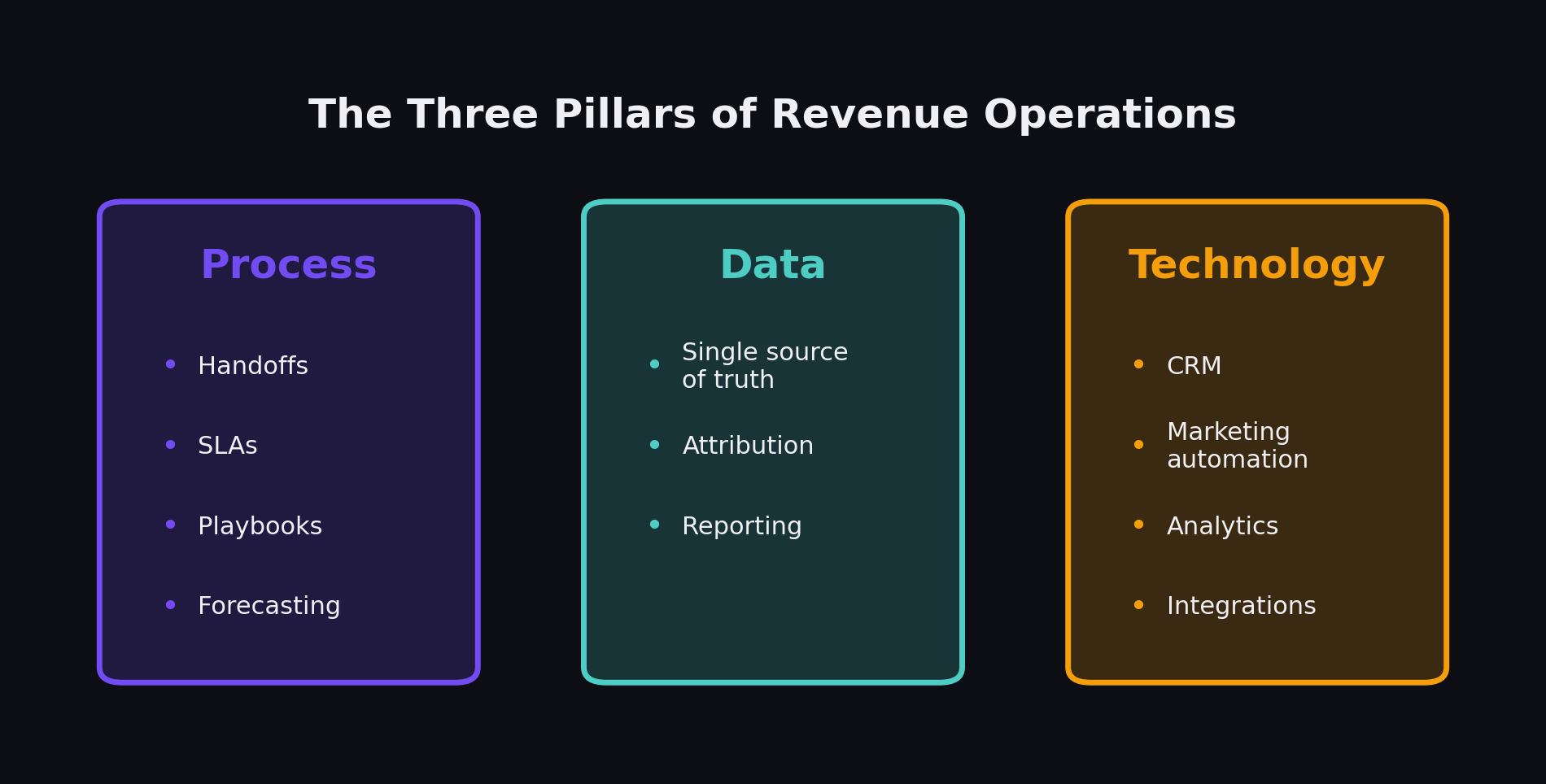
Every RevOps function is built on three pillars: Process, Data, and Technology. Get all three right and your revenue engine hums. Get any one wrong and the others fall apart.
Pillar 1: Process
Process is the most important and most neglected pillar. Tools are fun to buy. Data is fun to analyze. Process design is boring, tedious, and absolutely essential.
The revenue process map:
Your revenue engine has a defined set of stages that every customer passes through. RevOps documents, standardizes, and optimizes each stage and every handoff between stages.
| Stage | Owner | Key Process | Handoff Trigger |
|---|---|---|---|
| Awareness | Marketing | Content, ads, events generate interest | Visitor identifies themselves (form fill, chat) |
| Lead | Marketing | Lead scoring, enrichment, qualification | Lead meets MQL criteria |
| MQL | Marketing/Sales | MQL review, routing to sales | Sales accepts lead (SAL) |
| SQL | Sales | Discovery call, needs assessment | Qualified opportunity created |
| Opportunity | Sales | Demo, proposal, negotiation | Verbal agreement or closed-won |
| Onboarding | CS + Sales | Implementation, training, first value | Handoff meeting completed |
| Adoption | Customer Success | Usage monitoring, health scoring | Reaches target adoption metrics |
| Expansion | CS + Sales | Upsell/cross-sell identification | Expansion opportunity created |
| Renewal | Customer Success | Renewal process, negotiation | 90 days before renewal date |
Where processes break (and how to fix them):
The MQL-to-SQL handoff. This is the most common failure point in B2B SaaS. Marketing generates leads, sales ignores them, marketing complains about follow-up, sales complains about quality. The fix is a Service Level Agreement (SLA) with specific criteria:
- MQL definition agreed upon by both teams (not just marketing’s definition)
- Sales must follow up within a defined timeframe (best practice: under 5 minutes for inbound, under 24 hours for outbound)
- Sales must disposition every lead with a clear status and reason
- Weekly review of lead quality and follow-up compliance
The sales-to-CS handoff. The second most common failure point. Sales closes the deal and throws it over the wall to customer success, who has no context on what was promised, what the customer’s goals are, or what timeline was discussed. The fix is a structured handoff process:
- Mandatory handoff document that sales completes before the deal is marked closed-won
- Joint kickoff call with sales, CS, and the customer
- Clear ownership transfer date (not a gradual fade)
Lead routing. Leads going to the wrong rep, leads sitting unassigned, leads routed based on territory rules that nobody has updated in 18 months. This is pure revenue leakage. The fix is automated routing based on current rules, with real-time alerting for unassigned leads and SLA tracking for response time.
Pillar 2: Data
RevOps lives and dies on data quality. If your CRM data is unreliable, every report you build on top of it is a fiction. Every forecast is a guess. Every segmentation is wrong.
The data problems that kill SaaS companies:
Duplicate records. The average SaaS CRM has 15-25% duplicate contacts and 10-15% duplicate companies (Source: Validity Data Quality Report, 2025). Duplicates cause leads to be routed to the wrong rep, pipeline to be double-counted, and customer history to be fragmented.
Missing or inconsistent fields. If “Industry” is filled in on 40% of accounts, you cannot segment by industry. If “Company Size” uses different formats (some records say “50-100,” others say “mid-market,” others leave it blank), you cannot build reliable ICP analysis.
Stale data. Contact data decays at 25-30% per year (Source: ZoomInfo Data Accuracy Report, 2025). People change jobs, companies get acquired, phone numbers change. If you are not enriching and validating data continuously, a quarter of your database is wrong at any given time.
How RevOps fixes data:
-
Data governance. Define required fields, standardized picklist values, and validation rules. If a field is not required, it will not be filled in. If a picklist allows free text, you will get 47 variations of the same industry.
-
Automated enrichment. Use tools like Clearbit, ZoomInfo, or Apollo to automatically enrich records with firmographic and contact data. This should run on record creation and on a recurring schedule.
-
Deduplication. Run deduplication monthly. Merge logic should be documented and automated where possible.
-
Data audit cadence. Quarterly data quality audit that measures completeness, accuracy, and consistency across the CRM. Track data quality as a KPI, not an afterthought.
Pillar 3: Technology
The RevOps tech stack connects the revenue engine. The right tools eliminate manual work, enforce process, and provide visibility.
The Core RevOps Stack:
| Category | Tool Options | What It Does | When to Add |
|---|---|---|---|
| CRM | HubSpot, Salesforce | Single source of truth for all revenue data | Day 1 |
| Marketing automation | HubSpot, Marketo, Pardot | Lead scoring, nurture, campaign management | Day 1 |
| Sales engagement | Outreach, SalesLoft, Apollo | Sequence management, activity tracking | $1M+ ARR |
| Revenue intelligence | Gong, Chorus | Call recording, deal intelligence | $2M+ ARR |
| Lead routing | LeanData, Chili Piper | Automated lead assignment and scheduling | $2M+ ARR |
| Data enrichment | Clearbit, ZoomInfo | Contact and account data enrichment | $1M+ ARR |
| Forecasting | Clari, Aviso, InsightSquared | AI-powered forecasting, pipeline analytics | $5M+ ARR |
| Customer success | Gainsight, ChurnZero, Vitally | Health scoring, renewal management | $3M+ ARR |
| BI / reporting | Looker, Metabase, Tableau | Custom dashboards, cross-functional reporting | $5M+ ARR |
| Data warehouse | Snowflake, BigQuery | Centralized data for advanced analytics | $10M+ ARR |
| CPQ | DealHub, PandaDoc | Configure-price-quote automation | $5M+ ARR |
HubSpot vs Salesforce: The RevOps perspective
This is the most common RevOps technology decision in SaaS. Here is the honest comparison:
| Factor | HubSpot | Salesforce |
|---|---|---|
| Best for | $0-30M ARR SaaS | $10M+ ARR, complex sales processes |
| Ease of use | High - marketing and sales teams adopt quickly | Medium-low - requires admin expertise |
| Customization | Good for standard use cases | Unlimited (with development resources) |
| Marketing + CRM integration | Native, seamless | Requires Pardot/Marketo integration |
| Reporting | Good built-in, limited custom | Powerful but requires configuration |
| Admin overhead | Low - 0.5 FTE can manage | High - often needs 1+ dedicated admin |
| Total cost of ownership ($5M ARR) | $20K-40K/year | $50K-150K/year (licenses + admin + integrations) |
| Ecosystem | Growing rapidly | Massive, mature |
For most SaaS companies under $20M ARR, HubSpot is the better choice for RevOps. The native marketing-sales integration eliminates the data sync issues that plague Salesforce + Marketo/Pardot setups. The lower admin overhead means your RevOps team spends time on strategy, not on building Salesforce flows.
If you are an enterprise SaaS company with complex deal structures, multi-product lines, CPQ requirements, and dedicated Salesforce admins, Salesforce is the right foundation.
How to Implement RevOps by Stage
Pre-$2M ARR: Founder-Led RevOps
At this stage, you do not need a RevOps hire. You need RevOps thinking applied by the founding team.
What to do:
- Choose one CRM (HubSpot is the default answer at this stage) and make it the single source of truth. No spreadsheets. No separate databases.
- Define your pipeline stages with clear entry and exit criteria. Even if you only have 5 stages, document what it means for a deal to move from one to the next.
- Set up basic lead scoring. Even a simple model (downloaded content = 5 points, visited pricing page = 10 points, requested demo = 20 points) is infinitely better than no scoring.
- Build one dashboard that shows marketing-sourced pipeline, sales-sourced pipeline, conversion rates by stage, and average sales cycle length. Review it weekly.
- Standardize your data entry. Create required fields for new deals: company size, industry, source, decision maker identified. If it is not required, it will not get filled in.
What not to do:
- Do not hire a RevOps person yet. You do not have enough process complexity to justify the role. The founder or head of sales can handle this.
- Do not buy a forecasting tool. With 10-20 deals in pipeline, you can forecast in a spreadsheet.
- Do not over-engineer lead routing. If you have two salespeople, a round-robin in HubSpot is sufficient.
$2M-$10M ARR: First RevOps Hire
This is when RevOps becomes a distinct function. You have enough pipeline, enough team members, and enough process complexity to warrant a dedicated person.
The first hire: RevOps Manager or Director of RevOps
This person should be:
- Technically proficient with your CRM (can build workflows, reports, and integrations without external help)
- Process-oriented (thinks in systems, not one-off fixes)
- Cross-functional (comfortable working with marketing, sales, and CS leadership)
- Data-driven (can build reports, analyze conversion rates, and identify bottlenecks)
Salary range: $100,000-$150,000 base, depending on market and experience.
What this person should do in the first 90 days:
Days 1-30: Audit
- Map the current revenue process end-to-end (lead to renewal)
- Audit CRM data quality (completeness, accuracy, duplicates)
- Document all existing tools and integrations
- Interview marketing, sales, and CS leaders about their biggest operational pain points
- Identify the top 3 revenue leaks (leads that disappear, deals that stall, customers that churn without warning)
Days 31-60: Fix
- Implement the top 3 quick wins from the audit
- Standardize pipeline stages and definitions across teams
- Set up lead routing automation (LeanData or native CRM routing)
- Create the RevOps dashboard: pipeline velocity, conversion rates, forecast, leading indicators
- Establish the MQL-to-SQL SLA with specific criteria and response times
Days 61-90: Build
- Design and implement the sales-to-CS handoff process
- Set up automated data enrichment
- Build the first forecasting model (weighted pipeline by stage)
- Launch a recurring operations review cadence (weekly pipeline review, monthly RevOps report, quarterly business review)
- Create the first data governance documentation
$10M-$30M ARR: RevOps Team
At this scale, one person cannot do it all. You need a team.
Typical RevOps team structure at $10-30M ARR:
| Role | Focus | Reports To |
|---|---|---|
| VP/Director of RevOps | Strategy, cross-functional alignment, executive reporting | CRO or CEO |
| RevOps Manager (Marketing) | Marketing automation, lead scoring, campaign ops, attribution | VP RevOps |
| RevOps Manager (Sales) | CRM management, pipeline ops, territory planning, forecasting | VP RevOps |
| RevOps Analyst | Reporting, data quality, dashboard maintenance, ad-hoc analysis | VP RevOps |
Total team cost: $400,000-$600,000 annually.
Key projects at this stage:
- Advanced lead scoring incorporating intent data, product usage signals, and engagement history
- Automated forecasting with AI-powered tools (Clari, Aviso)
- Territory planning and quota setting based on data, not politics
- Customer health scoring that combines product usage, support tickets, NPS, and engagement metrics
- Cross-functional attribution model that shows marketing’s true pipeline contribution
- Revenue data warehouse that centralizes CRM, product, support, and financial data
$30M+ ARR: Mature RevOps
At this scale, RevOps is a strategic function with 5-10+ team members, a significant technology budget, and a seat at the executive table.
Mature RevOps team structure:
| Role | Count | Focus |
|---|---|---|
| VP of Revenue Operations | 1 | Strategy, executive alignment, board reporting |
| Director of Marketing Ops | 1 | Marketing tech stack, attribution, campaign ops |
| Director of Sales Ops | 1 | CRM, forecasting, territory planning, compensation |
| Director of CS Ops | 1 | Customer health, renewal ops, expansion ops |
| RevOps Engineers | 2-3 | CRM development, integrations, automation |
| RevOps Analysts | 2-3 | Reporting, data science, business intelligence |
| Data Quality Specialist | 1 | Data governance, enrichment, compliance |
Key capabilities at this stage:
- Predictive analytics (which deals will close, which customers will churn, which accounts to target)
- Revenue modeling for board reporting and planning
- Advanced segmentation and ICP analysis using machine learning
- Multi-product, multi-segment operational support
- M&A integration (combining revenue operations from acquired companies)
RevOps Metrics: What to Measure and Why
The RevOps Dashboard
Every RevOps team needs a single dashboard that the entire revenue leadership team reviews weekly. Here are the metrics that belong on it:
Pipeline Metrics:
| Metric | Formula | Healthy Benchmark | Warning Sign |
|---|---|---|---|
| Pipeline coverage | Total pipeline / quota | 3-4x | Under 2x |
| Pipeline velocity | (Opportunities x win rate x avg deal size) / sales cycle length | Increasing QoQ | Declining for 2+ quarters |
| Stage conversion rates | Deals advancing / deals in stage | Varies by stage, but stable | Sudden drops in any stage |
| Pipeline creation rate | New pipeline created this period | Consistent with growth targets | Below quota coverage threshold |
Efficiency Metrics:
| Metric | Formula | Healthy Benchmark | Warning Sign |
|---|---|---|---|
| CAC payback period | CAC / (monthly revenue x gross margin) | Under 18 months | Over 24 months |
| LTV:CAC ratio | Customer lifetime value / CAC | 3:1 or higher | Under 2:1 |
| Win rate | Closed-won / total closed deals | 20-30% (varies by segment) | Declining trend |
| Sales cycle length | Avg days from opportunity creation to close | Consistent or decreasing | Increasing by more than 10% |
Alignment Metrics:
| Metric | Formula | Healthy Benchmark | Warning Sign |
|---|---|---|---|
| Lead follow-up time | Avg time from MQL to first sales touch | Under 5 minutes (inbound) | Over 24 hours |
| Lead acceptance rate | Leads accepted by sales / total MQLs | 70-85% | Under 50% (quality issue) or over 95% (scoring too loose) |
| Forecast accuracy | Actual revenue / forecasted revenue | 85-95% | Under 75% or over 110% |
| Net revenue retention | (Starting revenue + expansion - churn) / starting revenue | 110-130% | Under 100% |
The One Metric That Matters Most
If you can only track one RevOps metric, track net revenue retention (NRR).
NRR tells you whether your revenue engine is healthy across the entire customer lifecycle. An NRR above 110% means your existing customer base is growing without acquiring a single new customer. An NRR below 100% means you are losing revenue faster than you can grow it from existing accounts.
NRR is the ultimate output metric of a well-run revenue engine. High NRR means:
- Marketing is attracting the right customers (good ICP targeting)
- Sales is closing the right deals (not selling to bad-fit accounts)
- Onboarding is effective (customers reach value quickly)
- Customer success is proactive (churn risks are identified early)
- Expansion is systematic (upsell/cross-sell opportunities are captured)
If NRR is below target, RevOps should be able to trace the problem back to a specific part of the revenue process and fix it. For a deeper look at retention metrics and what drives them, see our SaaS churn rate benchmarks guide.
What Doesn’t Work: Common RevOps Mistakes
Renaming Sales Ops to RevOps without changing anything else. If your “RevOps” person still only supports the sales team, does not touch marketing ops or CS ops, and reports to the VP of Sales instead of the CRO or CEO, you have Sales Ops with a trendy title. True RevOps requires cross-functional scope and cross-functional authority.
Buying tools before defining processes. Every week I see a SaaS company buy Clari or Gong or LeanData and expect it to solve their RevOps problems. Tools amplify good processes and amplify bad processes. If your pipeline stages are undefined, if your lead routing is manual, if your data is a mess, no tool will save you. Fix the process first, then buy tools to automate it.
Over-engineering too early. A $3M ARR SaaS company does not need a data warehouse, predictive analytics, or AI-powered forecasting. It needs a clean CRM, a defined sales process, and a weekly pipeline review. Build complexity as you scale, not before.
Letting RevOps become a service desk. RevOps should not spend 80% of its time building one-off reports and fixing CRM records. If that is what your RevOps team does, you have an admin, not an operations function. RevOps should spend 60% of its time on proactive projects (process improvement, tool optimization, data quality initiatives) and 40% on reactive support.
Ignoring customer success operations. Most “RevOps” functions cover marketing and sales but leave customer success as a separate island. This is the single most common RevOps implementation failure. If CS does not have the same data quality, the same process rigor, and the same reporting standards as marketing and sales, your NRR will suffer.
Measuring RevOps by the wrong outcomes. RevOps should not be measured on revenue (that is the CRO’s job) or lead volume (that is marketing’s job). RevOps should be measured on process efficiency, data quality, forecast accuracy, and cross-functional alignment. These are the operational inputs that drive revenue outcomes.
Not investing in change management. RevOps changes how people work. New CRM fields, new pipeline stages, new handoff processes, new reporting requirements. If you do not invest in training, communication, and enforcement, people will revert to their old habits within 30 days. Budget for change management - it is not optional.
RevOps for Different SaaS Models
PLG SaaS (Product-Led Growth)
RevOps in a PLG company looks different from RevOps in a sales-led company. The biggest difference is that product usage data becomes a primary input to the revenue process.
Key differences:
- Lead scoring incorporates product usage signals (feature adoption, frequency, depth of use) alongside traditional marketing signals
- The “MQL” equivalent is a Product Qualified Lead (PQL) - a free user whose behavior indicates readiness for a paid plan
- Sales engagement is triggered by product behavior, not marketing behavior
- Customer success is partially automated through in-app messaging and self-serve resources
PLG RevOps stack additions:
| Tool | Purpose |
|---|---|
| Amplitude or Mixpanel | Product usage analytics |
| Pendo or Appcues | In-app messaging and onboarding |
| Correlated or Calixa | PQL identification and routing |
| Segment | Data pipeline connecting product events to CRM |
Enterprise SaaS (Sales-Led, $50K+ ACV)
Enterprise SaaS RevOps is more complex because of longer sales cycles, larger buying committees, and multi-threaded deal management.
Key differences:
- Account-level tracking matters more than contact-level tracking
- Multi-threading (engaging multiple stakeholders at each account) is a core RevOps metric
- Deal rooms and mutual action plans replace simple email sequences
- Legal and procurement processes add stages to the pipeline
- Professional services and implementation factor into revenue recognition
Enterprise RevOps additions:
| Process | Tool | Purpose |
|---|---|---|
| Deal room | Aligned, Consensus | Buyer-facing deal portals |
| CPQ | DealHub, Conga | Complex pricing and quoting |
| Contract management | Ironclad, DocuSign CLM | Legal workflow automation |
| Account planning | Meddic-based frameworks in CRM | Strategic account management |
Vertical SaaS
Vertical SaaS companies (targeting a specific industry) have unique RevOps considerations. The market is smaller, the relationships are deeper, and the competitive dynamics are different.
Key differences:
- Total addressable market is defined and often finite. RevOps needs to track market penetration, not just pipeline.
- Community and word-of-mouth play a larger role. Self-reported attribution is more important than multi-touch models.
- Events (industry conferences, user groups) generate a disproportionate share of pipeline.
- Customer retention matters even more because replacement customers are harder to find in a smaller market.
Building Your RevOps Roadmap
Quarter 1: Foundation
- Audit current revenue process, data quality, and tech stack
- Define pipeline stages with clear entry/exit criteria
- Establish MQL-to-SQL SLA
- Clean CRM data (deduplication, standardization, enrichment)
- Build the RevOps dashboard (pipeline, conversion, efficiency metrics)
- Set up automated lead routing
Quarter 2: Optimization
- Implement advanced lead scoring (behavioral + firmographic + intent)
- Design and deploy the sales-to-CS handoff process
- Launch data governance program (required fields, validation rules, audit cadence)
- Build forecasting model (weighted pipeline + historical analysis)
- Establish recurring operations cadence (weekly pipeline review, monthly RevOps report)
Quarter 3: Scaling
- Add intent data to lead scoring and routing
- Implement customer health scoring
- Build cross-functional attribution model
- Launch territory planning and optimization
- Evaluate and implement forecasting tool (Clari, Aviso)
Quarter 4: Maturity
- Connect product usage data to revenue process (PQL scoring)
- Build revenue data warehouse for advanced analytics
- Implement expansion revenue tracking and automation
- Launch renewal operations process
- Set RevOps OKRs for next year aligned with revenue plan
The RevOps Hiring Guide
| Role | When to Hire | Salary Range (2026) | Key Skills |
|---|---|---|---|
| RevOps Manager | $2-5M ARR | $90K-$130K | CRM admin, process design, reporting |
| Director of RevOps | $5-15M ARR | $130K-$180K | Strategy, cross-functional leadership, forecasting |
| VP of Revenue Operations | $15M+ ARR | $180K-$250K | Executive presence, board reporting, team building |
| RevOps Analyst | $5M+ ARR | $70K-$100K | SQL, BI tools, data analysis |
| RevOps Engineer | $10M+ ARR | $100K-$140K | CRM development, API integrations, automation |
| Marketing Ops Manager | $10M+ ARR | $90K-$120K | Marketing automation, campaign ops, attribution |
| Sales Ops Manager | $10M+ ARR | $90K-$120K | CRM, forecasting, territory planning, comp design |
Where to find RevOps talent:
The best RevOps hires often come from Sales Ops or Marketing Ops backgrounds at SaaS companies one stage ahead of yours. A Sales Ops manager at a $20M ARR company is an ideal first RevOps hire for a $5M ARR company. They have seen what good looks like at scale and can build the foundation to get you there.
Avoid hiring consultants or agencies for your core RevOps function. RevOps requires deep institutional knowledge and ongoing operational involvement. Consultants are valuable for specific projects (CRM migration, data warehouse setup, process design) but cannot replace an embedded RevOps team.
The Bottom Line
RevOps is not a trend. It is the operational foundation that determines whether your SaaS company can scale revenue predictably.
Without RevOps, your revenue engine leaks pipeline at every handoff, forecasts with guesswork, and fights internal battles over data and definitions. With RevOps, you have a unified system where marketing, sales, and customer success operate as one revenue team with shared data, clear processes, and aligned incentives.
The implementation is not glamorous. It is cleaning CRM data. It is writing process documentation. It is building dashboards that nobody asked for until they realize they cannot live without them. It is sitting in meetings between marketing and sales to broker agreements on what an MQL actually means.
But the companies that do this work - the unglamorous, operational, foundational work - are the companies that scale past $10M, $30M, and $100M ARR without the chaos that kills so many SaaS companies in the growth stage.
Start with your process. Fix your data. Choose your tools deliberately. Hire someone who cares more about systems than about status. And never, ever rename your Sales Ops person to “RevOps” and think the job is done.
Data in this guide is sourced from Forrester Research (2025), Clari Revenue Operations Report (2025), Validity Data Quality Report (2025), LinkedIn Talent Insights (2025), ZoomInfo Data Accuracy Report (2025), and operational data from RevOps implementations across B2B SaaS companies managed by PipelineRoad. Updated March 2026.
PipelineRoad builds RevOps-aligned marketing and pipeline programs for B2B SaaS companies. If your revenue engine is leaking pipeline and your CRM is a mess, let’s talk.
Frequently Asked Questions
What is RevOps in SaaS?
RevOps (Revenue Operations) is a business function that aligns sales, marketing, and customer success under a unified operational framework. Instead of each team running its own processes, tools, and metrics independently, RevOps creates a single revenue engine with shared data, consistent processes, and aligned goals. The objective is to eliminate silos that cause pipeline leaks, forecast inaccuracy, and customer experience gaps.
What is the difference between RevOps and Sales Ops?
Sales Ops focuses on optimizing the sales team's processes, tools, and reporting. RevOps encompasses sales ops, marketing ops, and customer success ops under one umbrella. Sales Ops asks how do we help salespeople sell more. RevOps asks how do we optimize the entire revenue engine from first touch to renewal. The distinction matters because revenue leaks usually happen at the handoff points between teams, and Sales Ops alone cannot fix cross-functional misalignment.
When should a SaaS company hire for RevOps?
Most SaaS companies should invest in RevOps between $2M and $10M ARR. Before $2M, the founder can typically manage cross-functional alignment. After $10M without RevOps, you are almost certainly losing revenue to process gaps, bad data, and misaligned incentives. The trigger is usually when you notice forecast accuracy declining, lead handoff complaints increasing, or your CRM data becoming unreliable.
How much does RevOps cost to implement?
A first RevOps hire typically costs $100,000-$150,000 in salary. The tool stack adds $2,000-10,000 per month depending on your tech choices. Full RevOps implementation (people, process, tools) at a Series B SaaS company runs $300,000-600,000 annually. The ROI typically shows up within 6-12 months through improved conversion rates, faster sales cycles, and better forecast accuracy. Most companies see 10-20% improvement in win rates within the first year.
What tools do you need for RevOps?
The core RevOps stack includes a CRM (HubSpot or Salesforce), a data enrichment tool (Clearbit or ZoomInfo), a marketing automation platform (HubSpot or Marketo), a revenue intelligence tool (Gong or Chorus), and a forecasting or analytics layer (Clari, Aviso, or InsightSquared). Many SaaS companies also add LeanData for lead routing, Salesloft or Outreach for sales engagement, and a BI tool like Looker or Metabase for custom reporting.
What metrics should RevOps track?
The essential RevOps metrics are pipeline velocity (how fast deals move through stages), win rate by segment, CAC payback period, net revenue retention, forecast accuracy, lead-to-opportunity conversion rate, sales cycle length, and expansion revenue as a percentage of total revenue. The unifying metric is net revenue retention - if NRR is above 110%, the revenue engine is healthy. Below 100%, something is fundamentally broken.
Ready to build your SaaS marketing machine?
We have run these plays at 40+ B2B SaaS companies. Let's talk about yours.
Book a Strategy Call