MQL Definition Guide: What Marketing Qualified Leads Actually Mean in 2026
The complete MQL definition guide - what MQLs are, why the 'MQL is dead' debate misses the point, lead scoring models, MQL vs PQL vs SQL, and conversion benchmarks by industry.
MQL. Three letters that have launched a thousand LinkedIn debates and approximately zero useful conclusions.
Every quarter, a thought leader posts that “MQLs are dead” and gets 500 likes from marketers who are tired of being measured on a metric they know is flawed. Then a revenue operations person responds that “MQLs are not dead, your MQL definition is just bad,” and gets 200 likes from people who actually run the systems. Then nothing changes.
Here is the reality: MQLs are not dead. Bad MQL definitions are dead. The companies that abandoned MQLs replaced them with something functionally identical - they just called it a “hand-raiser” or a “signal” or a “buying intent indicator.” The taxonomy changed. The underlying need did not.
You need a way to separate the leads that are worth a sales rep’s time from the leads that are not. That is what an MQL is. The problem is not the concept. The problem is that most companies define MQLs so loosely that the designation means nothing, or so tightly that they miss half their pipeline.
This guide covers what an MQL actually is, how to define one that does not start a civil war between marketing and sales, lead scoring models that work, the differences between MQLs, PQLs, and SQLs (and when to use each), conversion benchmarks by industry, and step-by-step setup in HubSpot and Salesforce. If you are building the broader revenue operations framework around your MQL process, our RevOps implementation guide for SaaS covers the full operational foundation.
What an MQL Actually Is (And What It Is Not)
An MQL is a lead that has passed a threshold of fit and engagement that makes them worth direct sales outreach.
That is it. Two components. Fit and engagement.
Fit means the lead matches your ideal customer profile. They work at the right kind of company, in the right kind of role, in the right geography or industry. Fit is who they are.
Engagement means the lead has taken actions that signal buying interest. They visited your pricing page, requested a demo, downloaded a buyer’s guide, attended a product webinar, or spent significant time on your comparison pages. Engagement is what they do.
An MQL requires both. Here is why:
| Scenario | Fit | Engagement | Is It an MQL? | Why |
|---|---|---|---|---|
| VP of Sales at a $30M SaaS company visits your pricing page | High | High | Yes | Right person, right behavior |
| VP of Sales at a $30M SaaS company subscribes to your newsletter | High | Low | No | Right person, but no buying signal yet |
| Marketing intern downloads 5 ebooks | Low | High | No | Wrong person, regardless of activity |
| CEO of a 3-person startup requests a demo | Medium | High | Maybe | Depends on whether startups convert for you |
The most common MQL mistake is treating engagement alone as qualification. A person who downloads every piece of content you publish is not necessarily ready to buy. They might be a student. A competitor. A content marketer looking for inspiration. A consultant doing research. High engagement without fit is noise.
The second most common mistake is treating fit alone as qualification. A VP of Sales at a target account who has never visited your website is not an MQL. They are a target for outbound. That is a different motion with different criteria.
What an MQL Is NOT
An MQL is not a content download. Downloading an ebook does not indicate buying intent. It indicates interest in the topic. Those are different things. If your MQL definition is “anyone who fills out a gated content form,” your MQL-to-SQL conversion rate is probably 3-5%, and your sales team has stopped trusting marketing.
An MQL is not a webinar registrant. Registering for a webinar indicates interest in the topic or the speaker. It does not indicate interest in your product. Webinar attendees who also visit your pricing page within 48 hours of the event? Now you are getting somewhere.
An MQL is not a newsletter subscriber. Newsletter subscribers are exactly that - people who want your content. They may never buy your product. They may already be a customer. They may work at a competitor. A subscriber is the starting point for nurturing, not the end point.
An MQL is not a form fill. “Contact us” form submissions are high intent. “Download the report” form submissions are low intent. Treating them the same is how you get sales reps calling people who just wanted a PDF.
The “MQL Is Dead” Debate: What Both Sides Get Right
The “MQL is dead” camp makes valid points:
-
Buyer behavior has changed. B2B buyers complete 60-80% of their evaluation before ever talking to sales (Gartner, 2024). By the time someone becomes an MQL in most companies’ systems, they have already formed opinions, evaluated alternatives, and possibly made a decision. The MQL is a lagging indicator of intent, not a leading one.
-
Dark funnel activity is unmeasurable. Buyers research in Slack communities, ask peers for recommendations, listen to podcasts, and browse G2 reviews - all activities that your lead scoring model cannot see. An MQL model that only scores tracked website behavior misses the majority of the buying journey.
-
Volume incentives create perverse outcomes. When marketing is measured on MQL count, the rational strategy is to loosen the MQL definition until the number hits target. This creates high volume and low quality, which destroys sales trust and wastes follow-up capacity.
The “MQL is not dead” camp also makes valid points:
-
You need a handoff mechanism. Even in a product-led growth motion, there is a point where a lead becomes worth human attention. You can call it an MQL, a PQL, a hand-raiser, or a “qualified signal.” The name does not matter. The function is identical.
-
Revenue operations require definitions. If you cannot define what a qualified lead is, you cannot measure funnel conversion rates, forecast pipeline, allocate SDR capacity, or optimize marketing spend. Abandoning MQLs without replacing them with something equally rigorous is not enlightenment. It is chaos.
-
The problem is implementation, not the concept. Companies that define MQLs using both fit and engagement, calibrate the scoring model against closed-won data, and enforce marketing-sales SLAs see MQL-to-SQL conversion rates of 25-35%. The concept works. Most implementations do not.
Our position: MQLs are not dead, but they need to evolve.
The evolution looks like this:
| Old MQL | Modern MQL |
|---|---|
| Based on content downloads | Based on fit + engagement + intent signals |
| Marketing decides the definition alone | Marketing and sales define jointly |
| Scored on website activity only | Scored on website + product usage + third-party intent data |
| All MQLs routed the same way | Tiered routing based on intent level |
| Measured on MQL volume | Measured on MQL-to-SQL conversion rate and MQL-to-revenue rate |
| Static scoring model | Quarterly recalibration against closed-won data |
MQL vs. PQL vs. SQL: Definitions and When to Use Each
MQL (Marketing Qualified Lead)
Definition: A lead that meets fit criteria and has engaged with marketing content or campaigns above a scoring threshold.
Best for: Sales-led motions where buyers engage with marketing before requesting a demo. Companies without a free product or trial.
Typical conversion rate to opportunity: 5-15%
Example: A VP of Revenue Operations at a $25M B2B SaaS company who visited the pricing page twice this week, downloaded a comparison guide, and opened the last three emails.
PQL (Product Qualified Lead)
Definition: A user who has experienced meaningful product value through a free trial or freemium plan and is showing behavioral signals of readiness to convert to paid.
Best for: Product-led growth (PLG) motions. Companies with free trials, freemium tiers, or self-serve signup.
Typical conversion rate to paid: 15-25% (higher than MQL because they have already experienced the product)
PQL signals:
- Reached an activation milestone (e.g., completed first workflow, invited 3 team members)
- Used a feature gated behind the paid plan
- Hit a usage limit (e.g., exceeded free tier storage or seat count)
- Visited the billing or upgrade page
- Used the product for X consecutive days
- Exported data (indicates the product is generating value they want to keep)
Example: A team of 5 on a free plan that has created 20 projects, invited all 5 members, used the product 14 days straight, and hit the free tier’s storage limit. They are ready for a conversation about upgrading.
SQL (Sales Qualified Lead)
Definition: A lead that has been vetted by a human (typically an SDR/BDR) through a direct conversation and confirmed to meet qualification criteria (budget, authority, need, timeline, or an equivalent framework).
Best for: Every sales motion. The SQL is the human validation layer that sits between automated qualification (MQL or PQL) and active sales engagement (Opportunity).
Typical conversion rate to opportunity: 50-70%
Example: An MQL that an SDR called, confirmed has budget authority, validated the pain point matches your solution, and scheduled a meeting with an Account Executive for next Thursday.
The Hybrid Model (MQL + PQL)
Many SaaS companies in 2026 use both MQLs and PQLs simultaneously because they have both marketing-led and product-led acquisition channels.
Here is how the hybrid works:
| Source | Qualification Path | Routing |
|---|---|---|
| Content download + high fit score | MQL path: scoring threshold triggers SDR outreach | SDR makes contact, qualifies to SQL |
| Free trial signup | PQL path: product usage triggers in-app prompt or SDR outreach | Automated prompt first, SDR follow-up if no self-serve conversion |
| Demo request | Direct to SQL: high-intent action bypasses MQL scoring | Immediate SDR contact (within 5 minutes) |
| Inbound from G2/review site | MQL path with intent boost: third-party intent signal adds to score | SDR outreach with G2 context |
The key principle: do not force every lead through the same path. A demo request from a perfect-fit company should not wait for the lead scoring model to accumulate 75 points. It should be routed to sales immediately.
Lead Scoring Models That Actually Work
Model 1: The Two-Score System
Instead of a single composite score, maintain two separate scores:
Fit score (0-100): Based entirely on firmographic and technographic data. Does not change based on behavior. A VP of Sales at a $30M SaaS company has the same fit score whether they visit your site once or 100 times.
| Signal | Points |
|---|---|
| Target job title (VP, Director, C-suite) | +30 |
| Adjacent job title (Manager, Head of) | +15 |
| Target company size (sweet spot) | +25 |
| Adjacent company size | +10 |
| Target industry | +20 |
| Adjacent industry | +10 |
| Uses key integration (Salesforce, HubSpot, etc.) | +10 |
| Funding stage matches (Series A-C) | +10 |
| Competitor company | -100 |
| Student/edu email | -100 |
| Wrong geography | -50 |
Engagement score (0-100): Based entirely on behavioral data. Decays over time (a website visit from 90 days ago should count less than one from yesterday).
| Signal | Points | Decay |
|---|---|---|
| Demo request | +50 (auto-MQL) | None |
| Pricing page view | +25 | -5/week |
| Case study view | +15 | -3/week |
| Comparison page view | +20 | -4/week |
| Webinar attendance (live) | +15 | -3/week |
| Content download | +10 | -2/week |
| Email click | +5 | -1/week |
| Blog view | +3 | -1/week |
| Email open | +1 | -0.5/week |
MQL threshold: Fit score greater than or equal to 50 AND engagement score greater than or equal to 30.
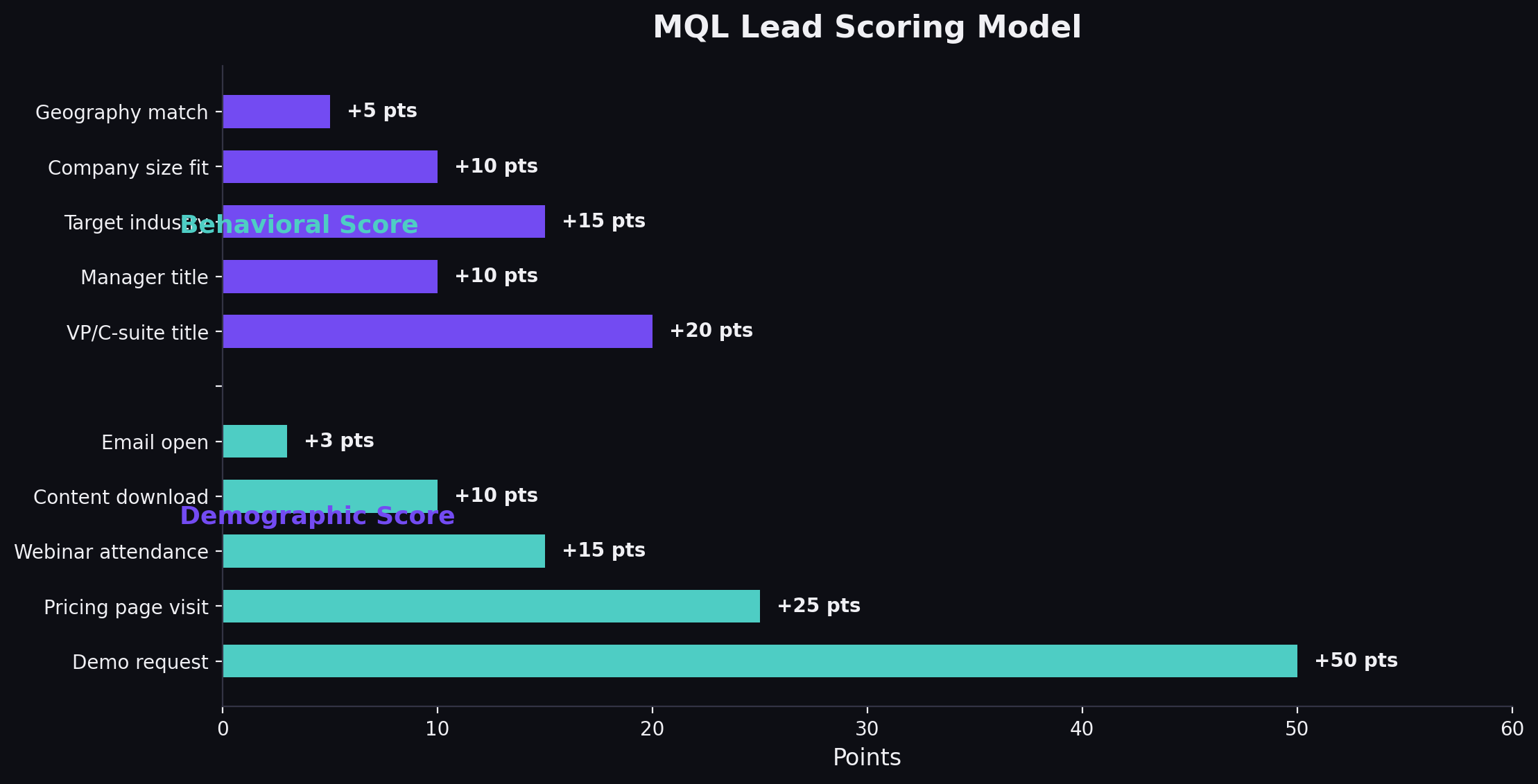
The two-score system prevents the most common scoring failure: a low-fit contact becoming an MQL through high engagement alone. No matter how many blog posts they read, a marketing intern at a 5-person company cannot reach an MQL threshold if the fit score gate requires 50 points.
Model 2: The Tiered MQL System
Not all MQLs are equal. A demo request from a perfect-fit company is fundamentally different from a whitepaper download that pushed someone over the scoring threshold. Treat them differently.
MQL Tier 1 (Hot): Demo request, pricing inquiry, or “contact sales” submission from an ICP-fit contact.
- SLA: Sales contact within 5 minutes
- Routing: Direct to AE if available, otherwise senior SDR
- Expected SQL conversion: 40-60%
MQL Tier 2 (Warm): High engagement score (multiple high-intent page views, multiple content interactions in a short window) from an ICP-fit contact.
- SLA: Sales contact within 1 hour
- Routing: SDR via standard round-robin
- Expected SQL conversion: 15-25%
MQL Tier 3 (Scored): Contact crossed the composite scoring threshold through cumulative engagement without a single high-intent action.
- SLA: Sales contact within 4 hours
- Routing: SDR via standard round-robin with nurture backup
- Expected SQL conversion: 5-10%
Tiering prevents the “all MQLs are treated the same” problem. Your sales team knows that a Tier 1 MQL is worth dropping everything for. A Tier 3 MQL can be worked into their regular outreach cadence.
Model 3: The Intent-Enriched Model
Layer third-party intent data on top of your first-party scoring for a more complete picture.
Third-party intent sources:
- Bombora: Tracks content consumption across 5,000+ B2B websites to identify companies researching specific topics
- G2 Buyer Intent: Identifies companies actively comparing products in your category on G2
- LinkedIn Sales Navigator alerts: Tracks job changes, company growth signals, and content engagement
- TechCrunch/Crunchbase: Funding events, executive hires, expansion signals
When a target account shows third-party intent signals, boost their score:
| Third-Party Signal | Score Boost |
|---|---|
| G2 comparison page view (your category) | +30 |
| Bombora surge on your topic cluster | +20 |
| New VP/Director hired at target account | +15 |
| Funding round announced | +15 |
| Job posting for role your product supports | +10 |
Third-party intent data is most valuable for identifying accounts that are in-market but have not yet visited your website. Combined with outbound, this creates a “warm outbound” motion that converts significantly better than cold outbound. For more on building a full SaaS demand generation engine, see our complete playbook.
Conversion Benchmarks by Segment
These benchmarks represent aggregated data across B2B SaaS companies. Use them as directional guidance, not as absolute targets.
By Company Size (of the SaaS company doing the selling)
| Stage | Seed-Series A ($0-5M ARR) | Series B-C ($5-30M ARR) | Growth ($30M+ ARR) |
|---|---|---|---|
| Lead to MQL | 12-18% | 18-25% | 20-28% |
| MQL to SQL | 8-12% | 13-18% | 18-30% |
| SQL to Opportunity | 50-60% | 60-70% | 65-75% |
| Opportunity Win Rate | 15-22% | 20-28% | 22-32% |
Early-stage companies tend to have lower conversion rates because their ICP is less defined, their lead scoring models are less calibrated, and their sales teams are less experienced with the qualification process.
By ACV (Average Contract Value)
| Stage | SMB (<$10K ACV) | Mid-Market ($10-50K ACV) | Enterprise ($50K+ ACV) |
|---|---|---|---|
| Lead to MQL | 20-30% | 15-22% | 10-15% |
| MQL to SQL | 15-25% | 12-18% | 8-14% |
| SQL to Opportunity | 55-65% | 60-70% | 65-80% |
| Opportunity Win Rate | 22-30% | 18-25% | 12-20% |
| Avg Sales Cycle | 14-30 days | 30-90 days | 90-180 days |
Higher ACV deals have lower top-of-funnel conversion rates but higher bottom-of-funnel conversion rates. This makes sense - enterprise deals involve more stakeholders and longer evaluations, but the deals that reach the SQL and Opportunity stages are more thoroughly qualified.
By Acquisition Channel
| Channel | MQL to SQL Rate | Notes |
|---|---|---|
| Inbound demo request | 40-60% | Highest intent signal |
| Free trial (PQL) | 25-40% | Product-qualified, pre-validated |
| Paid search (high-intent keyword) | 20-35% | Active solution seeker |
| G2/review site referral | 18-30% | Comparison shopper |
| Organic search (educational content) | 8-15% | Research phase, not buying phase |
| Webinar attendee | 8-12% | Interest in topic, not necessarily product |
| Content download | 5-8% | Lowest intent, highest volume |
| Outbound (cold) | 3-7% | No pre-existing intent |
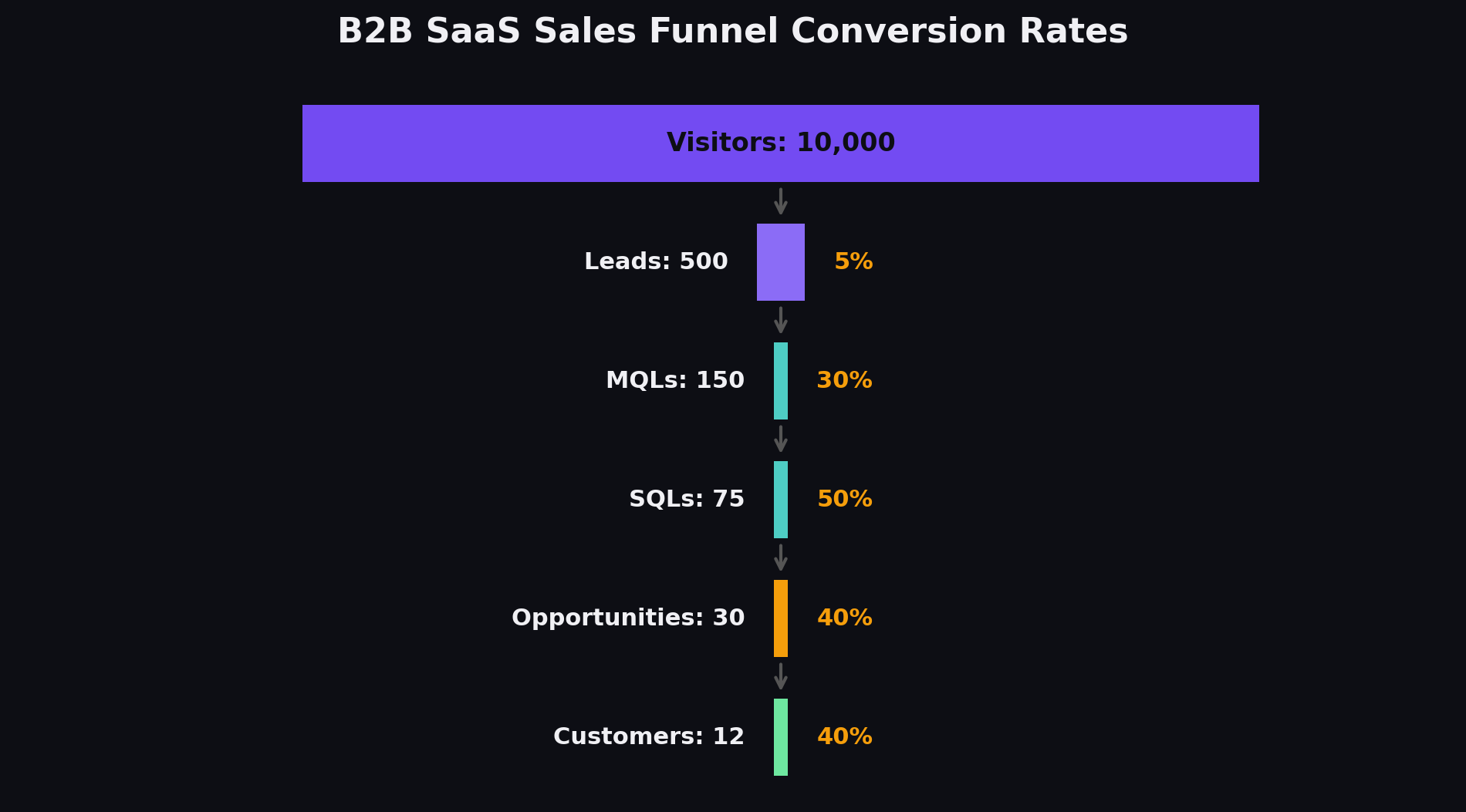
This data shows why channel-specific MQL definitions make sense. An MQL from a demo request converts at 8-12x the rate of an MQL from a content download. They should not have the same SLA, the same routing, or the same follow-up approach.
Setting Up Lead Scoring: Step-by-Step
HubSpot Setup
Step 1: Navigate to Settings > Properties > Contact Properties > HubSpot Score.
Step 2: Add positive scoring criteria for fit:
- Job title contains “VP,” “Director,” “Head of,” “Chief” = +25 points
- Company size is 50-500 = +20 points
- Industry is “Software” or “Technology” = +15 points
- Country is “United States” or “United Kingdom” = +10 points
Step 3: Add positive scoring criteria for engagement:
- Page view URL contains “/pricing” = +20 points
- Page view URL contains “/demo” = +15 points
- Form submission on “Demo Request” = +50 points
- Form submission on any form = +10 points
- Email clicked = +5 points
- Email opened = +1 point
Step 4: Add negative scoring criteria:
- Email domain contains “gmail.com” or “yahoo.com” = -10 points (adjust for your business)
- Job title contains “Student” or “Intern” = -50 points
- Company domain is a known competitor = -100 points
- Email unsubscribed = -30 points
Step 5: Set MQL threshold. Create a workflow:
- Trigger: Contact score is greater than or equal to 75
- AND: Lifecycle stage is “Lead” (prevents re-qualifying existing MQLs)
- Action: Set lifecycle stage to “Marketing Qualified Lead”
- Action: Send internal notification to assigned SDR
- Action: Create task for SDR with due date (based on your SLA)
Step 6: Create a decay workflow:
- Trigger: Contact has not visited website in 60 days
- AND: Lifecycle stage is “Marketing Qualified Lead”
- Action: Reduce score by 30 points
- Action: If score drops below 75, set lifecycle stage back to “Lead”
- Action: Enroll in re-engagement nurture sequence
Salesforce + Pardot Setup
Step 1: In Pardot, navigate to Marketing > Segmentation > Scoring.
Step 2: Create scoring categories:
- Default: For engagement scoring
- Custom: For fit scoring (create a separate scoring model)
Step 3: Configure engagement scoring rules:
- Page view (any) = +1 point
- Page view (pricing page) = +20 points
- Page view (demo page) = +15 points
- Form submission (demo request) = +50 points
- Form submission (content download) = +10 points
- Email click = +5 points
- Email open = +1 point
Step 4: Configure fit scoring using Pardot grading:
- Set up letter grades (A-F) based on prospect profile
- A = perfect ICP match (right title, right company size, right industry)
- B = partial match (2 of 3 criteria)
- C = adjacent match (1 of 3 criteria)
- D = poor match
- F = disqualified (competitor, wrong geography, wrong company type)
Step 5: Set completion actions:
- When score exceeds 75 AND grade is B or higher:
- Change prospect status to “MQL”
- Notify assigned sales rep
- Add to Salesforce campaign “MQL - [Month] [Year]”
Step 6: Create Salesforce automation:
- When Lead Status = “MQL,” create a Task assigned to the lead owner
- Task subject: “MQL Follow-Up: [Lead Name] at [Company]”
- Task due date: Today (for Tier 1) or Tomorrow (for Tier 2/3)
- Include lead score and recent activity in task description
What Does Not Work: Lead Scoring Anti-Patterns
Scoring Email Opens
Email open tracking is unreliable. Apple Mail Privacy Protection (introduced in iOS 15, now used by 50%+ of email recipients) pre-loads tracking pixels, making every email appear “opened” regardless of whether the recipient actually read it. If email opens represent more than 5% of your total scoring, your model is inflated.
No Score Decay
A lead who was active 6 months ago and has not visited your site since is not the same as a lead who is active today. Without score decay, your MQL queue fills up with stale leads that scored above threshold months ago and have long since lost interest. Implement a decay of 10-20% per month on engagement scores.
Equal Weighting for All Form Submissions
A “Request a Demo” form submission and a “Download our Annual Report” form submission are not equivalent signals. Weight them differently. Demo requests should be 3-5x the score of content downloads.
Scoring Page Views Without Context
A prospect who visits your blog post about “What is [category]?” is in a different buying stage than a prospect who visits your comparison page. Score by page intent, not page count. Pricing, demo, comparison, and case study pages should score 5-10x more than blog posts.
Never Recalibrating
Your scoring model should be recalibrated quarterly. Pull the scores of every contact who became a Closed Won customer in the past quarter. Pull the scores of every MQL that was rejected or went Closed Lost. Compare the distributions. If the scores overlap heavily, your model is not predictive. Adjust the weights until Closed Won contacts have consistently higher scores than non-converters at the point of MQL creation.
Scoring Without Negative Signals
If your model only adds points, it will eventually qualify everyone. A competitor employee who reads your blog daily will become an MQL. A student researching for a thesis will become an MQL. Add negative signals: competitor email domains (-100), personal email domains (-10 to -20 depending on your product), unsubscribed contacts (-30), contacts at companies smaller than your minimum (-25).
The MQL SLA: The Document That Stops the Blame Game
If you build one artifact from this guide, make it the SLA. This is the agreement between marketing and sales that defines what an MQL is, how quickly it must be followed up on, and what feedback must be provided.
Sample SLA Structure
Section 1: MQL Definition
- Minimum fit score: 50/100
- Minimum engagement score: 30/100
- Composite threshold: 75 (fit + engagement combined)
- Auto-MQL triggers: Demo request from ICP-fit contact (bypasses scoring)
- Exclusions: Known competitors, existing customers, contacts with invalid email
Section 2: Marketing Commitments
- Deliver [X] MQLs per month
- Enrichment: All MQLs will have company name, title, company size, and industry populated
- Tier classification: Every MQL will be tagged as Tier 1 (hot), Tier 2 (warm), or Tier 3 (scored)
- Reporting: Weekly MQL quality dashboard shared with sales leadership
Section 3: Sales Commitments
- Follow-up SLA:
- Tier 1: First outreach within 5 minutes during business hours
- Tier 2: First outreach within 1 hour
- Tier 3: First outreach within 4 hours
- Minimum contact attempts: 5 (mix of email, phone, LinkedIn)
- Disposition: Every MQL must be dispositioned in CRM within 14 days with one of: Accepted (converted to SQL), Rejected (with reason code), or No Contact (after 5 attempts)
- Feedback: Sales rep must select a specific rejection reason from a predefined list (not free text)
Section 4: Joint Commitments
- Monthly review of MQL-to-SQL conversion rates by tier
- Quarterly scoring model recalibration
- Bi-annual full MQL definition review
Section 5: Rejection Reason Codes
- Wrong persona (not a decision-maker or influencer)
- Wrong company size (too small or too large)
- Wrong industry
- No budget
- Already using a competitor (not evaluating)
- Bad contact info (bounced email, wrong phone number)
- Already a customer
- Not a real company (consultant, student, freelancer)
- Duplicate (already in pipeline with different contact)
- Timing - not ready (recycle to nurture)
The rejection reason distribution is the most valuable data marketing can get from sales. If 40% of rejections are “wrong persona,” you have a targeting or scoring problem. If 30% are “no budget,” you might be reaching the right people at the wrong companies. If 25% are “bad contact info,” you have an enrichment problem. Each pattern has a specific fix.
From MQL to Revenue: Closing the Loop
The MQL is not the end goal. Revenue is the end goal. The most sophisticated MQL programs track not just MQL volume and MQL-to-SQL conversion, but MQL-to-Revenue.
Here is the reporting stack you need:
Weekly dashboard:
- MQLs generated (total and by tier)
- MQL follow-up compliance (% contacted within SLA)
- MQL-to-SQL conversion rate (trailing 30 days)
- MQL rejection rate and top rejection reasons
Monthly dashboard:
- MQL-to-Opportunity conversion rate
- Average days from MQL to Opportunity
- Pipeline generated from MQLs (dollar value)
- MQL source breakdown (which channels and campaigns generate the most MQLs)
Quarterly dashboard:
- MQL-to-Closed-Won conversion rate
- Revenue attributed to MQLs
- Customer acquisition cost by MQL source
- Scoring model accuracy (do higher-scored MQLs close at higher rates?)
The quarterly dashboard is what prevents the volume trap. Marketing might be generating 500 MQLs per month from content downloads, but if those MQLs generate $0 in revenue while 50 MQLs from demo requests generate $2M, the scoring model and the incentive structure need to change.
The Future of Lead Qualification
The lead qualification landscape is shifting in three directions:
1. Signal-based selling. Instead of scoring individual contacts, companies are aggregating signals across accounts - website visits from multiple people at the same company, third-party intent data, job postings, funding events, and product usage. The “qualified” signal becomes an account-level determination, not a contact-level one.
2. AI-assisted scoring. Machine learning models trained on closed-won data can identify patterns that human-designed scoring rules miss. These models continuously recalibrate as new data flows in. HubSpot, Salesforce, and 6sense all offer AI-powered lead scoring that outperforms static rule-based scoring on conversion rate prediction accuracy (industry benchmark).
3. Product-led and marketing-led fusion. The line between PQL and MQL is blurring as more SaaS companies adopt hybrid acquisition models. A contact might enter through a blog post (marketing-led), sign up for a free trial (product-led), and then request a call with sales after hitting a usage limit. The qualification path is no longer linear, and the scoring model needs to account for both marketing engagement and product usage.
Regardless of where the landscape goes, the fundamental principle remains: you need a shared definition of “qualified,” a mechanism to route qualified leads to the right person at the right time, and a feedback loop that continuously improves the definition based on what actually closes.
Call it an MQL. Call it a PQL. Call it a “buying signal.” The name is irrelevant. The rigor is everything.
If you need help building an MQL framework that actually drives pipeline, PipelineRoad’s B2B SaaS marketing team can design and implement the full lead scoring and qualification system for you.
Frequently Asked Questions
What is an MQL (marketing qualified lead)?
An MQL is a lead that has demonstrated enough fit (matching your ideal customer profile) and engagement (taking actions that indicate buying interest) to warrant direct sales outreach. The specific criteria are defined jointly by marketing and sales based on historical data about which leads actually convert to customers. An MQL is not someone who downloaded a whitepaper. It is someone whose combined profile and behavior suggest they are likely to buy.
Is the MQL dead?
No. The MQL as a metric is still useful when defined properly. What is dead is the outdated version of MQL that equated content downloads with buying intent. Modern MQLs should combine firmographic fit scoring with behavioral intent signals and ideally product usage data. Companies that have abandoned MQLs entirely usually replace them with something functionally identical under a different name.
What is the difference between MQL and SQL?
An MQL is qualified by algorithms and data - lead scoring based on fit and engagement thresholds. An SQL is qualified by a human - a sales development rep who has spoken with the lead and confirmed they have a real need, budget, authority, and timeline. The MQL is a signal that says 'this lead is worth calling.' The SQL is a confirmation that says 'this lead is worth a full sales cycle.'
What is a PQL (product qualified lead)?
A PQL is a user who has experienced meaningful value in your product through a free trial or freemium plan and is showing signals of readiness to convert to paid. PQL signals include reaching an activation milestone, using key features, inviting team members, hitting usage limits, or visiting the billing page. PQLs typically convert at 2-5x the rate of traditional MQLs because they have already experienced the product value firsthand.
What is a good MQL to SQL conversion rate?
The median MQL-to-SQL conversion rate across B2B SaaS is 13-15%. Top-performing companies achieve 25-35%. Below 10% indicates your MQL criteria are too loose. Above 40% suggests you are being too conservative and likely missing qualified leads. The rate varies significantly by sales motion - inbound-heavy companies tend toward the higher end, outbound-heavy companies toward the lower end.
How do you set up lead scoring in HubSpot?
In HubSpot, go to Settings, then Properties, then HubSpot Score. Add positive scoring rules for fit criteria (job title, company size, industry) and engagement criteria (page views, form submissions, email clicks). Add negative rules for disqualifying signals (competitor domains, student emails, unsubscribes). Set the MQL threshold based on the scores of your last 50 closed-won deals. Create a workflow that changes lifecycle stage to MQL when a contact exceeds the threshold.
Ready to build your SaaS marketing machine?
We have run these plays at 40+ B2B SaaS companies. Let's talk about yours.
Book a Strategy Call