SaaS Marketing Team Structure: Org Charts, Hiring Guides, and Salary Benchmarks for 2026
How to structure a B2B SaaS marketing team by stage - org charts from $0 to $20M+ ARR, first hire guides, salary benchmarks, and when to outsource vs hire.
The first thing most SaaS founders get wrong about marketing is the team.
They either hire nobody for too long (the founder does everything until they are doing nothing well), or they hire the wrong person first (a brand marketer when they need demand gen, or a demand gen specialist when they need a generalist), or they hire too many people too fast (five specialists before anyone has defined the strategy).
Getting the marketing team structure right is not about following an org chart from a blog post. It is about matching your team to your stage, your go-to-market model, and your budget. A $2M ARR company with a sales-led motion needs a completely different team than a $2M ARR company with a product-led motion. A Series B company spending $150K/month on marketing needs a different team than a bootstrapped company spending $10K/month.
This guide covers how to build a SaaS marketing team at every stage - from founder-led marketing through a fully built-out department. It includes org charts, role descriptions, salary benchmarks, hiring sequences, and the agency vs in-house decision at each stage. Kalungi has their version focused on the T2D3 framework. Our version at PipelineRoad is based on what we see working across the SaaS companies we work with, which range from pre-revenue to $30M+ ARR.
The Principles of SaaS Marketing Team Design
Before looking at specific org charts, here are the principles that should guide every team-building decision:
Principle 1: Hire generalists first, specialists later.
A marketing generalist who can write a blog post, set up a LinkedIn campaign, send an email sequence, and read a GA4 report is infinitely more valuable at $1M ARR than a specialist who can only do one of those things brilliantly. You need breadth before you need depth. Specialists come in when the volume of work in a specific function exceeds what a generalist can handle.
Principle 2: Hire for the stage you are in, not the stage you want to be in.
A VP of Marketing from a $100M ARR company is rarely the right hire for a $3M ARR company. They are used to managing large teams, working with big budgets, and delegating execution. What you need at $3M is someone who can write copy, build a campaign in HubSpot, analyze pipeline data, and present a board deck - often in the same day. Hire from companies one stage ahead of yours, not three stages ahead.
Principle 3: Build the strategy before you build the team.
Do not hire a content marketer before you have defined your content strategy. Do not hire a demand gen manager before you know which channels work. The founder or first marketing hire should validate the strategy. Then hire people to execute and scale it.
Principle 4: Every marketing team member should tie to revenue.
If someone on the marketing team cannot explain how their work connects to pipeline and revenue, either their role is not defined correctly or their work is not aligned with the business. This is not about making everyone a demand gen robot. Brand and content play long-term roles. But even long-term investments should have measurable proxies (organic traffic growth, branded search volume, content-attributed pipeline).
Principle 5: Account for total cost, not just salary.
A $100K/year marketer costs $130-160K when you add benefits, payroll taxes, equipment, tools, and professional development. When comparing in-house vs agency, use the fully loaded cost, not just the salary. A $10K/month agency retainer might look expensive until you compare it to the $140K fully loaded cost of a single in-house hire who can only cover one function.
Stage 1: $0-$1M ARR - Founder-Led Marketing
At this stage, marketing is not a department. It is a set of activities that the founder does alongside everything else.
The Team
| Role | Who | Time on Marketing |
|---|---|---|
| Founder / CEO | You | 30-50% of time |
| Part-time contractor or agency (optional) | Freelancer or small agency | 10-20 hours/week |
What the Founder Should Do
- Outbound. Write and send cold emails. This is your primary pipeline source. Nobody can sell the vision better than the founder.
- LinkedIn. Post 3-4x per week about the problem you are solving. Build a personal brand that attracts your ICP.
- Website. Build a basic website with a clear value proposition, social proof, and a demo CTA. Webflow, Carrd, or even a well-designed single page is sufficient.
- Content. Write 1-2 blog posts per month about the problem your product solves. This is the foundation for SEO that will compound later.
- Customer stories. Document every early win. Video testimonials, case studies, logos. These are your most valuable marketing assets.
What the Founder Should NOT Do
- Do not hire a full-time marketer yet. You do not have enough process, strategy, or budget to keep a full-time marketer productive. Contractors and part-time help are more efficient.
- Do not run paid ads with less than $2K/month budget. Below that threshold, you will not generate enough data to optimize. Use organic channels instead.
- Do not invest in brand design. A professional logo and clean website template are fine. Custom brand identity work can wait until you have proven product-market fit.
- Do not build a marketing tech stack. HubSpot free CRM, Apollo for outbound, and GA4 for analytics. That is your stack. Everything else is a distraction.
When to Make the First Marketing Hire
You are ready for a first marketing hire when:
- You have consistent pipeline and early revenue ($500K+ ARR or clear path to it)
- You have validated at least one marketing channel (outbound, content, or paid)
- The founder is spending 20+ hours/week on marketing and it is pulling them away from product and sales
- You have budget for a $80K-$120K salary plus $2K-$5K/month in tools and programs
Stage 2: $1M-$5M ARR - The First Marketing Hires
This is the most critical stage for building the marketing team. The decisions you make here compound for years.
The First Hire: Marketing Generalist
Title: Marketing Manager, Growth Marketing Manager, or Head of Growth
What this person does:
- Owns the content calendar and writes or manages content production
- Runs email marketing (newsletters, nurture sequences, outbound support)
- Manages basic paid campaigns (LinkedIn, Google)
- Maintains the website (landing pages, CTAs, SEO basics)
- Reports on marketing metrics (traffic, leads, pipeline contribution)
- Manages agency and contractor relationships
What this person should NOT be:
- A pure brand/creative person (you need pipeline, not mood boards)
- A pure analyst (you need someone who does, not someone who measures)
- A junior person who needs heavy management (the founder cannot be a marketing manager and a marketing management trainer)
- An executive who only delegates (there is nobody to delegate to yet)
Ideal profile:
- 3-5 years of B2B SaaS marketing experience
- Has worked at a company in the $1-10M ARR range
- Can write (this is non-negotiable - if they cannot write a blog post, they cannot be your first marketing hire)
- Comfortable with data and analytics
- Scrappy - willing to do whatever needs doing, not precious about job scope
Salary range (2026): $85,000-$120,000 base, depending on market and experience.
The Second Hire: Content or Demand Gen
Your second hire depends on your go-to-market motion:
If you are content/SEO-led: Hire a content marketer. This person writes 8-12 blog posts per month, manages SEO, builds your organic traffic engine, and repurposes content for social and email.
If you are outbound/paid-led: Hire a demand gen marketer. This person manages paid campaigns, optimizes landing pages, runs ABM programs, and manages the tech stack for lead generation.
| Role | When to Hire | Salary Range | Focus |
|---|---|---|---|
| Content Marketing Manager | $1.5-3M ARR (if content-led) | $80,000-$110,000 | Blog, SEO, social, email content |
| Demand Gen / Growth Manager | $1.5-3M ARR (if outbound/paid-led) | $90,000-$125,000 | Paid media, landing pages, campaigns |
The Team at $3-5M ARR
| Role | Focus | Salary Range |
|---|---|---|
| Head of Marketing (or VP) | Strategy, leadership, board reporting | $130,000-$170,000 |
| Content Marketing Manager | Blog, SEO, social, thought leadership | $85,000-$115,000 |
| Demand Gen Manager | Paid media, campaigns, pipeline attribution | $95,000-$130,000 |
| Marketing Coordinator or Associate (optional) | Events, admin, project management | $55,000-$75,000 |
Total headcount: 3-4 people Total headcount cost (fully loaded): $400,000-$640,000
Org Chart: $3-5M ARR
CEO / Founder
    |
Head of Marketing
    |
    ├── Content Marketing Manager
    ├── Demand Gen Manager
    └── Marketing Coordinator (optional)

    + Agency partner(s) for SEO, design, specialized execution
Stage 3: $5M-$20M ARR - Building the Engine
This is where marketing transitions from a small team doing a bit of everything to a structured department with specialized functions.
The Hiring Sequence (in priority order)
| Hire # | Role | Why Now | Salary Range |
|---|---|---|---|
| 1 | VP of Marketing (if not already hired) | Need senior leadership, board-level reporting, GTM strategy | $160,000-$220,000 |
| 2 | Product Marketing Manager | Positioning, competitive intel, sales enablement become critical at this scale | $100,000-$140,000 |
| 3 | Senior Content Marketer or Content Lead | Content volume needs to increase, need editorial strategy | $95,000-$130,000 |
| 4 | Marketing Ops / RevOps | Tech stack complexity increases, need dedicated ops person | $90,000-$125,000 |
| 5 | Designer | Brand consistency matters more, ad creative needs increase | $80,000-$110,000 |
| 6 | Demand Gen Lead | Paid programs scale, need someone owning full demand gen stack | $110,000-$150,000 |
| 7 | SDR Manager (if outbound is significant) | SDR team needs management as it scales beyond 2-3 reps | $90,000-$120,000 |
| 8 | Community / Partnerships Manager | Community and partnerships become material pipeline sources | $80,000-$110,000 |
The Team at $5-10M ARR
| Function | Roles | Headcount | Total Cost (Fully Loaded) |
|---|---|---|---|
| Leadership | VP of Marketing | 1 | $200,000-$280,000 |
| Content | Content Lead + 1 Writer | 2 | $200,000-$280,000 |
| Demand Gen | Demand Gen Manager + SDR(s) | 2-3 | $250,000-$420,000 |
| Product Marketing | Product Marketing Manager | 1 | $130,000-$180,000 |
| Ops | Marketing Ops Manager | 1 | $115,000-$160,000 |
| Design | In-house Designer | 1 | $100,000-$140,000 |
| Total | 8-9 | $995,000-$1,460,000 |
Org Chart: $5-10M ARR
CEO / CRO
    |
VP of Marketing
    |
    ├── Content Lead
    │       └── Content Writer
    │
    ├── Demand Gen Manager
    │       └── SDR(s) [may report to Sales]
    │
    ├── Product Marketing Manager
    │
    ├── Marketing Ops Manager
    │
    └── Designer

    + Agency partners for SEO, PR, specialized campaigns
The Team at $10-20M ARR
At this scale, each function has its own sub-team and the VP of Marketing manages directors rather than individual contributors.
| Function | Roles | Headcount |
|---|---|---|
| Leadership | VP/CMO + Chief of Staff or Marketing Ops Director | 1-2 |
| Content & SEO | Director of Content + 2-3 Writers + SEO Specialist | 4-5 |
| Demand Gen | Director of Demand Gen + Paid Media Manager + Campaign Manager | 3-4 |
| Product Marketing | Director of PMM + 1-2 PMMs | 2-3 |
| Brand & Creative | Creative Director or Senior Designer + 1-2 Designers | 2-3 |
| Marketing Ops | Marketing Ops Manager + Analyst | 2 |
| SDR (if under marketing) | SDR Manager + 4-8 SDRs | 5-9 |
| Total (excluding SDRs) | 14-19 | |
| Total (including SDRs) | 19-28 |
Org Chart: $10-20M ARR
CEO / CRO
    |
CMO / VP of Marketing
    |
    ├── Director of Content
    │       ├── Senior Content Writer
    │       ├── Content Writer
    │       └── SEO Specialist
    │
    ├── Director of Demand Gen
    │       ├── Paid Media Manager
    │       └── Campaign Manager
    │
    ├── Director of Product Marketing
    │       └── Product Marketing Manager
    │
    ├── Creative Director / Senior Designer
    │       └── Designer
    │
    └── Marketing Ops Director
            └── Marketing Analyst

    + SDR Team (may report to Marketing or Sales)
    + Agency partners for PR, events, specialized execution
Stage 4: $20M+ ARR - The Full Machine
At $20M+ ARR, marketing is a fully built department with 15-30+ people across multiple specialized functions.
Key Functions at Scale
Content and Brand
- Content strategy and editorial
- SEO and organic growth
- Brand and creative
- Video production
- Social media
Demand Generation
- Paid media (multi-channel)
- ABM programs
- Events and field marketing
- Partnerships and co-marketing
- Web optimization (CRO)
Product Marketing
- Positioning and messaging
- Competitive intelligence
- Sales enablement
- Product launches
- Customer marketing
Marketing Operations
- Tech stack management
- Data and analytics
- Attribution and reporting
- Budget and forecasting
- Process and governance
New Roles That Appear at $20M+
| Role | What They Do | When to Add | Salary Range |
|---|---|---|---|
| CMO | Executive leadership, board-level strategy, cross-functional alignment | When the CEO can no longer lead marketing strategy | $200,000-$350,000 + equity |
| Director of Field Marketing | Regional events, ABM activation, local partnerships | When you expand beyond one geographic market | $130,000-$170,000 |
| Customer Marketing Manager | Case studies, advocacy programs, referral programs, customer events | When NRR and expansion become strategic priorities | $90,000-$120,000 |
| Marketing Analyst / Data Scientist | Advanced analytics, predictive modeling, multi-touch attribution | When you need insights beyond standard reporting | $100,000-$140,000 |
| Video Producer | In-house video content for social, ads, product demos, events | When video becomes a core content format | $80,000-$120,000 |
| Web Developer (Marketing) | Website development, landing pages, conversion optimization | When website changes outpace design team’s capacity | $100,000-$140,000 |
| PR / Communications Manager | Media relations, thought leadership placement, crisis communications | When brand reputation matters for enterprise sales | $90,000-$130,000 |
Salary Benchmarks for SaaS Marketing Roles (2026)
These ranges reflect US market rates for B2B SaaS companies. Remote roles in lower cost-of-living areas typically pay 10-20% less. San Francisco, New York, and Boston command premiums of 10-20% above these ranges.
Individual Contributor Roles
| Role | Junior (1-3 years) | Mid-Level (3-5 years) | Senior (5-8 years) |
|---|---|---|---|
| Content Writer / Marketer | $60,000-$80,000 | $80,000-$110,000 | $100,000-$130,000 |
| SEO Specialist | $60,000-$80,000 | $80,000-$110,000 | $100,000-$130,000 |
| Demand Gen / Growth Marketer | $70,000-$90,000 | $90,000-$120,000 | $110,000-$140,000 |
| Product Marketing Manager | $80,000-$100,000 | $100,000-$130,000 | $120,000-$160,000 |
| Marketing Ops / RevOps | $70,000-$90,000 | $90,000-$120,000 | $110,000-$140,000 |
| Designer (Marketing) | $65,000-$85,000 | $85,000-$110,000 | $100,000-$130,000 |
| SDR / BDR | $45,000-$55,000 (base) | $55,000-$70,000 (base) | N/A (typically become AE) |
Management Roles
| Role | Salary Range | Typical Experience |
|---|---|---|
| Marketing Manager (generalist) | $85,000-$120,000 | 3-5 years |
| Content Lead / Content Director | $110,000-$150,000 | 5-8 years |
| Demand Gen Director | $130,000-$170,000 | 6-10 years |
| Product Marketing Director | $140,000-$180,000 | 7-10 years |
| Marketing Ops Director | $120,000-$160,000 | 6-10 years |
| Creative Director | $130,000-$170,000 | 8-12 years |
| SDR Manager | $80,000-$110,000 (base) | 3-5 years |
Executive Roles
| Role | Salary Range | Equity (% of total comp) | Typical at |
|---|---|---|---|
| Head of Marketing | $130,000-$180,000 | 10-20% | $2-8M ARR |
| VP of Marketing | $160,000-$250,000 | 15-25% | $5-30M ARR |
| CMO | $200,000-$350,000 | 20-40% | $20M+ ARR |
| Fractional CMO | $5,000-$15,000/month | None typically | $1-20M ARR |
Source: Glassdoor (2025), Levels.fyi, LinkedIn Salary Insights (2025), Pavilion CMO Compensation Report (2025), and salary data from SaaS marketing placements facilitated by PipelineRoad.
When to Outsource vs Hire: The Decision Framework
This decision comes up at every stage. Here is a framework that accounts for cost, quality, speed, and strategic importance.
The Outsource-Hire Matrix
| Function | Stage 1 ($0-1M) | Stage 2 ($1-5M) | Stage 3 ($5-20M) | Stage 4 ($20M+) |
|---|---|---|---|---|
| Content strategy | Founder | In-house | In-house | In-house |
| Content production | Freelance | Hybrid (in-house + freelance) | In-house team | In-house team |
| SEO | Agency | Agency | In-house + agency | In-house team |
| Paid media | DIY or agency | Agency | In-house or agency | In-house team |
| Outbound / SDR | Founder + agency | Agency or first SDR | In-house team | In-house team |
| Product marketing | Founder | In-house | In-house | In-house team |
| Design | Freelance | Freelance or in-house | In-house | In-house team |
| Marketing ops | Founder (basic) | Agency or part-time | In-house | In-house team |
| Events | N/A | Agency | Hybrid | In-house + agency |
| PR | N/A | Agency (if needed) | Agency | In-house + agency |
| Video | Freelance | Freelance | Freelance or in-house | In-house |
The Cost Comparison at Each Stage
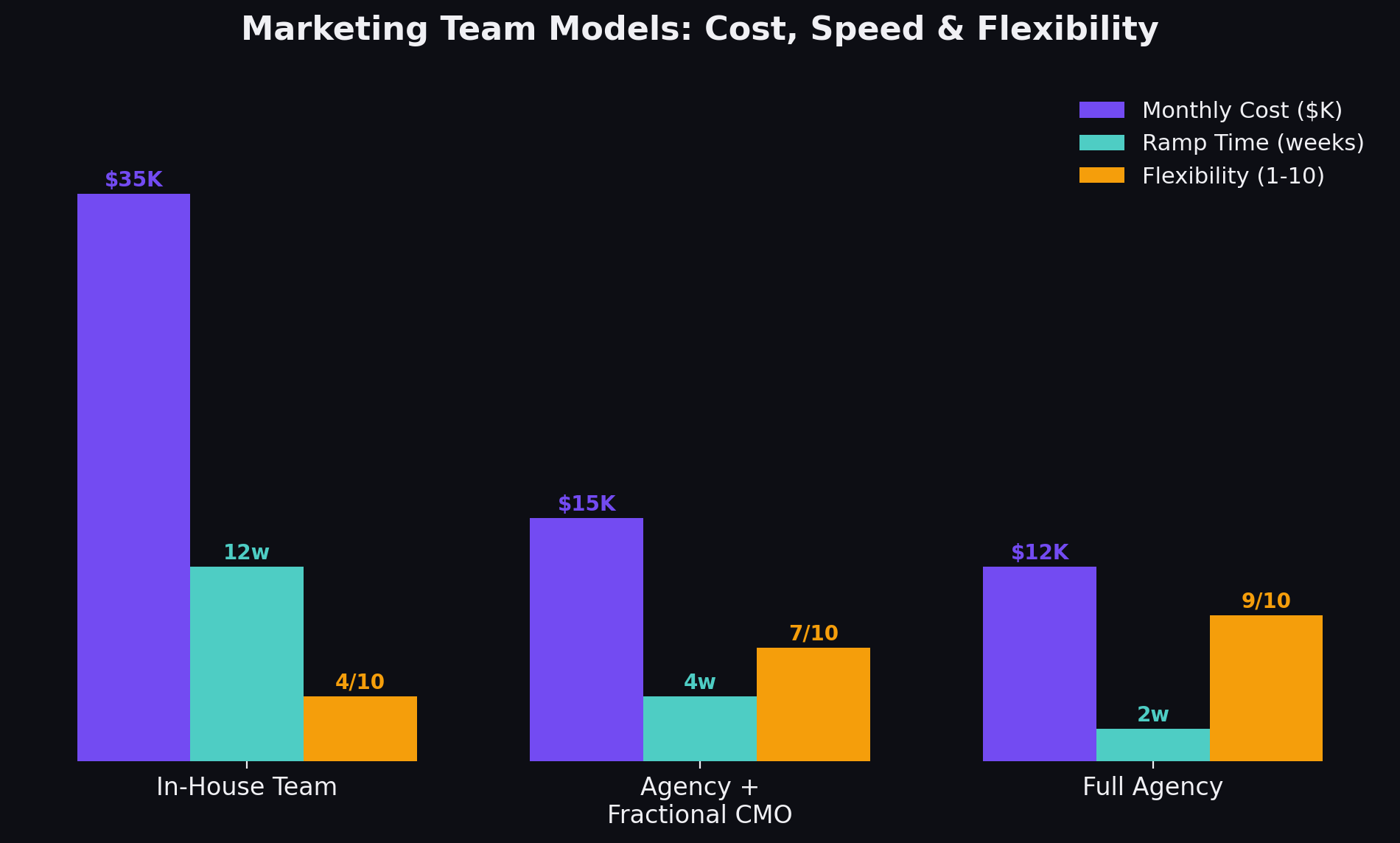
At $1-3M ARR: Agency-Heavy Model vs In-House-Heavy Model
| Component | Agency-Heavy | In-House-Heavy |
|---|---|---|
| Internal headcount | 1 (marketing generalist: $110K) | 3 (head + content + demand gen: $320K) |
| Agency retainer | $8K-15K/month ($96K-180K/year) | $2K-4K/month ($24K-48K/year) |
| Tools + ad spend | $3K/month ($36K/year) | $3K/month ($36K/year) |
| Fully loaded annual cost | $282K-$426K | $416K-$524K |
| Time to productivity | 2-4 weeks | 3-6 months |
| Flexibility | High (can scale up/down monthly) | Low (headcount is fixed cost) |
For most SaaS companies at this stage, the agency-heavy model wins on cost, speed, and flexibility. One strong internal hire coordinates strategy while the agency provides execution bandwidth.
At $5-10M ARR: Hybrid Model vs Fully In-House Model
| Component | Hybrid (In-House + Agency) | Fully In-House |
|---|---|---|
| Internal headcount | 5-6 ($600K-$800K) | 8-10 ($900K-$1.3M) |
| Agency retainer | $10K-25K/month ($120K-$300K/year) | $0-5K/month ($0-60K/year) |
| Tools + ad spend | $8K/month ($96K/year) | $8K/month ($96K/year) |
| Fully loaded annual cost | $816K-$1.2M | $996K-$1.46M |
| Specialized expertise | High (agency brings specialists) | Medium (generalists wearing multiple hats) |
At this stage, the hybrid model often still wins because agencies provide specialist expertise that would require additional hires to replicate in-house.
When Agency is Better Than In-House
- Speed. An agency can launch a program in 2-4 weeks. Hiring and onboarding takes 3-6 months.
- Specialized expertise. A good SEO agency, paid media agency, or PR firm brings depth of expertise that a single in-house hire cannot match.
- Variable cost. Agency spend can be adjusted monthly. Headcount is a fixed cost with severance implications.
- Senior leadership. A fractional CMO through an agency costs $5K-$15K/month. A full-time CMO costs $250K-$400K/year including equity.
When In-House is Better Than Agency
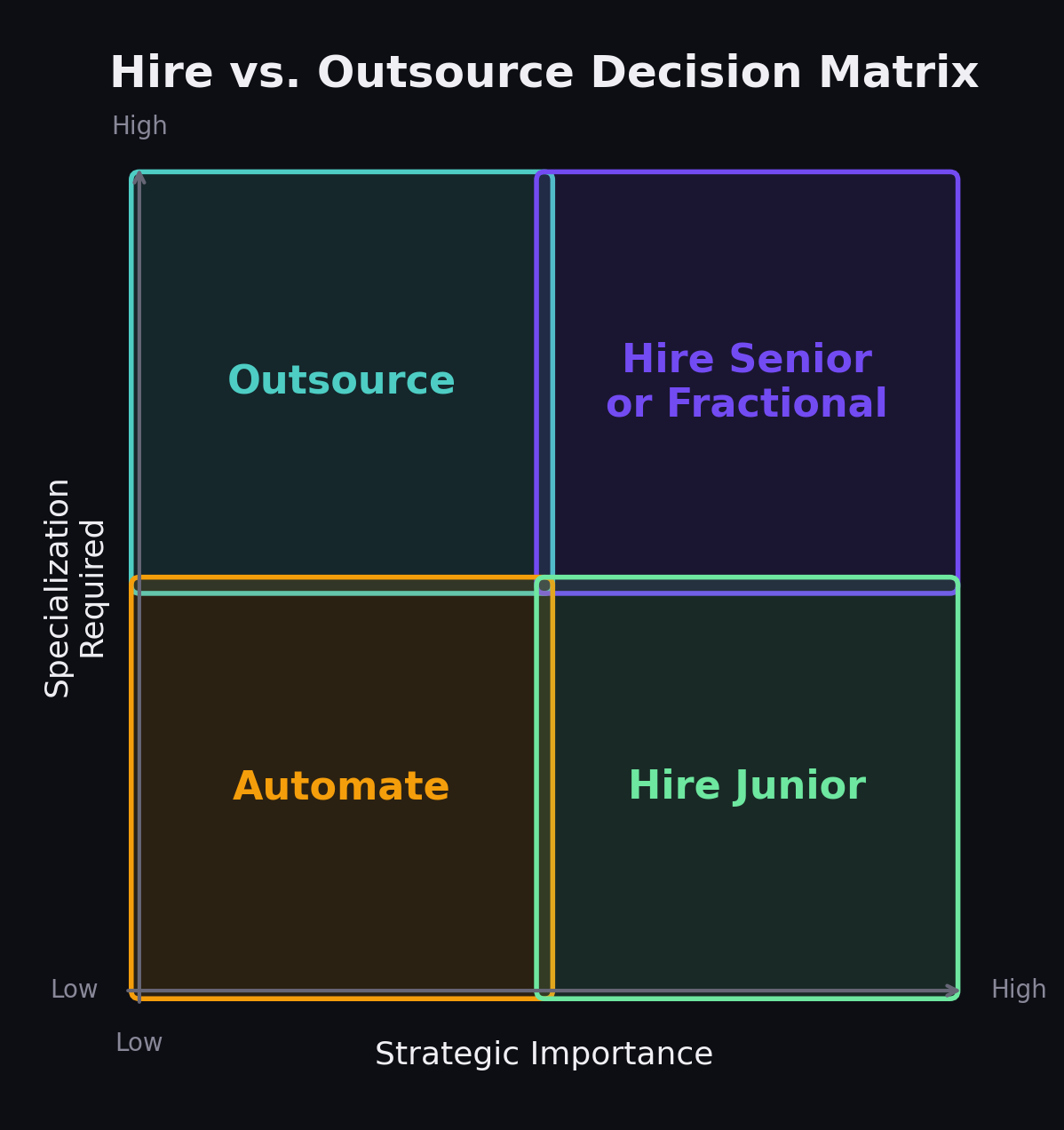
- Deep product knowledge. Product marketing, customer marketing, and sales enablement require intimate understanding of your product that an agency cannot develop quickly.
- Cultural integration. Someone who sits in your Slack, attends your all-hands, and hears the daily product and customer conversations produces more contextual marketing.
- Full-time dedication. An agency divides attention across multiple clients. An in-house hire is 100% focused on your company.
- Long-term cost efficiency. At high volume, in-house is cheaper. If you need 16 blog posts per month, an in-house writer at $100K/year is cheaper than an agency charging $500-$1,000 per post.
- Institutional knowledge. In-house teams accumulate knowledge about your market, customers, and competitors over time. Agencies start over with every new team member assigned to your account.
How to Hire SaaS Marketers
Where to Find Them
| Source | Best For | Notes |
|---|---|---|
| LinkedIn Jobs | All roles | The default. Post with salary ranges to attract better candidates. |
| Pavilion (formerly Revenue Collective) | Director+ roles | Strong B2B SaaS community. High-quality candidates. |
| Superpath | Content marketers | The best community for B2B content professionals. |
| Exit Five | B2B marketers | Dave Gerhardt’s community has strong mid-senior B2B talent. |
| On Deck Marketing | Early-stage marketing leaders | Good for startup-stage Head of Marketing hires. |
| Agency-to-hire | Any role | Work with an agency for 6 months, then hire their best team member. Expensive but low-risk. |
| Referrals | All roles | Your network is your best source. Referral hires consistently show higher retention rates than job board hires (industry benchmark). |
The Interview Process
For marketing generalist / manager roles:
| Stage | Duration | What You Evaluate |
|---|---|---|
| Resume screen | 5 min | Relevant B2B SaaS experience, trajectory, writing quality |
| Phone screen | 20 min | Communication, motivation, basic knowledge |
| Portfolio / work samples | Async | Quality of past work (blog posts, campaigns, email sequences) |
| Working session | 60-90 min | Give a real marketing challenge and work through it together |
| Final interview (with CEO) | 45 min | Cultural fit, strategic thinking, long-term vision |
| Reference checks | 2-3 calls | Verify claims, understand working style |
The working session is the most important stage. Give the candidate a real marketing challenge - “Here is our ICP, our current pipeline, and our top 3 channels. Build me a 90-day plan to increase pipeline by 30%.” Watch how they think, what questions they ask, and how practical their recommendations are.
Red flags in marketing interviews:
- Cannot explain how their work connected to revenue (even with caveats about attribution)
- Only talks about tactics, never strategy (or only talks about strategy, never tactics)
- Has not kept up with changes in their specialty (an SEO who does not mention AI search, a paid media person who does not mention privacy changes)
- Cannot write. Ask every marketing candidate to write something. If they cannot write clearly, they cannot market clearly.
- Only references big-brand experience (“I ran a $10M ad budget at Salesforce”). Running a big budget does not mean they can build a program from scratch.
The 90-Day Plan for New Marketing Hires
Every new marketing hire should come in with a 90-day plan. Here is the framework:
Days 1-30: Learn
- Meet every team (sales, product, CS, leadership) and understand their priorities
- Review all existing marketing assets, campaigns, and data
- Talk to 5-10 customers to understand why they bought and what they value
- Audit the current marketing tech stack and identify gaps
- Document the current state: what is working, what is not, and what is missing
Days 31-60: Plan
- Present findings and proposed strategy to leadership
- Define or refine marketing OKRs aligned with company goals
- Build the quarterly marketing plan with specific campaigns and projects
- Set up measurement infrastructure (dashboards, attribution, reporting)
- Quick wins: launch 2-3 initiatives that demonstrate impact
Days 61-90: Execute
- Full execution mode on the quarterly plan
- Establish recurring reporting cadence (weekly metrics, monthly pipeline review)
- Begin building relationships with agencies, contractors, and partners
- Identify the next hire needed and begin building the case for headcount
What Doesn’t Work: Team Structure Mistakes
Hiring a CMO too early. A true CMO manages directors, sets enterprise strategy, and interfaces with the board. If you are a $3M ARR company with no marketing team, you do not need a CMO. You need a player-coach Head of Marketing who can write a blog post in the morning and present to investors in the afternoon. Hiring a CMO before $15-20M ARR almost always results in an expensive mis-hire.
Building a top-heavy team. A VP, two directors, and no individual contributors means nobody is doing the actual work. At every stage, your team should be at least 60% ICs (individual contributors) who produce output. Leadership without execution capacity is a strategy deck with no results.
Splitting SDRs between marketing and sales. SDRs should report to one team, not both. The most common (and most functional) structure is SDRs reporting to sales with marketing setting the targeting, messaging, and enablement. Dual reporting creates conflicting priorities and turf wars.
Hiring by function instead of by impact. Do not hire a PR person because “we should do PR.” Hire based on where the biggest pipeline gap is. If organic traffic is your biggest bottleneck, hire for content. If paid campaigns are underperforming, hire for demand gen. If sales does not have the tools they need, hire for product marketing.
Ignoring marketing ops until it is too late. Marketing ops is not glamorous, but it is the infrastructure that makes everything else work. If your CRM is a mess, your attribution is broken, and your marketing automation has 47 workflows that nobody understands, you need a marketing ops hire before you need another content writer.
Not investing in design. B2B SaaS companies consistently under-invest in design. Your ad creative, landing pages, content visuals, and brand presentation all affect conversion rates. A good designer pays for themselves through improved conversion rates across every channel.
Trying to do everything at once. A 4-person marketing team cannot simultaneously run SEO, paid media, outbound, ABM, events, PR, community, product marketing, and video. Pick 3-4 channels, do them well, and expand as the team grows. Spreading thin across 8 channels means doing all of them poorly.
The Role of Agencies and Fractional Resources
Agencies and fractional executives are not a compromise. They are a strategic choice. Here is how to use them effectively at each stage.
Fractional CMO ($1-20M ARR)
A fractional CMO provides senior marketing leadership at 10-20 hours per week, at a fraction of the cost of a full-time hire.
What a fractional CMO does:
- Sets marketing strategy and OKRs
- Manages the marketing team or agency relationships
- Owns the marketing budget and reporting
- Presents to the board and executive team
- Makes hiring decisions for the marketing team
What a fractional CMO does NOT do:
- Write blog posts
- Manage paid ad campaigns day-to-day
- Design landing pages
- Send email campaigns
When a fractional CMO makes sense:
- $1-10M ARR companies that need strategic leadership but cannot afford or do not need a full-time CMO
- Companies in transition (between marketing leaders, pivoting go-to-market)
- Companies that want to build the marketing function correctly before hiring a full-time leader
Cost: $5,000-$15,000/month (vs $200K-$350K/year for a full-time CMO)
Marketing Agency ($0-30M+ ARR)
Agencies provide execution bandwidth and specialized expertise. The best agency relationships are long-term partnerships, not project-based engagements.
What to outsource to an agency:
| Function | Agency Value | Typical Monthly Retainer |
|---|---|---|
| SEO | Technical expertise, link building, content production | $3,000-$10,000 |
| Paid media management | Platform expertise, creative testing, optimization | $2,000-$8,000 + ad spend |
| Content production | Writer pool, editorial process, scale | $3,000-$15,000 |
| Outbound/SDR | Prospecting, sequence management, meeting booking | $3,000-$10,000 |
| PR | Media relationships, thought leadership placement | $5,000-$15,000 |
| Design | Ad creative, landing pages, content visuals | $2,000-$8,000 |
| Full-service (strategy + execution) | All of the above under one roof | $10,000-$40,000 |
How to evaluate marketing agencies:
- Ask for B2B SaaS references. An agency that specializes in B2B SaaS marketing will produce better results than a generalist agency, even if the generalist is bigger.
- Look at their own marketing. If their blog is outdated, their LinkedIn is quiet, and their website looks like it was built in 2019, what does that say about their capabilities?
- Ask about reporting. Good agencies report on business outcomes (pipeline influenced, cost per opportunity), not vanity metrics (impressions, clicks).
- Understand the team model. Will you work with senior strategists or will your account be run by junior coordinators? This is the single biggest quality differentiator between agencies.
- Check for strategic capability. Execution-only agencies are commodities. The best agencies provide strategic guidance alongside execution.
The Bottom Line
Your marketing team structure is not about copying an org chart. It is about matching your resources to your stage, your go-to-market, and your growth targets.
Start with one generalist. Validate channels. Hire specialists as specific functions reach volume thresholds. Use agencies to fill gaps and provide expertise you do not have in-house. Promote from within when you can. Hire from companies one stage ahead of yours when you cannot.
The most common mistake is building the team you want instead of the team you need. A $3M ARR company does not need a CMO, a product marketing director, a creative team, and a demand gen squad. It needs two or three excellent marketers who can write, run campaigns, and move fast.
Build the team to match the stage. Scale the team to match the revenue. And never hire someone just because a blog post told you that you should.
Salary data in this guide is sourced from Glassdoor (2025), Levels.fyi, LinkedIn Salary Insights (2025), Pavilion CMO Compensation Report (2025), and hiring data from B2B SaaS marketing teams built and managed by PipelineRoad. Updated March 2026.
PipelineRoad is a full-service B2B SaaS marketing agency that works as an extension of your team - from fractional CMO leadership through content, demand gen, and pipeline execution. If you need marketing firepower without building a 10-person department, let’s talk.
Frequently Asked Questions
What should a SaaS marketing team look like?
A SaaS marketing team structure depends on your ARR stage. At $0-1M, it is the founder plus one generalist marketer. At $1-5M, you need 2-4 people covering content, demand gen, and marketing ops. At $5-20M, you build specialized functions with 5-10 people including product marketing, brand, and analytics. At $20M+, you have 10-20+ people across fully built-out sub-teams. The key principle is to hire generalists early and specialists later.
Who should be the first marketing hire at a SaaS startup?
Your first marketing hire should be a marketing generalist or growth marketer who can write content, run basic paid campaigns, manage email sequences, and analyze data. Do not hire a specialist (pure SEO, pure paid media, pure brand) first. You need someone who can do a little bit of everything because you cannot yet afford specialists. The ideal first hire has 3-5 years of B2B SaaS marketing experience and has worked at a company one stage ahead of yours.
How many marketers does a SaaS company need?
A common benchmark is one marketer per $500K-$1M in ARR, though this varies by go-to-market model. PLG companies often have fewer marketers and more product/growth engineers. Sales-led companies need more marketers for content, demand gen, and sales enablement. At $5M ARR, most SaaS companies have 4-8 marketers. At $20M ARR, 10-20. These numbers include both in-house and full-time equivalent agency resources.
When should a SaaS company hire a VP of Marketing?
Most SaaS companies should hire a VP of Marketing or Head of Marketing between $2M and $5M ARR. Before $2M, the founder or a marketing manager can handle strategy. After $5M without marketing leadership, you will struggle to build a cohesive go-to-market. The right VP of Marketing at this stage is a player-coach who can set strategy AND execute, not a pure executive who only delegates.
Should a SaaS startup hire marketers or use an agency?
Use an agency for the first 12-18 months of marketing execution while hiring one internal generalist to own strategy and coordination. Agencies provide specialized expertise (SEO, paid media, content production) without the fixed cost of full-time hires. As you grow past $3-5M ARR, gradually bring functions in-house where the volume justifies a full-time hire. The hybrid model - internal strategy plus agency execution - is the most cost-effective approach for early-stage SaaS.
What is the average salary for SaaS marketing roles in 2026?
B2B SaaS marketing salaries in 2026 range widely by role and experience. Marketing managers earn $80,000-$120,000. Senior content marketers earn $90,000-$130,000. Demand gen managers earn $100,000-$140,000. Directors earn $130,000-$180,000. VPs earn $160,000-$250,000. CMOs at growth-stage companies earn $200,000-$350,000 plus equity. Remote roles often pay 10-20% less than in-person roles in major markets like San Francisco or New York.
Ready to build your SaaS marketing machine?
We have run these plays at 40+ B2B SaaS companies. Let's talk about yours.
Book a Strategy Call